
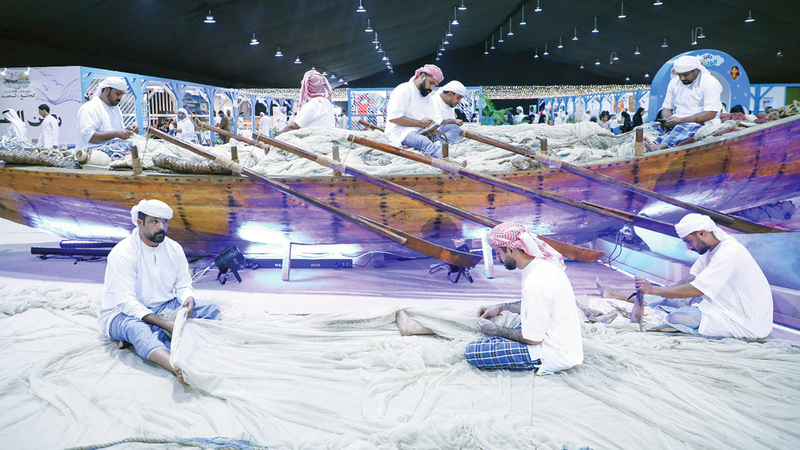
The KALBA Festival for Jash’a and Sahnab has successfully concluded, captivating thousands of visitors interested in marine industries and heritage professions over a four-day span. The festival served as a vibrant celebration of the coastal heritage and maritime memory of the region.
Festival Highlights
The inaugural edition of the festival, organised by the Sharjah Chamber of Commerce and Industry in collaboration with the Kalba Municipality, took place in the Al-Ghail neighbourhood of Kalba. It featured a wide participation of major national companies, alongside skilled artisans and fishermen. This festival provided a rich experience that combined shopping, cultural education, and direct engagement with maritime experts.
Rich Cultural Experiences
Visitors had the opportunity to acquire the finest varieties of Jash’a and Sahnab as well as salted fish. They also learned about modern fishing equipment and participated in workshops focused on sustainability and responsible fishing practices. Artisan Abdul Qader Ali amazed festival-goers with his intricately crafted models of traditional wooden ships, showcasing replicas of renowned historical vessels such as the Al-Boom, Al-Sanbooq, Al-Shu’i, and Al-Jalboot. He also presented a variety of ancient diving and fishing tools, offering practical lessons on traditional shipbuilding techniques and the navigational tasks associated with each vessel throughout the rich coastal history.
Craftsmanship and Knowledge Sharing
The booth of maritime craftsman Hashim Jumaa garnered significant attention, where he provided detailed explanations and insights into the production stages of Jash’a and Sahnab. He noted that the process begins with catching small sardines and anchovies, known locally as “Al-Bariyya,” using coastal fishing nets called “Al-Dhaghwa.” The catch is then brought fresh from the sea to the historical drying site known as “Al-Yirdab,” where it is traditionally spread over smooth pebbles. Modern producers now employ “Al-Farsh” and modern protective nets to adhere to high health standards and safeguard the product from impurities.
The Drying Process
The fish remains sun-dried for three to five days until it is fully dried and earns the designation of “Jash’a.” It is then stacked in pyramid-shaped piles known as “Kadas,” based on a traditional system where the carrier of the harvest receives one Kadas for every ten as a reward for their efforts. Finally, the fish is packed into hessian bags, known as “Al-Yawani,” and stored in a traditional “Al-Bakhar” warehouse in preparation for sale to traders. Jumaa emphasised the importance of preserving this complete trilogy of “Al-Bariyya – Jash’a – Sahnab” as a national duty to pass on ancestral knowledge to the younger generations.
Efforts in Resource Reuse
Salim Hamam Mubarak from the Arabian Sea Animal Feed and Production Factory discussed the factory’s 15-year experience in repurposing marine resources. He showcased two main products: “Fish Meal” (fish protein centre) and natural organic fertiliser made from Jash’a and local Anoom fish, highlighting the festival’s role in shedding light on value-added chains and a circular economy that maximises the use of marine products to support the agricultural and livestock sectors in the region.
A Night of Celebration
Last night, the festival concluded with the award ceremony for winners in three competitions: “Best Quality Jash’a and Sahnab” for adults, “Best Innovative Dish for Families,” and “Best Product for Children and Youth.”
Investment in Future Prospects
According to Khalil Al-Mansoori, the head of the organising committee for the Kalba Festival for Jash’a and Sahnab, the event’s inaugural edition reflected remarkable success, evidenced by strong public engagement and the advanced level of diverse participation. He pointed out that the involvement of six specialist national companies and factories, alongside more than 85 producer families and skilled artisans, has given the festival a unique investment and industrial dimension. This enhances the production and trade of dried fish, expanding it from a limited scope to promising transformative industries.
Supporting Sustainable Growth
Ali Mohammed Al-Kindi, general coordinator of the festival and director of the Sharjah Chamber in Kalba, stated that the participation of leading factories and companies offered fishermen, entrepreneurs, and aspiring youth the chance to explore the latest fishing equipment and advanced processing and packaging technologies, as well as eco-friendly production solutions. He underscored the Sharjah Chamber’s commitment to continuously support the community of fishermen and artisans, equipping them with the knowledge and modern technical means necessary to sustain their historic maritime professions and to open new markets contributing to the economic development of the Eastern Region.