
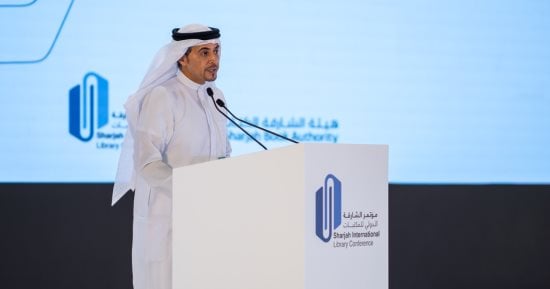
The 13th edition of the Sharjah International Library Conference commenced today, Sunday, organised by the Sharjah Book Authority in collaboration with the American Library Association. This year’s conference coincides with the 45th edition of the Sharjah International Book Fair, featuring approximately 400 library professionals, experts, and academics from 16 countries.
The conference was inaugurated by Ahmed bin Rakkad Al Ameri, CEO of the Sharjah Book Authority, and Ms. Sam Hillyard, former president of the American Library Association, who participated via video conference. A distinguished gathering of librarians and specialists from around the globe were also present.
The conference will address a variety of issues related to the development of library services, emphasising their roles in education and society. Key topics include applications of artificial intelligence (AI), enhancing user experiences, measuring the impact of reading, and developing the professional skills of library staff. Additionally, attendees will explore international experiences in innovation, the application of modern technologies, and expanding collaborative opportunities among knowledge institutions.
Ahmed Al Ameri: Our Duty to Empower Generations to Question Knowledge
In his opening remarks, Ahmed bin Rakkad Al Ameri stressed that the prosperity of libraries has historically been intertwined with the advancement of civilisations and the accumulation of knowledge shared across generations. He referenced the origins of libraries in Mesopotamia and the significant roles played by the Library of Alexandria and the Bayt al-Hikma in Baghdad in preserving and developing knowledge.
He noted that Sharjah continues this legacy under the vision of His Highness Sheikh Dr. Sultan bin Muhammad Al Qasimi, Member of the Supreme Council and Ruler of Sharjah, exemplified by the emirate’s celebration of its library centenary last year. Al Ameri reinforced the library’s role in shaping individuals and contributing to civilizational progress. He acknowledged the support of Her Highness Sheikha Bodour bint Sultan Al Qasimi, Chairperson of the Sharjah Book Authority, in promoting literature, publishing, and reading while enhancing the presence of knowledge in the lives of future generations.
Al Ameri concluded by stating that the evolution of knowledge tools, from clay tablets to the digital age, demands that libraries empower future generations to build upon the achievements of their predecessors. He added, “Today, it is no longer enough to pass down what we have known; it is our responsibility to enable them to question knowledge, develop it, and push its boundaries.”
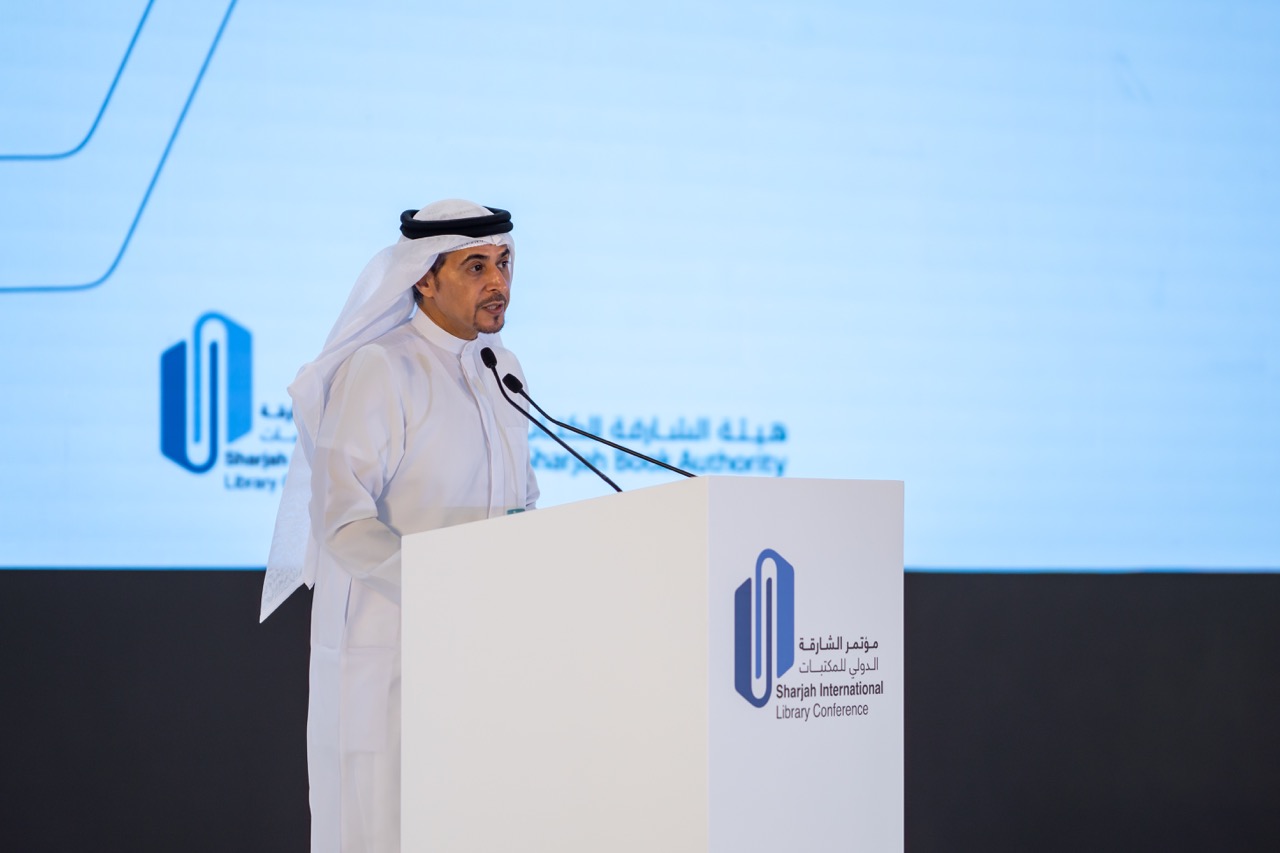
Ahmed Al Ameri, CEO of Sharjah Book Authority
Libraries as Vital Infrastructure in the Era of Content
In a virtual speech, Sam Hillyard warned of the challenges stemming from the transition from the “Information Age” to the “Content Age”. In this new era, individuals are inundated with vast amounts of information, often filtered by algorithms, which may lack accuracy, balance, and transparency. Hillyard asserted that these transformations heighten libraries’ responsibilities to aid the public in understanding how to choose, filter, and present information, while safeguarding privacy and ensuring access to diverse viewpoints.
“My mission is to provide information, and the choice belongs to the reader,” she stated, highlighting that libraries offer public spaces where people can learn, connect, and communicate without financial constraints. She emphasized the importance of advancing library services to meet community needs and ensuring equitable and sustainable access to digital resources.
Libraries and the Teaching of Artificial Intelligence
The first session of the conference, entitled “Artificial Intelligence for All: The Public Library as a Bridge between Academic Institutions and Society,” featured Hagar Nagdy, head of the Technical Skills Unit at the Bibliotheca Alexandrina in Egypt. She discussed the library’s initiative to disseminate knowledge about AI in collaboration with the Arab Academy for Science, Technology, and Maritime Transport.
Nagdy remarked that the widespread adoption of these technologies since 2023 has been accompanied by increasing public concerns and the spread of misinformation, prompting the library to enlist experts to provide reliable knowledge to various community segments through lectures, workshops, and interactive activities. “It is easy to teach people how to use AI tools, but more importantly, we must teach them how to evaluate their results, verify their accuracy, and understand their ethical implications,” she added.
Building Skills for Future Students
The second session, titled “Empowering Students for the Future: Building Capacities through the International Business Club,” focused on the use of educational activities and practical applications to develop students’ skills. It featured Sara Khalil Qishta, Director of Information Resources and Capacity Building Specialist, and Lamis Al Shafie, Head of the English Social Studies Department and teacher of economics and business from the Dual Language School in Egypt.
This session highlighted the “International Business Club” experience in fostering entrepreneurship, leadership, communication, financial literacy, and teamwork skills among students while linking academic knowledge to practical experiences to prepare them for their future educational and professional journeys.
The speakers noted that their project integrated the roles of school libraries and information resources with business and economics teaching, enabling students to apply their knowledge to real-life projects, from market studies and product development to marketing and sales. They explained that students received training in financial planning, from managing their personal budgets to researching, problem-solving, and decision-making skills, enhancing their readiness for the workplace.
AI and Reading Assessment
Dr. Wissam Youssef Musleh, a specialist in library and information science from the UAE, shared insights during the “Smart Reading Clinic” session, showcasing a platform that employs AI to evaluate reading speed, focus, and comprehension while preparing tailored plans to improve readers’ skills.
Ayoob Khan, Head of Library Services and Culture at the Warwickshire County Council in the UK and Director of “Designing Libraries,” presented during the session “User Experience at the Core of Attention,” discussing practices to enhance library services and facilities by leveraging user needs and feedback.
Professional Showcases, Networking, and Forward-Thinking Workshops
The first day’s programme also included sessions to showcase best practices in the library sector, as well as opportunities for professional networking between publishers and librarians, allowing participants to connect, share experiences, and establish new relationships.
The conference activities began on Saturday, November 7, with two training workshops. The first, led by Dana Ikhlif, Head Librarian at the International School of the First Linguistics in Kuwait, was titled “Design Thinking for Librarians.” In contrast, Dr. Heba Ismail, Director of Technical Affairs at the Egypt Culture and Community Development Association, conducted a workshop titled “Co-Designing Libraries that Feel and Listen,” focusing on enhancing user experiences through insights from American and Emirati library models.