
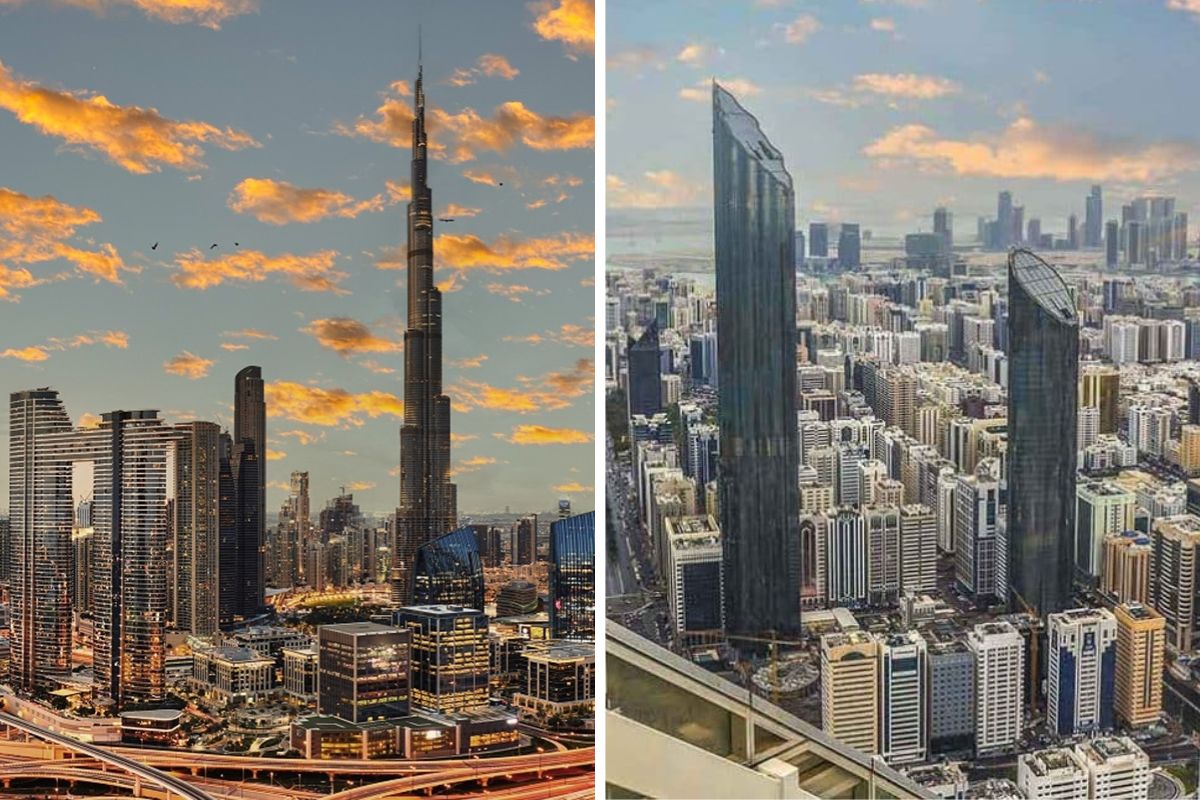
The office markets in Dubai and Abu Dhabi are undergoing a remarkable transformation in 2025, characterized by record sales, rising rents, and a surge of new developments that are reshaping the skylines of both cities. This boom is highlighted by Knight Frank’s H1 2025 Office Market Review, which outlines significant activity and investor confidence in each emirate’s commercial landscape. As these trends unfold, the Dubai and Abu Dhabi office markets thrive, presenting new opportunities and challenges for businesses and investors alike.
In Dubai, the first half of 2025 saw a staggering 83 office transactions worth over AED 10 million ($2.72 million), representing a 207 percent increase from just 27 deals during the same period in 2024.
Leading the market, Downtown recorded average prices exceeding AED 5,000 ($1,361) per square foot, while Business Bay surpassed the AED 2,000 ($544) per square foot mark for the first time, experiencing a growth of 21.2 percent since 2020.
Dubai Office Demand
There is a notable rise in off-plan office sales, particularly in Business Bay, which is expected to provide more than 1.3 million square feet of new space. This increase reflects strong investor confidence in Dubai’s key financial districts.
The Dubai International Financial Centre (DIFC) remains the most expensive office location in the city, with fitted offices averaging AED 400 ($109) per square foot. Other areas experiencing significant rental growth include The Greens (AED 260/$71 per square foot), Dubai Design District (AED 280/$76 per square foot), and Business Bay (AED 251/$68 per square foot).
The business services sector is the primary driver of demand, accounting for 38 percent of total transactions, followed closely by technology (31 percent), real estate (12 percent), and banking and finance (10 percent).
According to Faisal Durrani, Partner and Head of Research at Knight Frank MENA, “Confidence in Dubai as a global business hub remains exceptionally strong. This is reflected in record low vacancy rates for Grade A stock across the city, which stands in sharp contrast to many other global gateway cities.”
Durrani notes that “the technology and trading systems sector has emerged as a major driver of demand, while sustained activity from financial, real estate, and business consulting firms underscores the city’s appeal to a diverse range of global occupiers.”
He adds, “Developers are moving quickly to capitalize on current demand, with a further 25.2 million square feet expected by 2030, when we forecast the total office stock in the city to approach 148 million square feet.”
Additionally, the DIFC marked its busiest first half since its inception in 2004, welcoming 1,081 new businesses between January and June, pushing the total number of registered companies to 7,700.
Knight Frank predicts that Dubai’s total gross leasable area will reach 137.8 million square feet by 2030, with 15.8 million square feet of new supply. DIFC will contribute over 7 million square feet of build-to-rent office space by 2030, while Business Bay will experience robust build-to-sell activity, much of which is expected to be sold off-plan.
Abu Dhabi Office Demand
In Abu Dhabi, office demand surged to over 5 million square feet in H1 2025, reflecting a 110 percent year-on-year increase. Similar to Dubai, the business services sector was the largest segment of demand, accounting for 32 percent, while government entities represented 9 percent.
Durrani stated, “New rental contracts in Abu Dhabi have been a primary driver of market activity this year, with transaction volumes experiencing a significant peak in January, signaling fresh demand and business expansion in the UAE capital.”
He noted that “mirroring Dubai, occupancy levels are at record highs across Grade A stock, and limited availability is driving up rents for best-in-class space.”
Musaffah led the rental growth in Q2 2025 with a 73 percent quarter-on-quarter increase, followed closely by Al Bateen (68 percent) and Al Hisn (19 percent). In contrast, some older districts, such as Al Danah (-2 percent) and Al Nahyan (-7 percent), experienced slight declines due to the high concentration of secondary stock.
James Hodgetts, Partner – Occupier Strategy & Solutions, MEA, remarked, “There is good news on the horizon, with a strong pipeline of high-quality developments poised to be welcome additions to the Abu Dhabi office market.”
He added that “this new supply is likely to help ease current constraints, offering occupiers greater choice and setting new benchmarks for quality, sustainability, and design.”
New completions, including Aldar’s HB Tower on Yas Island (238,647 square feet) and the Saas Business Tower on Al Reem Island (129,210 square feet), are expected to alleviate supply pressure.
According to Shehzad Jamal, Partner – Strategy and Consultancy, MENA, “Demand is expected to remain robust and will likely continue to outpace the delivery of new premium supply for the remainder of the year, fueling further rental growth in the prime segments across Dubai and Abu Dhabi.”
He also indicated that “pre-leasing activity for landmark projects scheduled for 2026-2028 will be a key indicator of market sentiment. We expect the performance gap between Grade A, well-located assets and older, secondary stock to widen further as the flight-to-quality trend intensifies in the short term.”