
Recent insights from Cavendish Maxwell reveal a remarkable surge in Dubai’s residential real estate market, with sales values climbing 36.4% this year to reach AED 262 billion. As demand for housing continues to accelerate, the market demonstrates resilience across various property segments, making Dubai an increasingly attractive destination for both investors and residents. This article delves into the factors contributing to the growth, the types of properties in demand, and the implications for the future of Dubai’s real estate landscape.
According to a new market performance report released by Cavendish Maxwell, residential transactions reached 91,900 in the first half of the year, reflecting a robust 23 percent year-on-year increase. This growth indicates sustained demand in both off-plan and ready property segments.
Ronan Arthur, MRICS, Director and Head of Residential Valuation at Cavendish Maxwell, stated: “The first six months of the year have highlighted a strong, thriving Dubai real estate market, with robust buyer demand and rising sales. At the same time, we are seeing early signs of moderation in rental price growth – good news for a city focused on attracting new talent and expanding its population.”
Strong demand fuels Dubai residential growth
Off-plan sales dominated the market, accounting for over 70 percent of transactions, although interest in ready homes is on the rise, evidenced by 27,400 recorded deals — a 10 percent increase year-on-year. The market share for off-plan apartments dipped by 5.6 percent to 76.7 percent in the first half, while sales of villas and townhouses gained traction as more buyers sought spacious homes with gardens.
A considerable proportion of off-plan villa and townhouse sales were concentrated in four-bedroom properties, which represented 55 percent of transactions. In the realm of ready homes, three- and four-bedroom units topped the demand charts, though five-bedroom sales also experienced a notable uptick, capturing a 13 percent share of transactions.
Leading the charge in sales volume were Emaar, DAMAC Properties, and Sobha Group. For the first time, Beyond entered the top ten developers, bolstered by strong performance in Dubai Maritime City. Other prominent developers included Binghatti, Danube, Samana, Nakheel, Azizi, and Wasl.
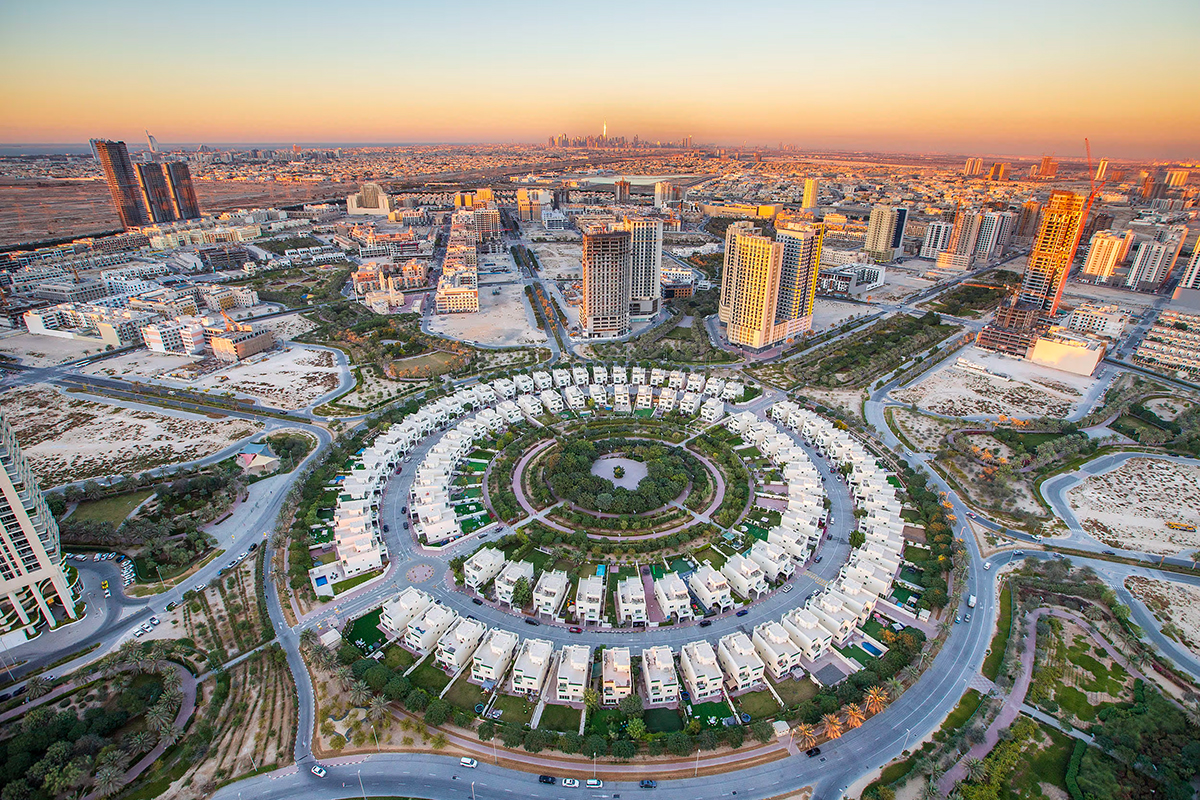
In terms of specific areas, Jumeirah Village Circle recorded the highest number of apartment sales, with over 8,000 transactions. DAMAC Islands topped off-plan villa and townhouse sales, while DAMAC Hills 2 led in ready villa and townhouse transactions.
Luxury sales also saw a significant leap, with over 1,400 properties priced above AED 20 million sold in the first half of the year, marking an 82 percent increase year-on-year. Transactions for ultra-luxury properties valued above AED 50 million rose 33 percent to 140 deals.
“Dubai Land Department’s recently launched First-Time Home Buyer Programme will further boost the residential market, particularly among end-users,” Arthur mentioned. “In time, the scheme could also help diversify the buyer base, promote long-term residency, and contribute to a more balanced, inclusive housing market.”
In parallel, residential prices surged 16.6 percent year-on-year, averaging AED 1,609 per square foot. Although rental prices grew nearly 10 percent from the first half of 2024, they saw a slight decline of 0.6 percent compared to the latter half of the previous year, a trend attributed to the influx of new units entering the market.
As of June 2025, gross rental yields averaged 7.2 percent for apartments and 5 percent for villas and townhouses. Notably, Dubai Investments Park offered the highest apartment yields at 10.3 percent, while Dubai Industrial City led the way for villas and townhouses with a yield of 7 percent.
During the first half of the year, approximately 17,200 residential units were completed, with nearly half of all handovers occurring in Jumeirah Village Circle, Sobha Hartland, and Mohammed Bin Rashid City. Notably, apartment handovers accounted for over 77 percent of completed properties.
Developers launched 300 new projects in the first half, contributing 87,900 units to the market, equating to an impressive average of 490 new homes per day. Despite over 61,800 units currently under construction for the remainder of 2025, only 21 percent of projects slated for completion this year have achieved 75 percent or more in construction progress.
“These projections suggest an average of 9,000 units could be delivered every month through to 2027, but actual completion rates are expected to be lower, potentially leading to timeline shifts and delayed handovers,” Arthur noted.