
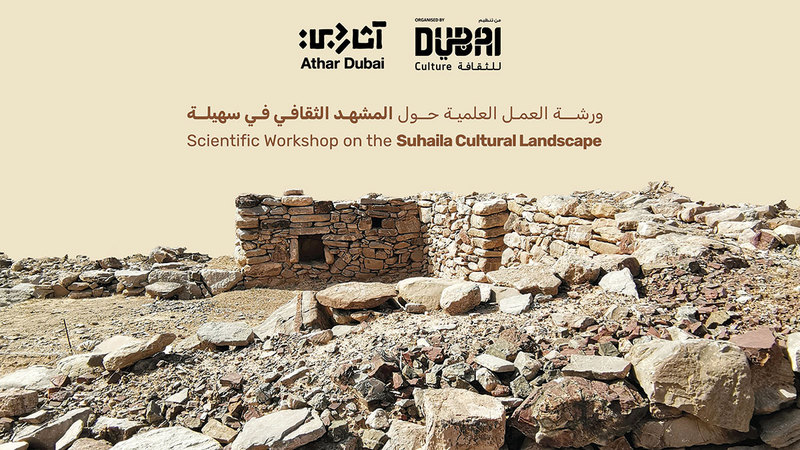
In a landmark initiative, the Dubai Culture and Arts Authority has organised a scientific workshop titled “The Cultural Landscape of Suhailah – Hatta,” aimed at enhancing knowledge about the history and archaeological significance of the Hatta region. This event seeks to discuss the outcomes of recent studies and excavations, as well as to explore best global practices in the protection, management, and documentation of archaeological sites. The workshop aligns with the authority’s mission to broaden collaboration with international experts and academic institutions, while highlighting the importance of Dubai’s archaeological and historical sites as part of its strategic objectives to enhance the emirate’s presence on the world heritage map.
A Platform for Knowledge Exchange
Taking place on October 27 and 28 in Hatta, the workshop serves as a platform for exchanging scientific knowledge and experiences. It will delve into the historical and environmental characteristics of the cultural landscape of Suhailah – Hatta and will examine the results of archaeological surveys and excavations in the area. Furthermore, the Dubai Culture and Arts Authority aims to develop a comprehensive research programme that will contribute to understanding human settlement patterns and the relationship between inhabitants and their surrounding environment. The workshop is also intended to establish a scientific framework that highlights the site’s uniqueness and cultural significance, while fostering cooperation between research institutions, government entities, and the local community. This initiative seeks to connect research findings with the requirements for the protection and management of the “Suhailah Archaeological Site” and to define priorities for future action.
Features of the Workshop Program
The workshop will feature the participation of a distinguished group of archaeologists, researchers, and cultural heritage management specialists. The opening address will be delivered by Dr. Fatima Ali Al-Maamari, Director of Cultural Heritage at the Ministry of Culture. The programme includes a series of workshops, sessions, and specialised scientific presentations that will illuminate the archaeological landscape in Dubai and Hatta, focusing on human settlement history and its correlation with the local mountainous environment and natural resources.
Among the notable sessions is “Overview of Archaeological Sites in Dubai,” where Dr. Mansour Barak, an archaeologist at Dubai Culture, will highlight key aspects of the emirate’s archaeological heritage. Additionally, the authority’s Chief Archaeologist, Hassan Zain, will present on “Archaeological Sites in Hatta: Focus on the Cultural Landscape of Suhailah – Hatta,” discussing the site’s uniqueness and heritage components. The segment will also feature a discussion led by Afra Mahmoud Muhammad, Senior Nature Conservation Specialist at Dubai’s Environment and Climate Change Authority, on the environmental background of Hatta and its relationship with the evolution of human lifestyles and activities.
International Insights
The programme also includes presentations from international experts on assessing the outstanding universal value of archaeological sites. Jeremy Chiticat, Research Director at the French National Centre for Scientific Research, will discuss the site of Al-Faw in Saudi Arabia in his session “From Disparate Knowledge to an Integrated Vision: Identifying Outstanding Universal Value.” Additionally, Mr. Abdul Rahman Al-Nuaimi, Head of the World Heritage Site Management Section at the Department of Culture and Tourism – Abu Dhabi, will share insights into the management of heritage sites based on experiences from the cultural sites in Al Ain. Sadaqat Dawudova, Deputy Head of the Protected Areas Management Center at Azerbaijan’s government tourism agency, will present on “The Cultural Landscape of the Khinalug People and their Migration Path.” Finally, Martin Price, Executive Director of Insuco, will outline best practices for stakeholder engagement, drawing from experiences in Saudi Arabia and Uzbekistan.
Promoting Cultural Heritage Preservation
Engagements also include specialised scientific discussions that aim to devise plans for the development, protection, and management of the cultural landscape in Suhailah – Hatta. Notable contributions will come from Engineer Badr Mohammed Al Ali, Director of Antiquities at Dubai Culture, alongside François Christofoli and Simon Rika from RC Heritage Foundation. The outcomes of these sessions are expected to lay the groundwork for an initial management framework for the cultural landscape in Suhailah – Hatta, focusing on defining stakeholder roles, coordinating efforts, and prioritising subsequent research and protection strategies in a bid to enhance collaborative scientific and institutional efforts to secure the site’s cultural value.
The Importance of Scientific Research
In her remarks, Mona Faisal Al-Qarq, Executive Director of the Museums and Heritage Sector at Dubai Culture, underscored that the protection of archaeological sites is fundamental to Dubai’s efforts to preserve its identity and cultural heritage. She emphasised the significance of scientific research in documenting the emirate’s history and showcasing its civilisational aspects. “The cultural landscape of Suhailah – Hatta is an essential part of Dubai’s civilisational memory, reflecting the profound relationship between the Emirati people and their land, as well as their ability to adapt to their environment and utilise its resources through various historical phases. Through this programme, we aim to strengthen scientific and institutional cooperation and exchange expertise that enrich our understanding of the site, while developing a comprehensive vision for its preservation and highlighting its historical and human value.” She also highlighted the authority’s commitment to embedding Dubai’s archaeological sites in community awareness and educating future generations about their significance and the insights they provide into past communities in the region.
Focus on Future Research and Collaboration
Engineer Badr Mohammed Al Ali noted that the scientific workshop offers a vital platform for exchanging specialised expertise and discussing the results of archaeological research related to the cultural landscape of Suhailah – Hatta. He stated, “Studies associated with the Suhailah archaeological site shed light on significant aspects of human settlement history in Hatta, exploring adaptation methods to its mountainous environment and water and agricultural resource management. Dubai Culture aims to build a knowledge database through excavation and archaeological surveys that trace its historical development and document its architectural and environmental characteristics while identifying the needs for its protection and management.” He affirmed the importance of collaboration with universities and specialised institutes to enrich archaeological studies, elevate methodologies, and learn from international experiences to shape future work priorities.