
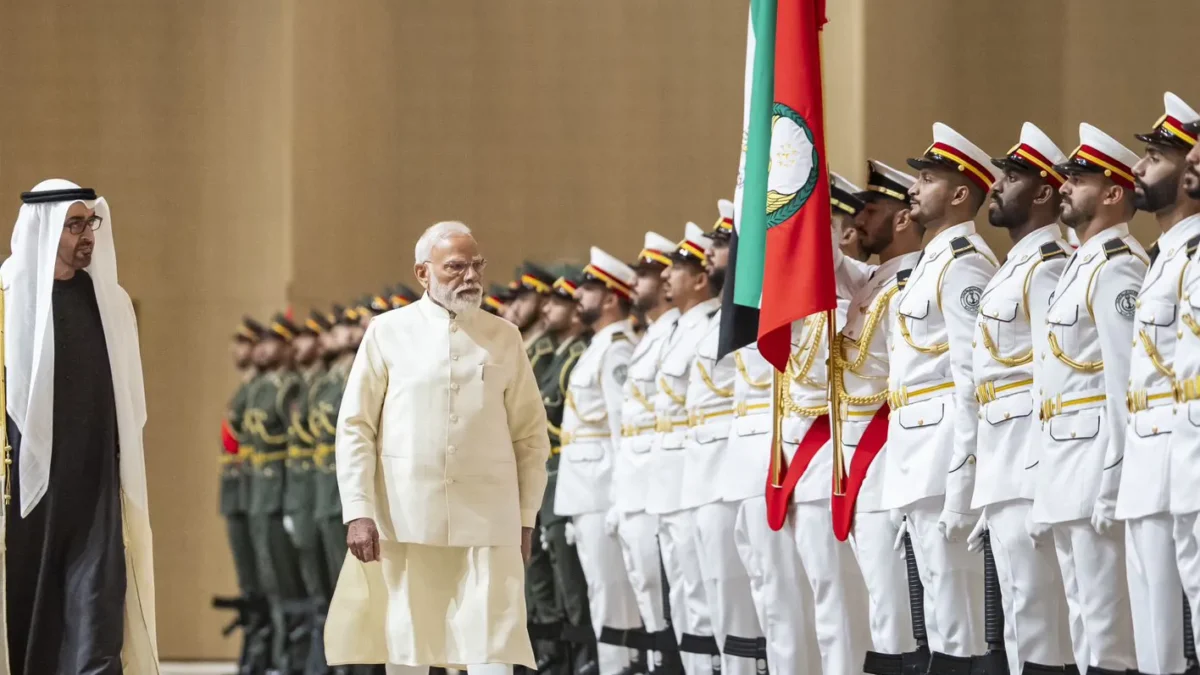
The relationship between the UAE and India is entering a more strategic phase, propelled by rapid regional developments. From tensions in the Strait of Hormuz to the ambitious Indian-Middle Eastern Corridor (IMEC), both Abu Dhabi and New Delhi view this initiative as a gateway to long-term economic and security cooperation, reinforcing stability in the region. Prime Minister Narendra Modi’s recent visit to the UAE highlighted this burgeoning partnership, during which he and President Sheikh Mohammed bin Zayed Al Nahyan discussed deepening their “comprehensive strategic partnership” across the energy, technology, defense, and infrastructure sectors. This collaboration is increasingly seen as pivotal for protecting trade links and fostering pathways for regional de-escalation, making the UAE-India partnership a vital component of the broader IMEC strategy.
Strengthening Bilateral Ties
During Modi’s visit, various agreements were signed in key sectors such as energy, defense, infrastructure, and advanced technologies. The UAE also announced a substantial investment of $5 billion in India. This shift has led Emirati media to assert that the bilateral relationship has evolved beyond mere traditional trade links into what is now being described as a “golden era” of comprehensive strategic partnership.
Conversely, Indian newspapers argue that relations with the UAE have transcended temporary, interest-based pragmatism to become a model of strategic partnership anchored in trust, technology, and shared geopolitical realities. Dr. Pooja Bhat, an associate professor at O.P. Jindal Global University, emphasizes that the comprehensive partnership between India and the UAE is characterized by energy security, military cooperation, and a substantial Indian diaspora in the Emirates. She states, “The significance of this partnership increases amid the current geopolitical and maritime environment in West Asia, where both countries strive for stability.”
The Indian Corridor Initiative
Among the monumental projects proposed in recent years is the India-Middle East-Europe Corridor (IMEC), often referred to as the “Indian Corridor.” In this strategic initiative, the UAE serves as a cornerstone, and the multiple agreements signed affirm the importance of a relationship steeped in centuries of history. However, developments following events in Gaza and U.S. actions against Iran, which intensified tensions in the Strait of Hormuz, have collectively slowed the implementation phases of the IMEC.
International dynamics also play a role, as the corridor is seen as a direct competitor to China’s Belt and Road Initiative, prompting China to strengthen its relationships in the region. Dr. Bhat notes, “The U.S.-Iran conflict has exposed vulnerabilities in existing economic connectivity projects like the IMEC, which both countries are investing in.” She asserts that it is essential for both nations to stabilize the region through diplomatic political approaches, supported by joint military protection, to ensure the continued execution of this International Trade Corridor project.
BRICS and Peace Initiatives
In addition to bilateral agreements, the UAE and India are part of the BRICS coalition, representing around 30% of global GDP and accounting for 25% of global exports, alongside a massive population constituting 45% of the world. Modi’s visit to Abu Dhabi also marked a significant moment as it was his first since the UAE joined the BRICS group. Discussions focused on encouraging BRICS nations to invest in collaborative projects between the UAE and India, especially in artificial intelligence and renewable energy, transforming their bilateral cooperation into a launchpad for collective action within BRICS.
Given the interconnectedness of these relations, India’s interests are inevitably affected by any geopolitical upheavals. With ambitions of becoming one of the top three economies globally, Bhat highlights that, due to strong ties and interests in most West Asian countries, India’s “participation in the peace process will be crucial.” Therefore, India could potentially offer to mediate between conflicting parties, leveraging its established position as a trustworthy nation.