
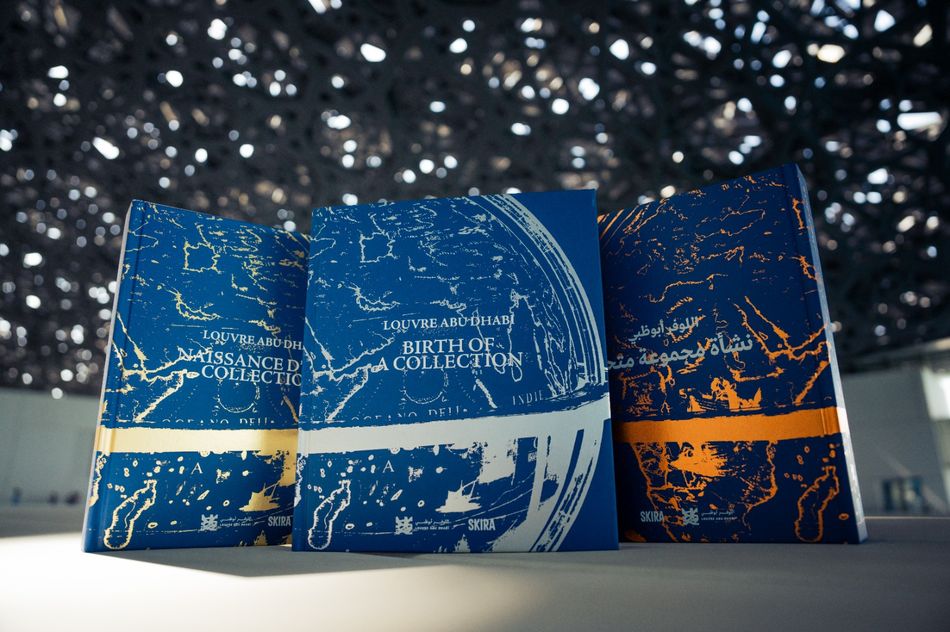

Launch of _The Origins of a Museum Collection_ © Department of Culture and Tourism – Abu Dhabi – Image attached to press release
The Louvre Abu Dhabi has announced the release of its new publication, _The Origins of a Museum Collection_, in collaboration with the specialized art publisher Skira. This reference work celebrates the exceptional journey that the museum has achieved over the past decade, tracing the evolution of an ambitious cultural vision into one of the most distinctive and notable art collections worldwide, showcasing Abu Dhabi as a global hub for cultural exchange, creativity, and dialogue.
Documenting a Decade of Artistic Diversity
This significant book features contributions from 42 leading curators, historians, and researchers, reflecting the museum’s development as a global platform for dialogue between civilisations. It highlights a growing collection of artworks that spans thousands of years, covering various geographic regions and artistic traditions.
Mohammed Khalifa Al Mubarak, Chairman of the Department of Culture and Tourism – Abu Dhabi and Chairman of the Louvre Abu Dhabi, remarked, “The book _The Origins of a Museum Collection_ reflects the extraordinary evolution of the Louvre Abu Dhabi’s collection, which has expanded in scope and reached a distinguished level of maturity and diversity. It is now one of the most prominent and unique art collections in the world. This ongoing journey exemplifies the cultural maturity of Abu Dhabi and the United Arab Emirates. The Department of Culture and Tourism – Abu Dhabi continues to be guided by the principle of establishing a cultural legacy for future generations everywhere.”
A Comprehensive Insight Into Curatorial Vision
The publication, edited by Dr. Guilhem Andre, Director of the Art Collection and Research at the Louvre Abu Dhabi, includes 240 selected pieces explored through illustrated essays that highlight the foundational vision of the museum. It portrays the museum as a global entity where the story of human creativity unfolds across history as a connected narrative of cultural exchange through dialogues among esteemed artworks from major civilisations.
Dr. Souraya Noureddine, Director of the Louvre Abu Dhabi, noted, “I participated in the book _The Origins of a Museum Collection_ since the outset of efforts to prepare it; at that time, I held the position of the first Director of the Art Collection and Research at the Louvre Abu Dhabi. I feel a sense of satisfaction and pride to see this project come to light, as I cherish my role in issuing it, from contributing to the original idea of the book, selecting its title, to co-authoring it. Such projects require years of research, cooperation, and dedication to complete. My return to the Louvre Abu Dhabi carries a special meaning as I have witnessed how the teams developed and supported this project to yield a publication of this significant depth and importance. I am delighted that the book is being published, as it is a landmark; it embodies the level of maturity the museum has achieved and the prominent role of scholarly research that continues to shape the museum’s future.”
A New Chapter in the Louvre Abu Dhabi’s Journey
The publication of _The Origins of a Museum Collection_ marks a new phase in the history of the Louvre Abu Dhabi’s collection. In the context of the institutional maturity the museum has experienced, the collection has remarkably evolved to encompass an exceptional assortment of diverse and cohesive works, reinforced by its iconic character. Today, the Louvre Abu Dhabi stands as a world-class cultural landmark that embodies the realisation of a global museum vision emerging from the Arab world, uniting human cultures in a shared space of knowledge, beauty, and exchange.
Since its opening, the museum’s collection has seen substantial growth, increasing from approximately 600 artworks to over 6,000 today. Two-thirds of the pieces currently on permanent display at the Louvre Abu Dhabi belong to the museum’s private collection. Illustrating the prominent status of the Louvre Abu Dhabi on the international stage, the museum also loans pieces from its collection to leading cultural institutions worldwide. Notable partnerships include French museums such as the Louvre, the Quai Branly – Jacques Chirac Museum, the National Museum of Asian Arts – Guimet, and the Musée d’Orsay, along with the Museum of Modern Art and the Metropolitan Museum of Art in New York, the Getty Museum in Los Angeles, the Saadiyat Cultural District in Abu Dhabi, the Jameel Arts Centre in Dubai, and the National Museum of Oman, among others.
A Journey Through Time
The book is divided into four realms presented in chronological order, tracking human creativity through the ancient world, the medieval world, the early modern period, and modern and contemporary worlds. Each realm is presented not as a series of separate traditions but as a network of exchanges. The book explores the ancient world as a collection of parallel civilisations formed in light of common ideas and practices; the medieval period as an era that laid the foundations for faith and knowledge; the early modern era as a period marked by intensified communication, exchange, and progress; culminating in the modern age where the reconfiguration of ideas and traditions is apparent, with artists like Hokusai, Picasso, and Kandinsky seemingly offering differing answers to persistent human questions throughout history.
A Continuation of Historic Narratives
_The Origins of a Museum Collection_ extends from the 2013 publication _The Birth of a Museum_, which documented the early foundational phases of the Louvre Abu Dhabi collection and crystallised its vision as the first museum of its kind in the Arab world. While the previous publication documented the formative moment when the institution was still in the process of formation, the new book addresses a phase of realisation; it presents a museum firmly embedded on the global stage, where its foundational vision has transitioned into a solid institutional reality, supported by a long-term vision, scholarly research, and museological practice. This publication has been prepared based on extensive research, compiling vital knowledge and values that underpin the establishment of the museum’s collection and the logic behind the acquisition processes. Through this, the book expands access to the Louvre Abu Dhabi beyond its exhibition halls, allowing readers worldwide to explore the research and studies that have contributed to shaping its artistic collection.
Highlighting Iconic Artworks
Among the notable works discussed in the publication are a winged bronze dragon (dating back to 475–221 BC), an ancient depiction of one of the most prevalent creatures in Chinese art and a masterpiece characterised by its quality and aesthetic sophistication; a statue of a man praying (circa 2400–2300 BC), an impressive figure in a stance of devotion that offers a glimpse into the religious beliefs and practices of the Sumerians; and a massive lion (circa 1100–1200 AD), regarded as one of the most significant Islamic artworks in the Mediterranean, believed to have functioned as a self-sound-making instrument, with its hollow body indicating it once produced a roaring sound.
Additional remarkable works highlighted include an angel holding a censer, dressed in yellow by artist Bernhard Strigel (circa 1520), a recently discovered painting that offers an insight into the transition from late Gothic practices to the early Renaissance; wall banners adorned with maps of Japan and the world (circa 1690), which extend over 2.5 metres and embody the global spread of knowledge, posing a universal question about individual status in the world; and hunting scenes for Maximilian (1665–1673), an ensemble of hanging textiles embroidered with golden threads, completed as a commission during the Renaissance; along with a piece by artist Syed Haider Raza (1986), epitomising the dual culture characteristic of the artist’s experience.
A Multilingual Commitment to Knowledge
_The Origins of a Museum Collection_ is published in Arabic, English, and French, embodying the Louvre Abu Dhabi’s commitment to publishing in three languages. Through this approach, the Louvre Abu Dhabi has become one of the first museums in the UAE to document and publish art history and museum studies in Arabic on such a scale and ambition, enhancing its role in advancing scholarly knowledge in the region and beyond. Since its inception, the museum has released over 50 publications, and this commitment to multilingual publishing lies at the core of the museum’s vision from its earliest stages, continuing to shape its publishing programme. Furthermore, certain publications are also available in Russian and Chinese, reflecting the museum’s expanding international audience and increasing appeal to visitors from around the world. The publishing programme encompasses a wide range of publications, interweaving rigorous scholarly research with thoughtful narrative and exquisite design to present art history as a shared global narrative shaped through dialogue between cultures.
Ranging from scholarly volumes and exhibition catalogues to children’s books and experimental publications, the Louvre Abu Dhabi’s publications cater to the needs of its international audience and contribute to establishing a clear and reliable regional voice in the narrative of art history in Arabic. The publishing programme is carried out in collaboration with a selection of international partners, reflecting a steadfast commitment to intellectual excellence and meaningful engagement with readers worldwide. Among these publications is _The Origins of a Museum Collection_, now available for purchase through the Louvre Abu Dhabi’s store.