
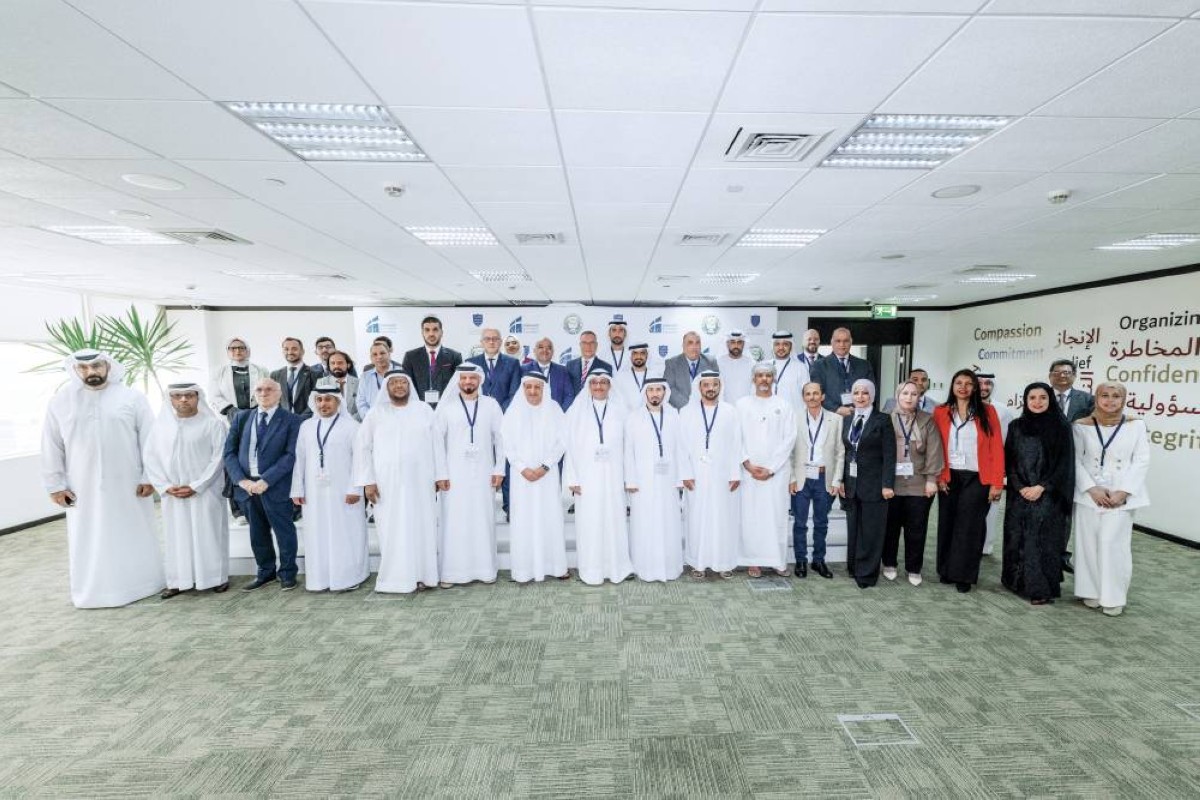
The Mohammed bin Rashid School of Government in Dubai launched the scientific conference titled “Finance and International Trade in the Era of New Protectionism” yesterday, in collaboration with the Arab Planning Institute from Kuwait and the Gulf Consultants for Training and Advisory. This two-day event, which includes both in-person and virtual participation, focuses on the impacts of geopolitical transformations and protectionist policies on trade, finance, and supply chains, alongside strategies to enhance the resilience of Arab economies.
Among the attendees of the opening ceremony were His Excellency Hamid Mohammed Al Qatami, Chairman of the Board of Trustees of the Hamdan bin Rashid Al Maktoum Foundation for Medical Education and Health Sciences, along with officials, experts, academics, and policymakers.
Dr Ali bin Sebaa Al Marri, the Chief Executive Officer of the Mohammed bin Rashid School of Government, emphasized that the role of academic and research institutions extends beyond merely transferring knowledge; it is about developing and applying this knowledge to serve public policies. He highlighted the need to connect researchers, experts, and decision-makers, integrating research with practical application.
Al Marri explained that new protectionism is no longer limited to traditional trade barriers, as it now encompasses industrial policies, technical and environmental standards, digital tools, and measures related to food security and supply chains. He also stressed the critical role of artificial intelligence in market analysis and risk forecasting, while referring to the UAE’s achievements in economic diversification, openness, innovation investment, and building partnerships.
Economic Diversification and Global Trade
Dr Khaled Al Wazni, a Professor of Economics and Strategy at the Mohammed bin Rashid School of Government, noted that economic diversification enhances both oil-exporting and non-oil-exporting countries’ abilities to navigate global trade shifts. He pointed out that non-oil activities account for more than three-quarters of the UAE’s gross domestic product, illustrating the country’s diverse economic activity.
He further stated that the UAE continues to expand its investments in industry, research and development, technology, and logistics services, while also strengthening its international trade relations.
Trade Restrictions and Their Economic Impact
Dr Adel Abdullah Al Wuqayan, Director General of the Arab Planning Institute in Kuwait, revealed that approximately 22% of imports within the G20 countries are subject to trade restrictions, amounting to over $4 trillion, according to estimates from the World Trade Organization. He remarked on the organization’s projections of a slowdown in global goods trade growth from 4.6% in 2025 to 1.9% in 2026. Global foreign direct investment flows are anticipated to reach $1.6 trillion in 2025; however, over 80% will be concentrated in 20 countries.
In the Arab world, intra-Arab exports are expected to be merely 14% of total Arab goods exports in 2024, with foreign direct investment flows into Arab countries declining by about 10% in 2025 to approximately $119 billion, in stark contrast to a global increase of 6%.
Financing Industrial Development
Raihan Mubarak Fayez, Chief Executive Officer of Gulf Consultants for Training and Advisory, underscored the interconnection between trade financing, industrial development, and the fight against harmful practices to build a resilient economy capable of withstanding shocks. He stated that diversifying the production base necessitates financing for the establishment and expansion of industries, developing technology and innovation, and enhancing competitiveness.
He cautioned that financing factories will not meet its objectives if their products face unfair trade practices, mentioning international trade rules that provide mechanisms to combat dumping, compensatory measures against subsidies, and preventative actions against rising imports.
Ensuring Fair Competition
Mahfoud Ben Nasser Al-Ruqadi, Director General of the Technical Secretariat Office for Combatting Harmful Trade Practices for the Gulf Cooperation Council countries, argued that open markets require regulations to ensure fair competition and protect industries from dumping and subsidization that distort competition, as well as unexpected increases in imports. He noted that GCC countries have adopted a unified law to combat dumping and implement compensatory and preventative measures, with the office taking on the role of a Gulf investigative authority by examining complaints, analysing damages, and establishing causal relationships before recommending appropriate actions.