
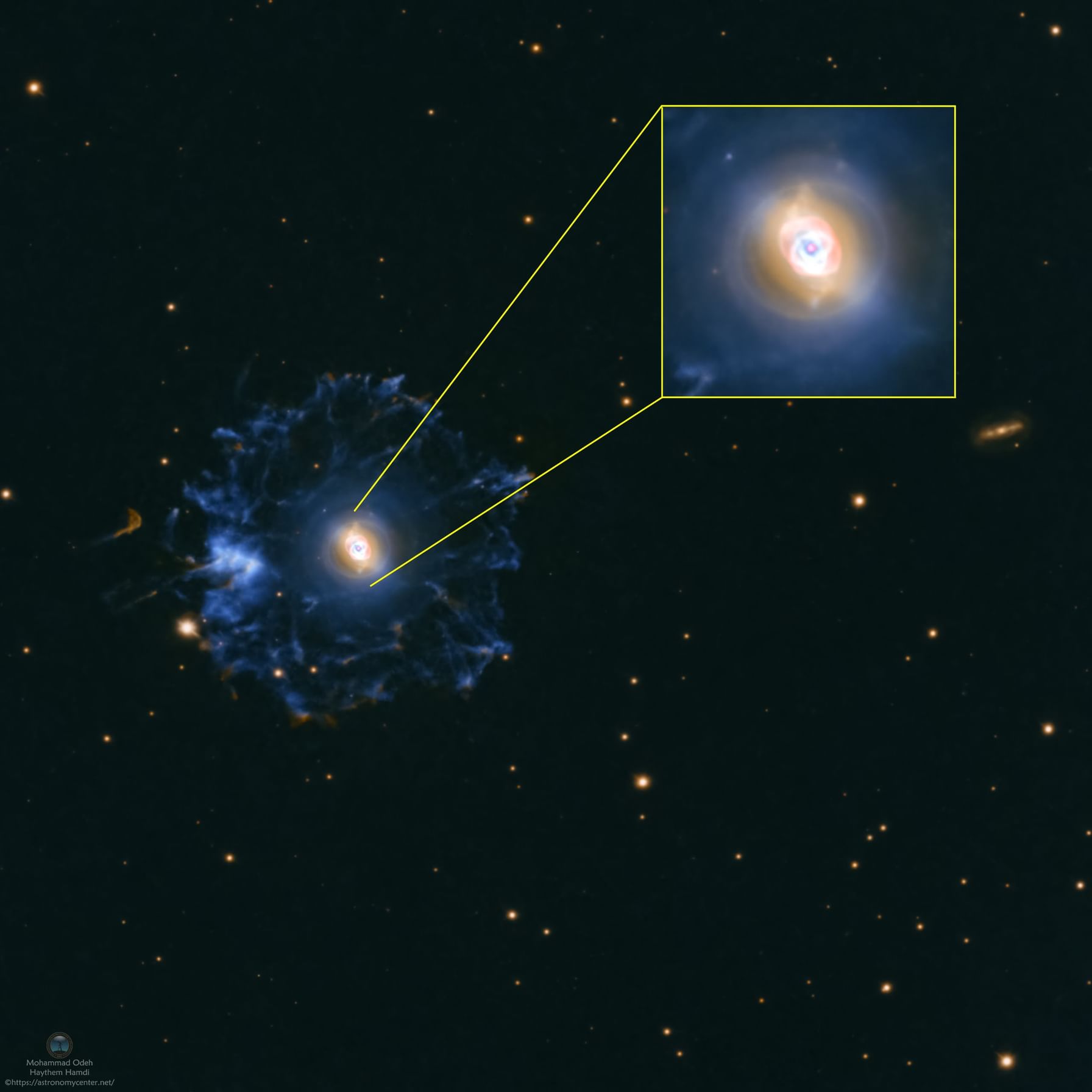
The Khalifa Telescope at the International Astronomical Centre has captured a stunning detailed image of the famous planetary nebula known as the “Cat’s Eye Nebula,” revealing its intricate internal structure and vast, faint outer halo from the skies of Abu Dhabi. This image showcases the nebula’s bright core and the extensive remnants of a star nearing the end of its life cycle, with a mass similar to that of our Sun.
Exploring the Cat’s Eye Nebula
Catalogued as NGC 6543, the Cat’s Eye Nebula is located in the Draco constellation, approximately 3,000 light-years away from Earth. It represents one of the final stages in the life of stars with solar-like masses. As these stars exhaust their nuclear fuel, they expand into red giants, shedding their outer layers and releasing gases into space, while a hot core remains, ultimately evolving into a white dwarf.
The Intricate Structure
The central region of the nebula features the vibrant “Cat’s Eye,” a highly luminous structure comprised of overlapping gas shells and bubbles encircling the central star. Observations from the Hubble Space Telescope have suggested that this area contains some of the most complex structures known in planetary nebulae, characterised by gas shells, fast-moving jets, and clumps of gas produced by shock waves.
Scientists believe that the rapid stellar winds emitted by the hot white dwarf star at the core have played a significant role in shaping this structure. These winds have collided with the gas previously expelled by the star, compressing it and sculpting the intricate layers and details surrounding the star.
High-Temperature Surroundings
Chandra’s X-ray Observatory has revealed that the heart of the Cat’s Eye Nebula is enveloped by gas with temperatures reaching millions of degrees. This high energy results from the interaction of fast stellar winds with materials previously ejected by the star, with some of the expelled material travelling at speeds of up to 6 million kilometres per hour.
Understanding Complexity
The complex structure of the Cat’s Eye is still under investigation. One theory suggests that the presence of a companion star could influence the white dwarf’s emissions, leading to non-spherical and intricate formations. Hubble’s studies have indicated that the presence of a binary star system might clarify several observed details in the nebula.
Outer Halo and Historical Context
The image also reveals a massive and faint outer halo that encircles the central formation, resembling an extensive and irregular cloud interspersed with strands, edges, and fragmented gas clumps. This outer layer is not a simultaneous formation with the Cat’s Eye but rather originates from an earlier phase of the star’s death and loss of its outer layers. Recent images combining observations from Hubble and the Euclid space telescope confirm that this outer region’s material was ejected before the prominent central nebula developed.
These images depict sequential stages of the star’s demise, showing how gas expelled in earlier phases travelled further away, creating the expansive halo, while more recent material loss and stellar winds contributed to the formation of the smaller, brighter, and more intricate structure known as the Cat’s Eye.
New Insights into Stellar Evolution
Hubble’s observations have revealed that the nebula’s surrounding area contains 11 or more concentric shells or rings, which are actually edges of nearly spherical gas bubbles observed in projection against the sky. These observations imply that the star experienced repeated episodes of material loss, with approximately 1,500 years between each event, rather than expelling all of its outer layers in a single episode.
The striking contrast in brightness between the two structures is notable; while the Cat’s Eye appears small and intensely bright, visualising the faint outer halo required extensive exposure times and precise image processing to highlight the dimly lit gas that spreads over a much larger area, revealing strands and irregular clumps that are remnants of material previously cast into space, which later became influenced by radiation, stellar winds, and shock waves.
The Cat’s Eye Nebula serves as a compelling model for what may occur to our Sun after several billion years, as it progresses to advanced stages of development and expels its outer layers into space. However, the specific remnants of the Sun will not necessarily resemble the Cat’s Eye, as the shapes of planetary nebulae can be influenced by various factors, including the method of mass loss, stellar winds, and potentially the presence of companion stars affecting the ejected material and its evolutionary pathway.