
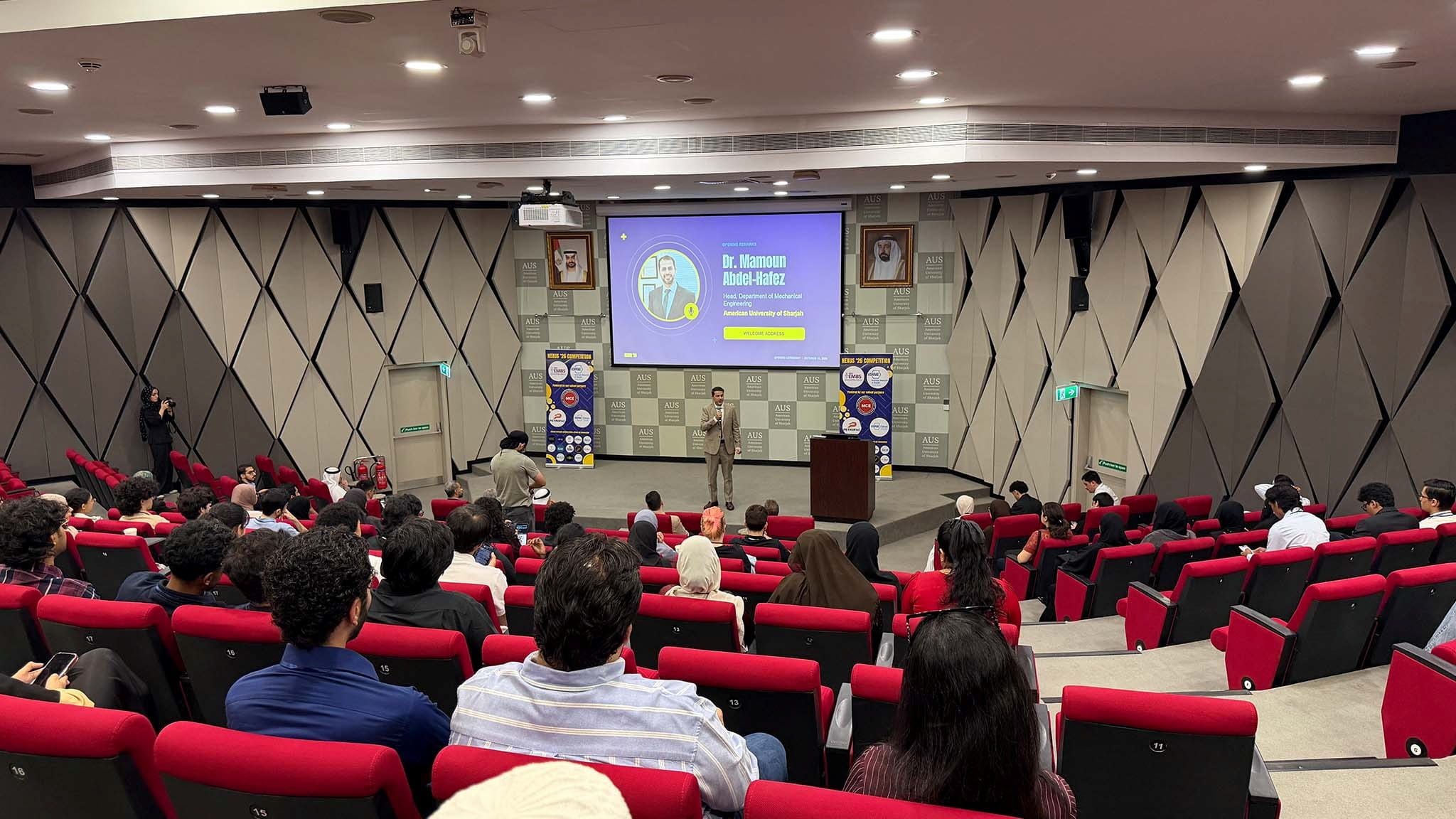
The American University of Sharjah (AUS) recently hosted the “Nexus 2026” design competition, which inspired students to apply their theoretical knowledge and mathematical skills to address real-world challenges in the healthcare sector. The event took place on October 24 and saw participation from over 120 students representing various universities across the United Arab Emirates.
Dr. Mamoun Abd El-Hafiz, Head of the Mechanical Engineering Department at AUS, highlighted the competition’s role in encouraging students to transform their classroom learning into practical solutions. Judges, comprising professionals from hospitals and academic institutions, provided feedback on the participants’ designs, helping them understand industry requirements and prepare for the job market.
Hosted on campus, the competition allowed students to develop innovative solutions to challenges faced by the healthcare industry, emphasising the importance of interdisciplinary collaboration among scientific, engineering, and technological fields.
The event was organised by the student chapters of the American Society of Heating, Refrigerating and Air-Conditioning Engineers (ASHRAE) and the Engineering in Medicine and Biology Society (EMBS) within the Institute of Electrical and Electronics Engineers (IEEE), bringing together students from engineering, science, medicine, and computing programs.
Participants competed in three main tracks, each addressing different aspects of healthcare infrastructure and service delivery. The first track focused on hospital facilities and their efficiency, encompassing mechanical systems, heating, ventilation, air conditioning, as well as biomedical engineering and electrical engineering applications, including automation, control systems, and smart hospitals.
The scientific track revolved around the design and operational efficiency of pathology laboratories, where students were tasked with developing solutions to enhance laboratory facilities and workflows.
Meanwhile, the health informatics track explored digital platforms that improve data analysis and streamline workflows in emergency departments, examining the role of technology in enhancing healthcare operations.
The event commenced with remarks from academic and engineering leaders at the university, followed by an overview of the competition tracks and judging criteria. Students worked at designated stations to develop their projects before presenting their proposed solutions to the judging panels.
Projects were evaluated based on their technical quality, level of innovation, feasibility, and alignment with industry standards. Dr. Abd El-Hafiz emphasised the significance of providing students with opportunities to apply their learning through practical courses, laboratory work, and capstone projects, thus enhancing their ability to tackle real-world problems.
He noted that the competition offers valuable lessons to all participants, regardless of their final rankings. While winners celebrate their achievements, those who do not secure top positions benefit from the experience, learning perseverance and adaptability, as well as the importance of dedicating further effort to achieve success.
Through “Nexus 2026,” the American University of Sharjah has created a platform for students from diverse academic backgrounds to share ideas and collaborate on multidisciplinary projects, exploring practical approaches to improve healthcare facilities and services. The competition also provided participants the opportunity to gain insights from experts, bolstering their skills in translating academic concepts into actionable solutions.