
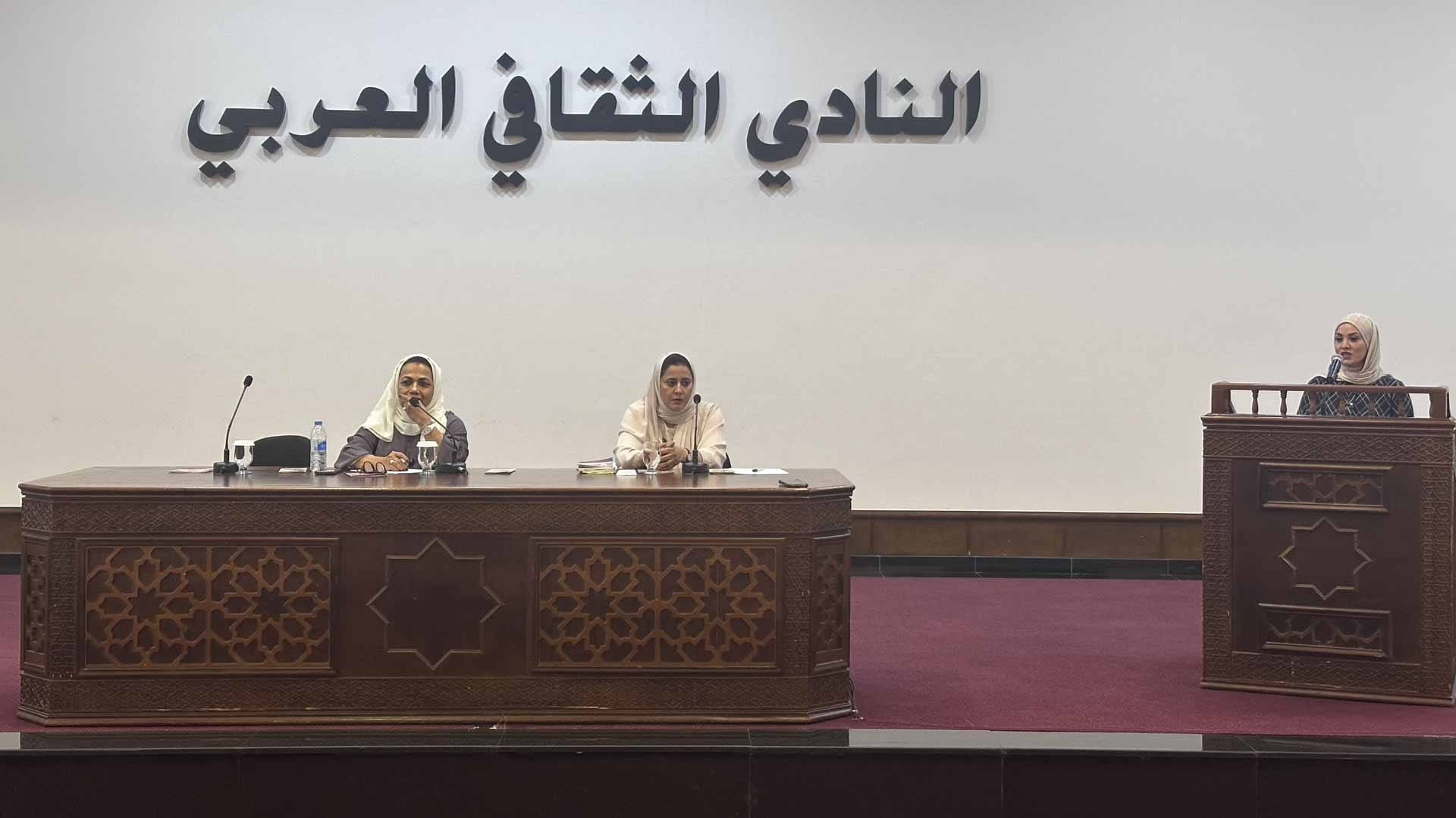
On Saturday evening, the Arab Cultural Club in Sharjah held a thought-provoking discussion featuring the esteemed writer Aisha Sultan, marking the release of her new short story collection, “Housh Al Ghurabaa” (The Yard of Strangers). The session was moderated by fellow author Maryam Al Saadi, with Rola Al Banna serving as the session’s presenter. The event was graced by the presence of Dr. Omar Abdul Aziz, the Chairman of the Club’s Board of Directors, and Ali Al Mughni, the Vice Chairman, along with a diverse audience of literary enthusiasts and fellow writers.
Rola Al Banna commenced the session by highlighting Sharjah’s commitment to culture, stating, “The emirate has never treated culture as a fleeting event but has viewed it as a project, an identity, and a long-term investment in humanity. Thanks to the visionary insights of His Highness Dr. Sultan bin Muhammad Al Qasimi, Member of the Supreme Council and Ruler of Sharjah, culture has become an ongoing project that positions the writer and their works at the forefront. This vision has firmly established Sharjah as one of the most significant cultural capitals in the Arab world today.”
Al Banna further elaborated on Aisha Sultan’s multifaceted career as not only a poet but also a journalist and influential figure within the UAE’s cultural and media scene for nearly three decades. “Aisha’s involvement in cultural journalism, television, and institutional work has been profound. She is a member of several organizations, including the Journalists’ Association and the Emirates Writers Union, and has founded the Cultural Forum for Reading,” she noted.
Turning her attention to the moderator, Maryam Al Saadi, Al Banna praised her extensive literary contributions, which include notable works such as “The Kingdom of Bees in My Head” and “The Crystal Eyes of Writing.” Al Saadi, in her opening remarks, expressed how she had always envisioned Aisha Sultan transitioning into narrative writing, seeking to understand her motivation for focusing on short stories.
“I should first answer why I write,” Aisha responded. “As writers, we have no other profession but writing. In the second year of middle school, our teacher asked us to write about what we wanted to become in the future. I simply replied, ‘I wish to be a writer.’ At that time, I was deeply influenced by the stories of Al-Manfaluti that I was reading. Although I momentarily forgot that dream, it returned when I sent an article to ‘Readers’ Mail’ at Al-Bayan newspaper, which was surprisingly published not in the readers’ section but in the Opinion page. That marked the beginning of fulfilling a dream I had long neglected, leading to over 10,000 articles over 27 years.”
When asked why she chose to write short stories, Aisha elaborated, “I consider articles and short stories to be siblings in the realm of writing. I often begin my articles with a brief anecdote that forms the foundation of my concepts. I am an avid reader of both stories and novels, and writing short stories aligns with my current focus, as our region needs alternative forms of expression. The nature of storytelling, rooted in symbolism and suggestion, provides a greater latitude for expression than the directness of articles.”
Aisha continued, “However, this does not mean I intend to abandon writing articles. My identity as a journalist is invaluable to me, and I can easily combine it with story writing. During the creation of ‘Housh Al Ghurabaa,’ I continued to write articles daily without interruption. What truly matters is the writer’s conviction and the vision they express through their work.”
In the discussion, Aisha identified her inclination towards the portrayal of women striving to assert their presence in society, noting, “While there are three women in my stories who seek to establish themselves in a landscape of limited options, I do not subscribe to the notion that women are oppressed in our traditional society. On the contrary, they possessed the freedom to act and move within societal values and ethics. The women I grew up around adeptly managed household affairs and community situations, demonstrating that they were never constrained.”
Post-discussion, several critics offered their insights. Dr. Maryam Al Hashemi commented on the setting as the protagonist in “Housh Al Ghurabaa,” arguing that the yard serves as the backdrop for the characters to converge from different backgrounds and experiences, thereby intertwining their narratives. Dr. Omar Abdul Aziz highlighted Aisha’s decision to avoid restrictive genre classifications for her work, emphasizing this open-endedness allows for fluidity in narrative forms, whether short stories, novellas, or broader storytelling, resulting in a rich tapestry of interconnected tales within a singular narrative universe.