
Struggling for Survival Against “Vampires” Feeding on Journalists’ Efforts: Is AI Research Writing the Death Certificate for News Websites?
In today’s digital journalism landscape, many journalists are facing unprecedented challenges due to the use of artificial intelligence in news content. Predictions suggest that this trend may lead to a decline and a radical transformation in the way media operates, raising an intriguing question: Will artificial intelligence put an end to news websites as we know them?
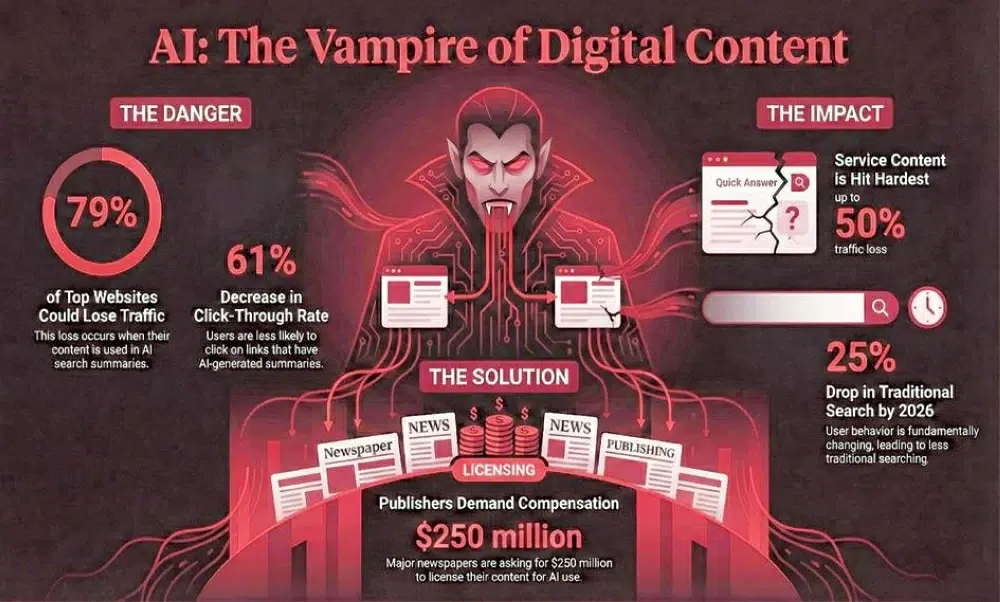
A recent study by the American company Seer Interactive, which specializes in data analysis and search engine marketing (SEO), revealed a sharp decline in the click-through rate (CTR) for websites featuring AI-generated summaries. The study found that the CTR dropped by 61% for queries associated with those summaries, decreasing from 1.76% to 0.61%, even in cases where AI was not displayed. The study also noted an overall decline of 41%, reflecting a shift in user behavior towards relying solely on what appears on the first page of search results. The global firm Gartner predicted that traditional search volume would decrease by 25% by 2026, as users turn to “answer engines” like ChatGPT and Gemini.
It is clear that news websites began feeling the impact of this decline in 2025, representing the minimum expected losses due to search engines. In a similar study from the British firm Authoritas, it was reported that websites ranking first in search results could lose up to 79% of their traffic if their content appears under an AI summary, as users receive information directly without needing to click on the original link.
How is AI Changing the Game?
In a technical and analytical reading of the landscape, Dr. Marco Mamdouh, a professor of computing and artificial intelligence engineering, believes we are witnessing a new generation of search engines. He points out that AI has become the “heart” of the information process, asserting that the “first result war” fought by websites for years has become a thing of the past. When comparing traditional search with AI, it can be said that it is now merely an “old and outdated” technical method.
Mamdouh views these transformations as an opportunity for AI to delve into the details of human experience. He poses a fundamental question: “Which is better for a person: to open 200 search results and get lost in their mazes for an hour or two, or to let a smart tool search and provide the answer directly?” This method has become more suitable for today’s audience, prompting Google to reshape its search engine in accordance with this trend.
Negative Impacts on Journalism
However, this change does not come without consequences. Data from major news organizations like MailOnline and Forbes has shown a significant drop in traffic. For instance, officials at MailOnline reported in mid-2025 that clicks had decreased by between 48% and 56% on mobile and desktop browsers for pages featuring AI functionalities.
In reality, there has been a tide towards declining ad revenue, forcing many news organizations to reorganize their strategies. The question has arisen: How can they survive in a world where AI-generated search results replace original sources?
Can Journalism Overcome This Crisis?
In the face of these challenges, some news organizations have begun developing new business models. Strategies focused on AI-driven search engine optimization (GEO) have emerged, shifting the focus from keywords to the site being the source from which AI draws information for its responses. Some organizations, like the New York Times, have also moved to implement paid subscription systems to ensure audience loyalty.
Other organizations have responded by signing licensing agreements with companies like OpenAI to allow their content to be used for training models. This approach provides organizations with the financial advantages necessary to survive in these complex circumstances.
These changes are essential to ensure the continuity of journalism in the face of the challenges posed by artificial intelligence, and institutions must seek innovations that make their content unique and difficult to replicate.
As artificial intelligence continues to impact the media industry, there remains hope that news organizations will find ways to adapt and thrive in this new era of search and information. Journalists must resist the temptation to abandon the depth and reliability that distinguishes their work.