
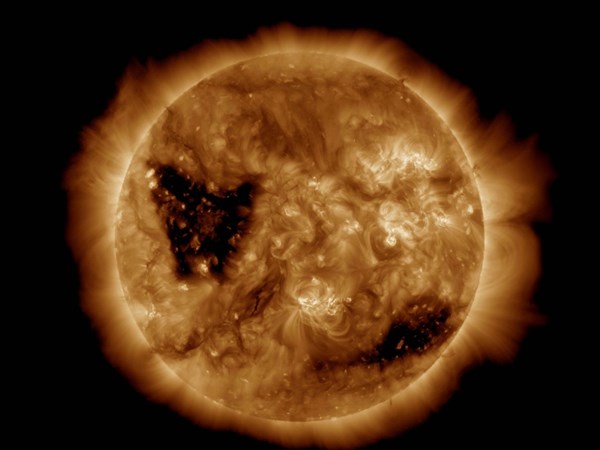
At New York University Abu Dhabi (NYUAD), researchers are harnessing artificial intelligence to predict solar wind speeds up to four days in advance, marking a significant advancement over existing methods. This groundbreaking study, published in the prestigious The Astrophysical Journal Supplement Series, showcases the potential of AI in enhancing our understanding of solar phenomena.
Innovative AI Model Development
Under the guidance of postdoctoral researcher Dataraj Duri and Sharavan Hanasoji, a research associate at the Center for Astrophysics and Space Science (CASS) at NYUAD, the team has developed a sophisticated AI model. This model has been trained using high-resolution ultraviolet images from NASA’s Solar Dynamics Observatory, along with historical records of solar wind data.
Unlike current techniques, which often rely on text analysis, this innovative AI model focuses on analyzing solar images to identify the conditions that lead to variations in solar wind. This shift in approach represents a substantial leap forward in the predictive capabilities of solar wind analysis.
Enhanced Predictive Accuracy
The new system has reportedly improved the accuracy of solar wind predictions by 45% compared to traditional methods and by 20% over standard AI models. Dataraj remarked, “This approach represents a significant step forward in protecting satellites, navigation systems, and energy infrastructure that modern life depends on.” The integration of advanced AI with our monitoring of solar conditions provides a pathway for early warnings that can safeguard critical systems both on Earth and in space.
Broader Impact and Future Research
The research efforts at NYUAD are not only groundbreaking in their specific field but also reflect the university’s commitment to scientific exploration. With over 90 labs and faculty-led projects, NYUAD has collectively produced more than 9,200 research papers, academic articles, and books. The implications of applying artificial intelligence to solar wind predictions could pave the way for further innovations across various scientific disciplines.
As researchers continue to refine their AI models and explore the nuances of solar phenomena, the potential for improved safety and efficiency in space weather forecasting becomes increasingly attainable. The collaboration between advanced technology and astrophysical research stands to reshape how we respond to and prepare for solar events, ultimately benefiting both modern infrastructure and the broader scientific community.