
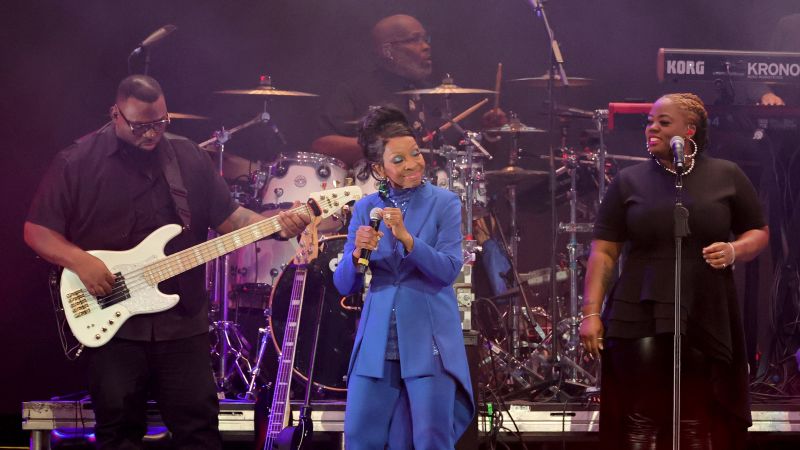
(CNN)– Gladys Knight, the legendary musician, has recently sparked concern among fans after appearing disoriented during a summer concert. This has led to mixed perspectives from family members and her staff regarding the well-being of the 82-year-old artist.
Concerns Over Recent Performance
Videos circulating on social media from her August performance show Knight wandering aimlessly on stage while her backup band takes the lead in singing her famous hit, “Midnight Train to Georgia.” In response to the growing unease expressed on social platforms, a statement was released through her official accounts, indicating that she would reduce her live performances to focus on transitioning into a new phase of her career and life.
Family Disagreements
However, her son, Shanga Hankerson, dismissed this statement, expressing doubts about its authenticity. He claimed, “That was a lie. It was just a way to keep things going; it wasn’t real.” Since the announcement, Knight has taken the stage seven more times, the last being on October 10 in Atlantic City, where she performed a selection of her greatest hits. According to her website, she has two more scheduled performances before November.
Divided Opinions on Health
The ongoing discussions about Knight reflect a deeper family conflict that predates the recent video. There seem to be contrasting views regarding her condition. Some are worried about her cognitive abilities, while Knight herself has not made any public announcement regarding a medical diagnosis. On one hand, some family members express concerns about her declining health, yet she appears determined to continue performing.
Public and Personal Struggles
CNN reached out to Knight, her husband William McDowell, and her publicist Laura Hurlovitch for comments. Initially, Hurlovitch referred to the statement released on Knight’s social media in response to ongoing concerns. When informed that the report focuses on her cognitive health, including comments from her sister Brenda Knight Clarke about Knight taking medications typically prescribed for dementia, Hurlovitch responded via email, stating, “Gladys will feel betrayed by her family discussing her personal life with the media” and added that neither she nor Knight’s team would provide any further comments.
A Life on Stage
Gladys Maria Knight has devoted her entire life to music, originally singing in front of audiences at the age of four at the Mount Moriah Baptist Church in Atlanta. By the 1960s, she had become a recording artist with Motown, leading the group “Gladys Knight and the Pips” alongside her brother Merald “Bubba” Knight Jr. Her illustrious career is far too expansive to be succinctly captured for a generation accustomed to digital streaming experiences, and Hankerson remarked that the woman the world knows is “gradually fading away.”
Family Concerns
Hankerson noted that his mother has been experiencing memory issues for some time, making it challenging for her to form complete sentences. He recalled a moment last year when she seemed not to recognize him. “This decline has been going on for a long time,” he stated, commenting on her isolation from family. He further pointed to McDowell’s role in keeping her on a tight performance schedule, suggesting her desire to continue performing might have been manipulated. “I know she enjoys performing and making people happy, but I also know she values her downtime and loves spending time with her family,” he stated.
Contrasting Narratives Among Caregivers
Hankerson is aware that some may question his motivations, given his legal troubles in the past regarding his mother’s restaurant in Atlanta, but he insists the concern is about ensuring she receives proper care using her own earnings. Knight’s older sister Clarke shares Hankerson’s apprehensions, recalling an incident when a hired aide instructed her to administer two pills to Knight at bedtime. After inquiring about the medication, she discovered one was memantine, which is typically used to manage symptoms of moderate to severe Alzheimer’s disease. Clarke expressed her certainty regarding Knight’s condition: “She has dementia. I don’t care what others say; I’ve seen it myself.”
Support and Commitment to Performance
In August, McDowell told TMZ, “No one is forcing me to say that my wife is healthy, but all she wants to do is sing.” He reiterated that Knight has not been diagnosed with dementia but indicated that she would be assessed by a doctor soon. The current status of that evaluation remains unclear, as numerous attempts to contact McDowell for further comments have been unsuccessful.
The Drive to Perform
Despite the concerns voiced publicly, those close to Knight portray a different picture than that of a frail artist. Charles Barnwell, who has been her driver for nearly 15 years, acknowledged memory issues but stressed that no one pressures her to perform. He noted, “What’s really remarkable is that she can still get on stage and sing. She might lose focus or forget a line now and then, but I’ve seen many artists experience similar issues.” Barnwell affirmed that as long as she possesses her voice, she wants to sing, as she cannot envision doing anything else.
Maintaining Vitality through Music
Photographer Andrew Agresta Jr., who captured her performance in August, described it as vibrant and noted that her voice was “extremely powerful.” Another musician, Dey Zyne, who played alongside Knight, remarked that the performance was “excellent,” with Knight appearing “radiantly joyful.” Veteran music critic J.D. Considine explained that professional musicians persist in performing because it is part of their identity. Molly Marie O’Brien, a music writer, stated that relinquishing the immense energy derived from performing can be extremely challenging for artists like Knight, who have devoted decades to the craft.
O’Brien reflected, “If you’ve been making music and performing at a high level your entire life, it’s natural that this becomes all you know; thus, ceasing could feel unnatural or wrong in your life’s journey.” She concluded, “There’s truly a driving force in the act of getting up and performing… those experiences bring life.” The dedication of Gladys Knight to her art remains evident, illustrating the complex intertwining of identity, family, and her enduring love for music.