
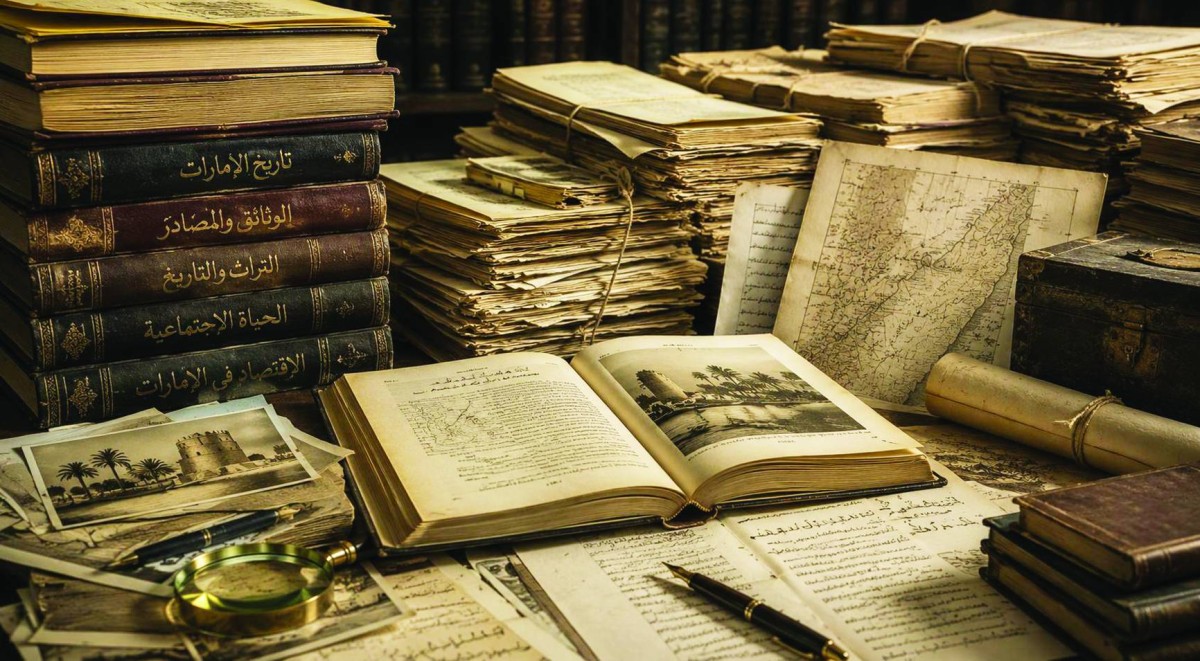
From the narrator’s lips, the story begins, and through the archives, its contours emerge, actively seeking new questions on digital screens today. This signifies the journey of Emirati historical writing, transitioning from a generation that preserved the memory of place to a younger generation that utilises modern research tools to revisit both narrative and document, uncovering the human, social, and cultural transformations behind historical events.
Evolving Methodologies in History Writing
This journey is not merely a shift from memory to documentation; rather, it represents an expansion in the very meaning of documentation itself. The oral narrative that served as the initial point of departure is no longer an end in itself but has become a witness to be compared with both local and foreign written sources.
The digital archive has enabled young researchers to access materials that previously demanded considerable time and effort. Navigating between stringent methodology and the allure of storytelling, a new generation of authors is documenting the history of the UAE through contemporary lenses. They aim to lend accuracy to the past while simultaneously restoring its human voice and vibrant spirit.
Academic Insights and National Narratives
In this context, Dr. Fatima Al-Sayegh, an academic at the University of the Emirates and a member of the Board of Trustees of the Sultan Bin Ali Al-Owais Cultural Foundation, emphasised to *Al-Bayan* that the methodology of writing the history of the UAE has witnessed marked development. This evolution coincides with the state’s efforts in sending many students abroad for study and the establishment of a history department at the University of the Emirates that employs contemporary research methodologies.
Dr. Fatima explained that this development is evident in the fusion of oral narratives with local sources, alongside utilising national archives and documents that have been established across various emirates. She noted the importance of contrasting local sources with British documents, which contain a substantial amount of historical material pertaining to the region, as well as Saudi and Omani documents due to the geographic and historical unity of the area.
Furthermore, she highlighted that the creation of history departments within national universities and the introduction of master’s and doctoral programmes have cultivated a generation of qualified Emirati historians who experienced events and witnessed transformations, enabling them to read history from a national perspective.
Emirati researchers have significantly enriched the historical library by relying on national memory, local narratives, and analytical comparisons between foreign and local documents. Dr. Fatima pointed to the emergence of a new generation of pioneers in this field, recalling the role of Dr. Faleh Hanidhal, who is considered a mentor in historical studies.
She also mentioned her own experience in preparing her PhD thesis at a western university, striving to narrate the reality and history of the region from a local perspective that transcends a Western viewpoint. Among her contemporaries is Dr. Aisha Al-Sayyar, the first Emirati woman to earn a PhD in history, who stands as a pioneer in this domain.
Bridging Gaps Between Sources
Dr. Fatima stressed that while external historians often emphasised political history, Emirati researchers focus on social, economic, cultural, and religious transformations, along with developments related to women. This approach has rendered them more adept at understanding and analysing their community’s changes. She pointed out that modern access methods to documents and digital sources do not impose new challenges but instead offer new angles for emerging researchers.
While facilitating the exploration of previously unaddressed material, she noted that digital techniques save time and effort. In the past, a researcher would spend an entire day in the British library to obtain a single document, but now such documents are just a click away from the comfort of one’s own home.
She concluded by stating that an abundance of sources provides skilled young researchers with speed and flexibility in their investigations. However, fully benefiting from this advantage demands that researchers possess strict historical research skills and methodologies to ensure the accurate extraction of historical truths and a proper understanding of events.
A Contemporary Approach to Heritage
In a passionate new experience, young author Ahmed Rashid bin Fahd asserted that despite historical books and sources filling the mind with dates and events, they leave a notable void in understanding human emotions. He explained that the main driving force behind his latest publication, “Granada After the Fall,” was to approach history through the gateway of storytelling and memory.
Ahmed noted that the new generation of writers and readers is increasingly inclined to re-read the past from emotional and narrative angles, rendering history more relatable to contemporary readers. He believes that events and occurrences are merely “skeletons”, whereas stories and memories embody the spirit injected into that skeleton.
He observed that today’s youth are not attracted to dry narratives or direct instruction; instead, they seek experiences and stories that ignite passion and resonate with reality. He emphasised that presenting history through the lens of travel literature and human connection transforms it from a heavy academic subject read merely for examinations into a living, ongoing dialogue that connects individuals with their identities and answers their daily questions.
Finding Balance Between Rigor and Narrative
Regarding the balance between historical accuracy and narrative aesthetics, the young writer articulated that the passion for exploring the roots of present questions is the primary motive for revisiting the past. He added that achieving equilibrium lies in the strict respect for sources and documents as an untouchable foundation, while possessing the courage to present them in a fluid literary style and modern narrative, summarising his proposition with a commitment to presenting the facts authentically and recounting them in a language that resonates with today’s generation without pretence.