
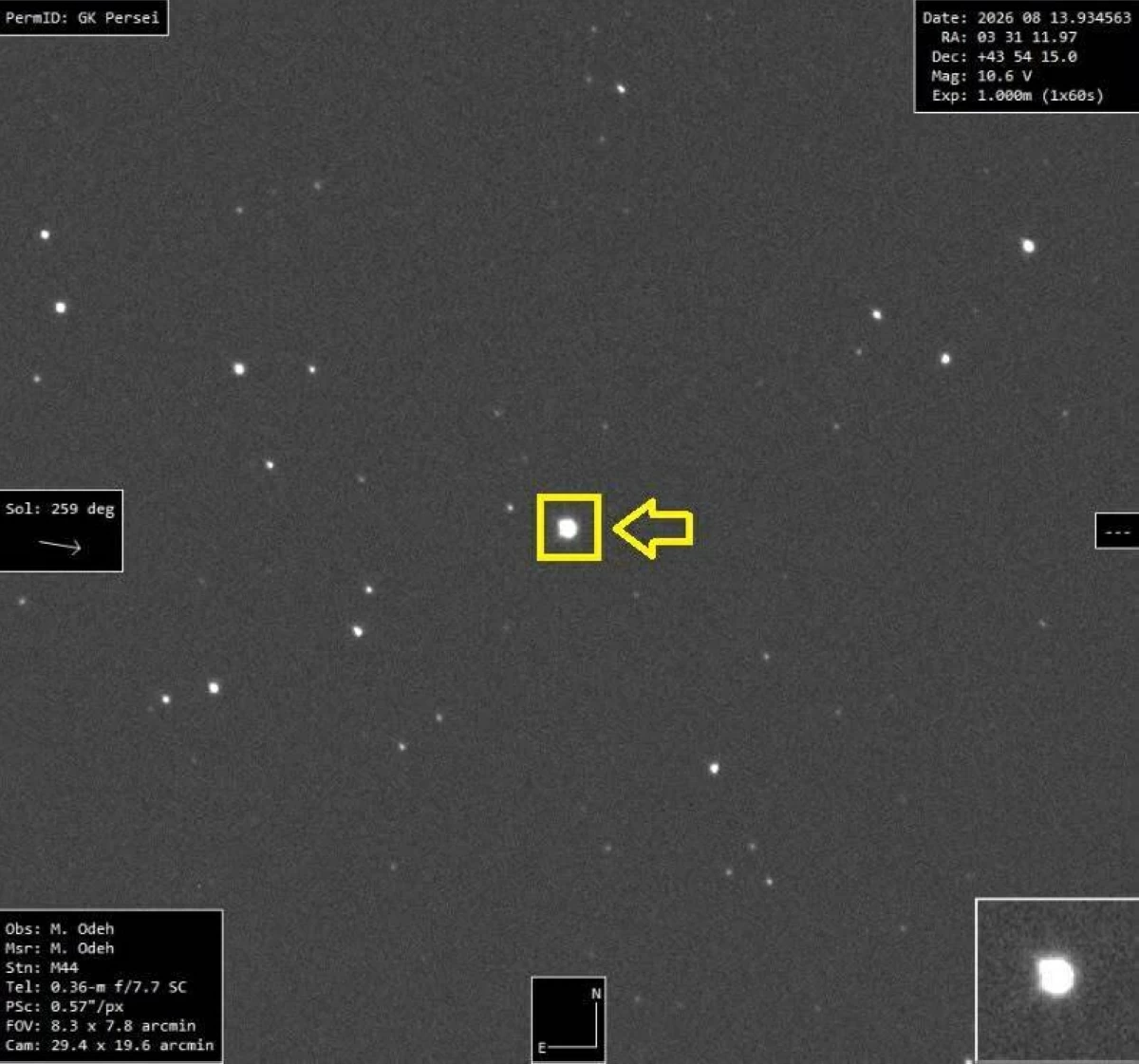
On August 15, 2026, significant activities regarding the variable star GK Persei were observed by the Khatm Astronomy Observatory, part of the International Astronomy Centre. This observation forms part of a global campaign aimed at studying the star’s current activity and evolution.
Observations and Findings
The Khatm Astronomy Observatory successfully recorded notable variations in the brightness of the well-known variable star GK Persei. Continuous photometric measurements indicated a gradual decrease in the star’s brightness, interspersed with clear periodic fluctuations. These observations reflect the rapid changes occurring within the system over short timeframes.
When combined with data from other observatories, these measurements provide a more comprehensive and accurate picture of the system’s behaviour and its evolving activity. According to engineer Mohammed Shawkat Ouda, Director of the International Astronomy Centre, GK Persei is a significant celestial body in the study of variable stars and binary star systems. Its observational history is remarkable, particularly following its spectacular explosion in 1901, when it shone brightly as a nova known as Nova Persei 1901, becoming easily visible to the naked eye.
The Nature of GK Persei
Currently, GK Persei is classified within the category of catastrophic magnetic variable binary systems. It consists of a dense, highly magnetic white dwarf that attracts material from a companion star. As this material accumulates in a surrounding disc before falling towards the white dwarf, varying rates of material transfer lead to noticeable changes in the system’s brightness.
The importance of monitoring this star has increased due to its heightened brightness observed in July 2026, prompting intensified temporal measurements to track these changes. The American Association of Variable Star Observers (AAVSO) has called for repeated photometric and spectroscopic observations to capture the fluctuations in brightness over short intervals.
Dynamic Characteristics of the System
One of the notable dynamic characteristics of this system is the rapid rotation of the white dwarf, with a rotation period of approximately 351 seconds (around 5.9 minutes). The orbital period of the binary system itself spans about two days. This variance in temporal measurements influences the nature of the observed light changes, which are tied to the processes of material accumulation, the rotation of the white dwarf, and the motion of the system’s components.
Continued Scientific Interest
Even after roughly 125 years following its historic explosion, GK Persei continues to attract significant scientific interest. A recent study published this year, drawing from data provided by the SPHEREx space observatory, revealed a large envelope of molecular hydrogen surrounding the system. This finding adds new insights into the material surrounding the nova remnants and its interaction with the surrounding medium.
The observations conducted by the Khatm Astronomy Observatory in the UAE contribute to an international effort to monitor GK Persei. This collaborative approach aims to provide continuous observational data of this active stellar system, track its changes, and enhance our understanding of the associated physical processes.