
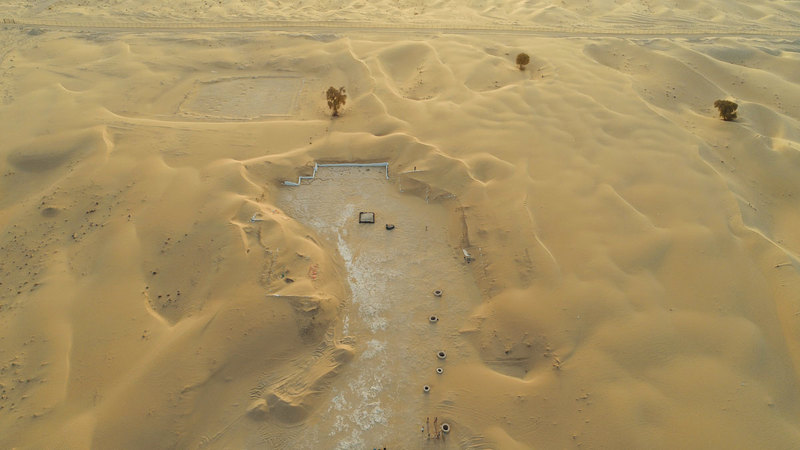
The recent inclusion of five archaeological sites in the UAE on the tangible heritage list of the Islamic World Educational, Scientific and Cultural Organization (ICESCO) highlights the nation’s rich cultural heritage. From Saruq Al Hadid to Wadi Al Helo, these sites represent a significant step in acknowledging the UAE’s historical value and commitment to preserving its ancient treasures. This article delves into these remarkable locations that are now part of the ICESCO heritage list and discusses their historical significance.
Saruq Al Hadid: A Gateway to the Past
Saruq Al Hadid stands out as one of the most significant archaeological sites in Dubai. Situated approximately 95 kilometers from the city, it was discovered in 2002 when His Highness Sheikh Mohammed bin Rashid Al Maktoum, Vice President of the UAE and Ruler of Dubai, noticed blackened remnants in the desert during a flight. Subsequent investigations revealed that these remnants were iron smelting waste from ancient times, with evidence pointing to its activity from the early Bronze Age around 2600 BCE to the late Iron Age circa 550 BCE. This makes Saruq Al Hadid an extraordinary site for understanding ancient metallurgy in the southeastern Arabian Peninsula.
Wadi Al Helo: A Testament to Copper Mining
Wadi Al Helo, located in the eastern region of the UAE, is recognized as the earliest site of copper mining in the Arabian Peninsula during the transition from the Neolithic period. It showcases an intricate understanding of ancient metallurgy and the relationship of its inhabitants with the local environment. The archaeological findings here elucidate the development of local copper mining techniques that were essential for the region’s advancement. Its inclusion in the ICESCO list underlines the importance of Wadi Al Helo’s contributions to understanding early human settlement and resource exploitation.
Cultural Heritage in Sharjah: The Valley of the Past
The ICESCO listing also encompasses several significant sites in Sharjah, including the prehistoric cultural site at Al Faya, which offers invaluable insights into early human habitation. Another noteworthy inclusion is the historical towers and fortifications in Khor Fakkan, representing a cohesive defensive system established over centuries. These structures, including the Portuguese castle and the Al Adwani Tower, bear witness to the strategic importance of Khor Fakkan throughout history, showcasing architectural evolution from the 14th to the 20th centuries.
The Importance of Preserving Heritage
Sheikh Salem bin Khalid Al Qasimi, Minister of Culture and Chairman of the National Committee for Education, Culture, and Science, emphasized that the addition of these sites to the ICESCO heritage list is a measure of the UAE’s deep-rooted cultural legacy. He stated, “The inclusion of these new sites on the tangible heritage list is a remarkable achievement that reflects the depth of the nation’s cultural heritage and its commitment to preserving historical sites.” This commitment not only reinforces the UAE’s role in global cultural dynamics but also ensures that its historical narrative continues to enrich future generations.
This recent recognition is part of a broader effort by the UAE to enhance its position on international heritage lists. Previously, several prominent sites were also acknowledged, including the Umm Al Nar settlement and grave, the Abu Dhabi Sabkha, and various other important locations within Sharjah. Each designation contributes to painting a fuller picture of the UAE’s rich historical tapestry.
As the UAE continues to foster an appreciation for its cultural heritage through such recognitions, it simultaneously affirms its intention to safeguard these treasures for future generations. The stories woven into sites like Saruq Al Hadid and Wadi Al Helo are now firmly embedded in the global narrative of historical significance.