
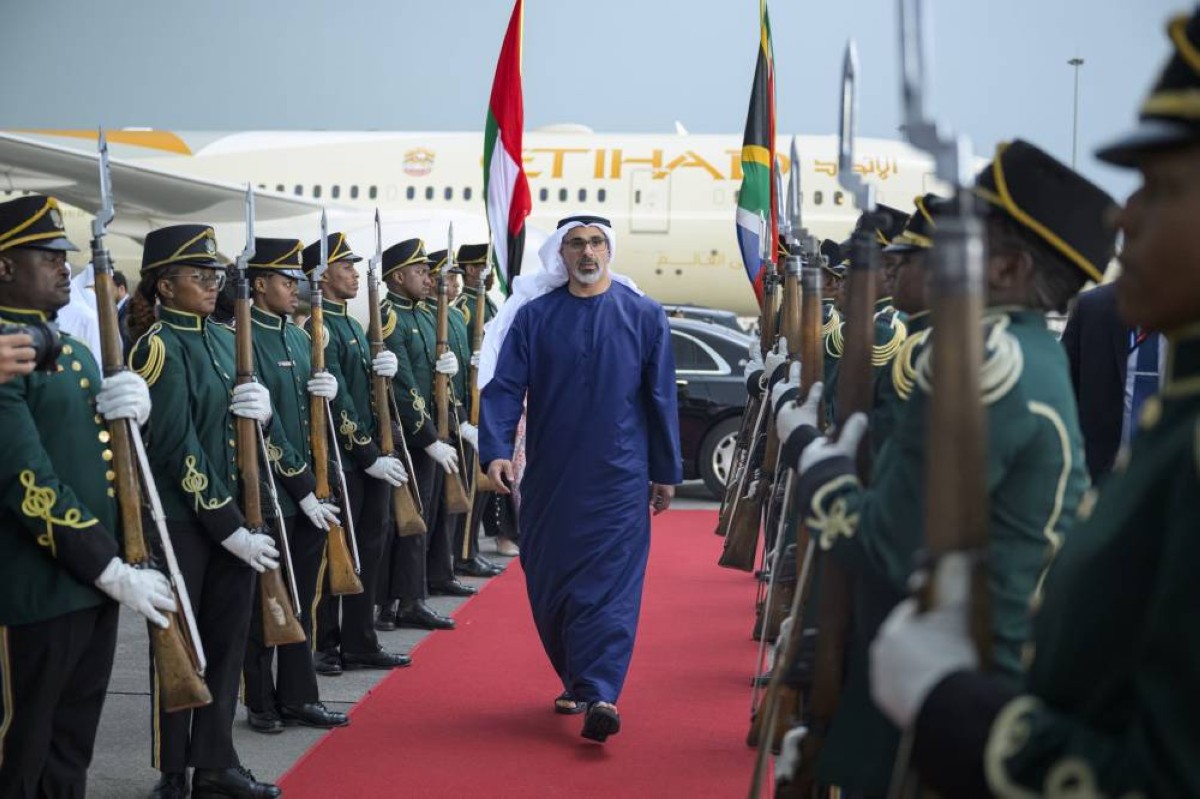
At the conclusion of the annual meetings of the world’s most influential group, the UAE’s participation in the G20 meetings stands out as a strategic step that distinguishes the country on the international stage. For the sixth time, the UAE’s involvement in the G20 meetings highlights the importance of this participation, its economic and political benefits, and its pivotal role in addressing global challenges.
Participation of His Highness Sheikh Khaled bin Mohammed bin Zayed Al Nahyan
On behalf of His Highness Sheikh Mohammed bin Zayed Al Nahyan, President of the UAE, His Highness Sheikh Khaled bin Mohammed bin Zayed Al Nahyan, Crown Prince of Abu Dhabi, participated in the G20 Summit held in Johannesburg, South Africa. During the opening session of the summit, he delivered a speech representing the United Arab Emirates, which was held under the theme: “Building Our Economies, the Role of Trade, Financing Development, and the Debt Burden.” In his speech, he conveyed the greetings of His Highness Sheikh Mohammed bin Zayed Al Nahyan to the participating leaders, wished them success, and praised the invitation from the President of South Africa for the UAE to participate in the summit’s proceedings.
The Importance of UAE Participation in the G20
The G20 invites countries like the UAE to participate in its meetings for strategic, economic, and diplomatic reasons. These participations are not full memberships but aim to enhance the effectiveness of the group and represent the global economy more broadly. The UAE began participating in G20 meetings as a guest country at the France Summit in 2011, and under the slogan “Solidarity, Equality, and Sustainability,” South Africa has invited the UAE to participate as a guest country in the 2025 summit. This marks the UAE’s sixth participation in the G20, having previously attended several summits, notably in Brazil, India, Indonesia, and Saudi Arabia.
Economic and Political Impacts of UAE Participation
The UAE’s participation in G20 meetings enhances its position on the international stage and has notable economic and political impacts. First, its involvement contributes to expanding global economic representation, considering that G20 countries represent most of the world’s economy, while many influential economies are absent. Today, the UAE is a global financial hub and plays a key role in the energy and trade sectors.
Second, the UAE plays an important role in stabilizing energy markets by securing oil and gas supplies, expanding renewable energy projects, and initiating climate initiatives. Its presence at the G20 meetings contributes to addressing energy and climate issues that are central to the agenda of discussions.
Third, the UAE is a pivotal partner in financing and development issues, possessing one of the largest sovereign wealth funds in the world and making substantial developmental contributions in various regions, thereby enhancing its ability to influence discussions related to international financing.
Strategic Partnerships and Initiative Enhancement
Fourth, the UAE’s presence contributes to enhancing political partnerships, providing an important perspective on security and economic issues. The invitation extended to the UAE reflects a significant appreciation of its regional and international role and the desire of major countries to build stronger cooperation.
Fifth, the G20 addresses global issues such as the impacts of debt and food security, and the UAE has a strong presence in these areas, making it an active partner in discussions. Lastly, the UAE is an important hub for artificial intelligence and financial technology, where it sets international standards and plays a fundamental role in shaping the digital economy.