
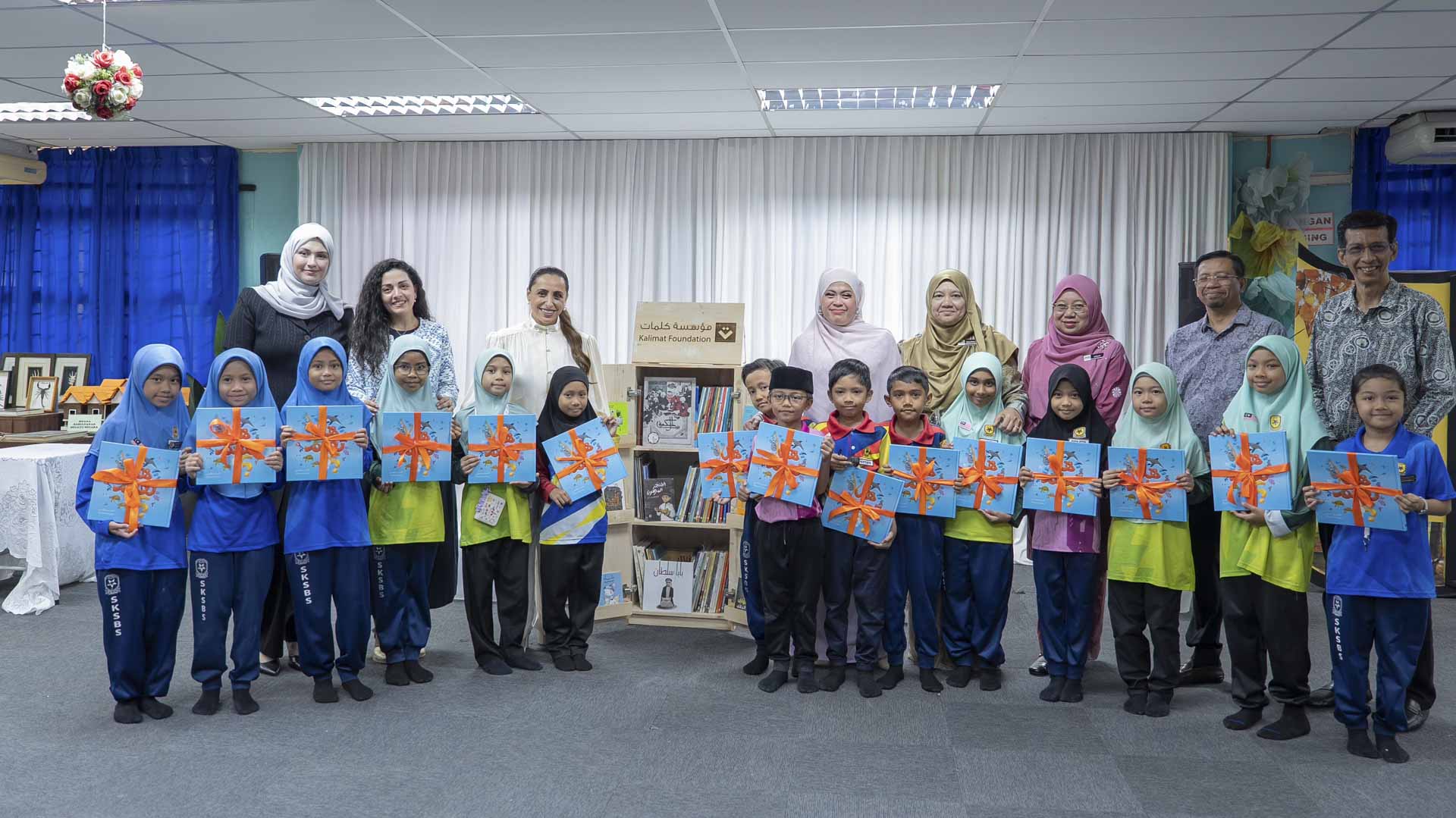
Princess Sheikha Bodour bint Sultan Al Qasimi, Founder and Chairperson of Kalimat Foundation, has led the foundation’s latest international initiative in Malaysia, providing six mobile libraries containing 600 books for children to schools across the country. The effort will give more than 4,000 students access to quality reading resources that enrich school libraries, support language learning, develop imagination, and strengthen their connection to reading, knowledge and culture.
The initiative was carried out in partnership with Kotabuku, a Malaysian semi-governmental organisation focused on promoting reading and developing the national publishing sector, and in cooperation with the Malaysian Board on Books for Young People, the national branch of the International Board on Books for Young People. Through these partnerships, Kalimat Foundation supported primary schools across Malaysia with mobile libraries, helping to enrich their school libraries, strengthen Arabic-language learning resources for students and teachers, and provide young readers with quality books that nurture imagination and build a lasting relationship with reading.
As part of the initiative, Princess Sheikha Bodour bint Sultan Al Qasimi visited Seri Bintang Selatan National School, one of the schools included through the partnership with Kotabuku. She was received by Adibah Omar, Chief Executive of Kotabuku; Siti Maziah Malik, the school principal; and a number of senior officials from the Malaysian Ministry of Education, along with representatives of Kotabuku. The visit included a tour of the school’s facilities and library, as well as attendance at a student programme celebrating the Arabic language and its culture.
A valuable addition to educational environments
Speaking about the initiative, Princess Sheikha Bodour bint Sultan Al Qasimi said: “Malaysia has a long and rich legacy in teaching the Arabic language, with schools and local communities helping to uphold it across generations. Through the ‘Adopt a Library’ initiative, we are proud to contribute to this legacy by expanding children’s access to quality Arabic books and enriching educational environments where language, culture and Arab identity can flourish. Every library we provide in a school, community centre or educational setting reflects our belief that the book can open horizons of learning, curiosity and opportunity for children, and give them the ability to build deeper and more meaningful connections with the world around them.”
For her part, Adibah Omar said: “Reading helps broaden children’s horizons and strengthen their intellectual and cognitive abilities. We welcome this collaboration with Kalimat Foundation for the valuable opportunities it provides for students to engage with the Arabic language and literature, alongside its role in strengthening the close educational and cultural ties between Malaysia and the United Arab Emirates. Such partnerships are a valuable addition to our educational environment and reflect our shared commitment to investing in future generations through education.”
The visit also included a series of student activities attended by Princess Sheikha Bodour bint Sultan Al Qasimi, featuring an Arabic-language performance, the presentation of Arabic books to participating children, a storytelling session, and a creative workshop in which students designed bookmarks inspired by the story. The experience encouraged them to engage through imagination, dialogue and artistic expression.
Knowledge initiatives spanning 6 continents
The initiative reflects Kalimat Foundation’s mission to make quality Arabic literature available to children outside the Arab world. Alongside supporting Arabic-language education, it helps expand young readers’ knowledge, enrich their Arabic vocabulary, and deepen their engagement with the language through reading and discovery.
Through its programmes spanning six continents, “Adopt a Library” has distributed more than 216 libraries, benefiting over 100,000 children in about 30 countries, in collaboration with governments, educational institutions and humanitarian organisations, with the aim of ensuring that every child has the chance to read, learn and remain connected to the richness of the Arabic language and its culture.