
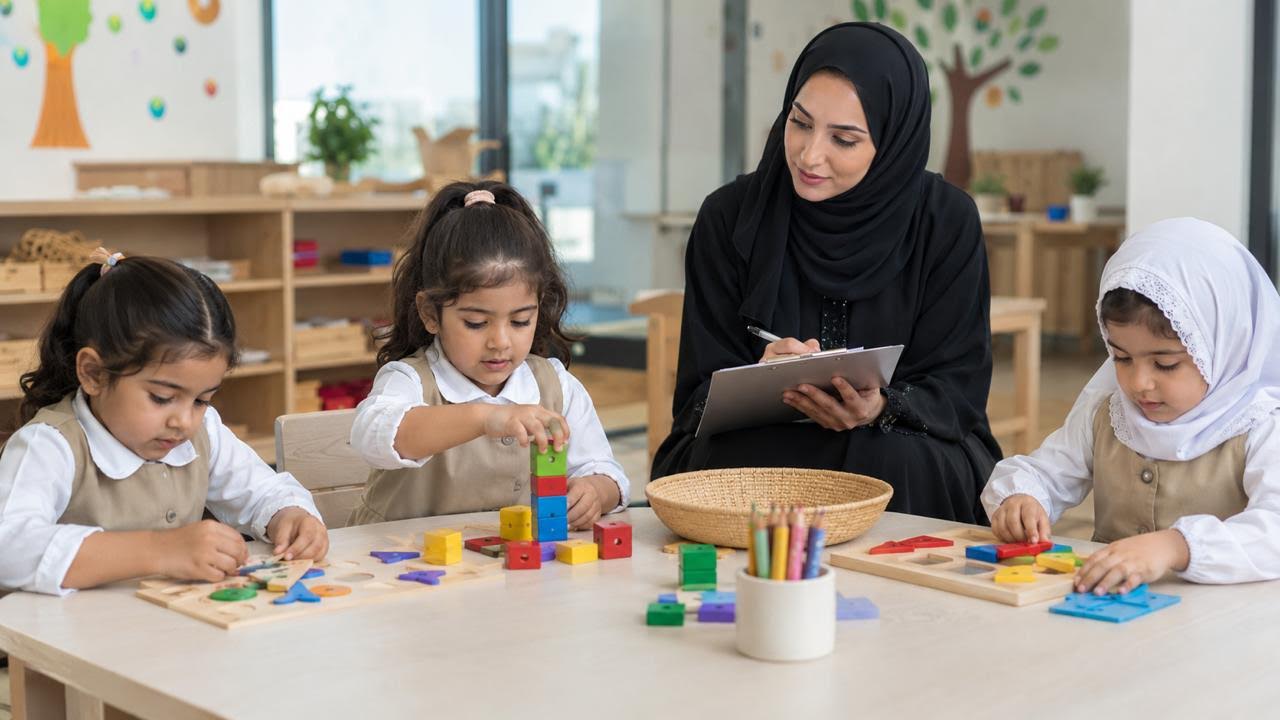
The Ministry of Education has established a comprehensive framework for assessing kindergarten students, focusing on continuous monitoring of a child’s overall development. This new assessment system aims to tailor educational guidance according to individual needs, relying on observations, real-life evidence, and play-based learning, rather than solely evaluating academic performance.
Guiding Principles for Assessment
According to the assessment policy guidance document for the 2026-2027 academic year, which was reviewed by “Emirates Today”, the ministry has outlined six key principles and six essential components for evaluating students. These principles encourage a child-centric approach that considers developmental growth through play, while also being inclusive of cultural identity.
The principles further stipulate that assessment should be continuous, comprehensive, ethically sound, and collaborative, integrating the evaluation process as a seamless part of the educational practice rather than a standalone activity.
Continuous Assessment Cycle
The guidelines implement a cohesive and ongoing cycle for assessing kindergarten children, progressing through five interconnected stages: observation, assessment, planning, implementation, and reflection. This cyclical process ensures that observations go beyond merely recording a child’s performance levels; it also evaluates what has been achieved, plans the next educational steps, and reflects on the outcomes, thus providing a continuous loop for tracking growth and enhancing teaching practices in alignment with individual needs.
Core Components of Evaluation
The ministry has identified six critical components for assessing students in the kindergarten stage. The first component, “Developmental Screening Tools,” is used at the beginning of the academic year to identify early developmental indicators and individual needs, helping to form an initial understanding of each child’s growth trajectory.
The second component, “Beginning of Year Assessment (BOY),” is conducted during the first seven weeks of the academic year to establish a baseline for each child. This assessment is repeated periodically to monitor ongoing development.
Continuous assessment occurs through daily observations, learning story records, and analysis of children’s work samples, where results guide instructional strategies, thus making assessment an integral part of the learning environment.
End-of-Term and Year Reviews
The assessment framework also includes “End-of-Term Reviews,” featuring structured reflection sessions where teachers and parents collaboratively discuss the child’s progress and establish next steps, reinforcing the family’s role as a partner in the child’s development.
At the end of the academic year, “End-of-Year Reviews” are conducted, relying on annual evaluations and an analysis of the child’s achievement portfolio to develop a comprehensive picture of their growth during this stage.
The sixth component, “Diagnostic Assessment – As Needed,” is selectively implemented to support children with specific educational or developmental needs, with results guiding appropriate interventions tailored to those requirements.
Performance Levels
In terms of measuring children’s progress, the ministry has established four descriptive performance levels that create an educational framework for tracking developmental growth. These levels describe individual progress rather than compare children against one another, allowing for a focus on various developmental areas.
The performance levels begin with “Beginning”, indicating that the child is just starting to engage with concepts or skills and relies heavily on support from adults. The next level, “Developing,” signifies that the child demonstrates growing understanding and begins to apply skills or knowledge periodically, requiring some support in specific instances.
The “Proficient” level reflects that the child has a solid understanding and can consistently perform required skills independently in familiar and new learning contexts, which is the expected level to be achieved by the end of this stage. Finally, “Exceeding Expectations” indicates that the child shows clear advancement in learning through creativity, initiative, or leadership, applying their values in diverse contexts, surpassing the developmental expectations for this stage.
This structured assessment framework does not measure kindergarten children merely through a singular grade or direct comparisons with peers, but rather through a connected progression that starts with observing their growth and needs, advancing through evaluation, planning, implementation, and reflection. This approach is underpinned by everyday evidence gathering and portfolio work, in partnership with families, leading to a well-rounded understanding of each child’s development and readiness for the transition to primary school.