
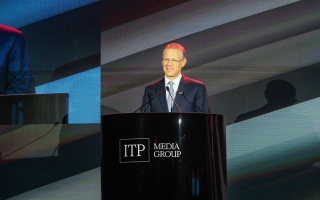
The United Arab Emirates (UAE) has demonstrated remarkable resilience against ongoing geopolitical disruptions, showcasing its robust economic structure as a solid foundation. This article delves into how the UAE is capable of surpassing geopolitical challenges, emphasizing the strength and adaptability of its economy that has been built over decades.
Strategic Response to Geopolitical Challenges
Badr Jafar, the special envoy for the Minister of Foreign Affairs for Business and Charitable Affairs, highlighted that the UAE’s exceptional ability to navigate geopolitical disturbances is not merely a display of resilience but also a compelling testament to the effectiveness of its sturdy economic framework. During his address at “The Briefing” event by Arabian Business at the JW Marriott Marquis Dubai, he remarked, “The UAE’s steadfastness in times of crisis is not an improvised reaction, but a foundational principle we are built upon, characterized by determination, planning, and prudent readiness.”
A Legacy of Human Spirit and Vision
Jafar connected this unique resilience to the very establishment of the UAE, recalling the late Sheikh Zayed bin Sultan Al Nahyan, and reminded the audience that “whatever we build or create, the true driving force behind our progress is the human spirit.” He praised the nation’s success in maintaining operational continuity across various sectors during the most challenging weeks, stating, “No matter how much adversity has prevailed, the nation kept its promise, as ports, flights, hospitals, and markets continued their daily operations, reflecting the efficiency that defines us.”
Driving Economic Growth Amidst Adversity
The event gathered a distinguished group of decision-makers from finance, aviation, tourism, technology, and retail sectors. Speakers included influential figures such as Kerry Healy, CEO of ACCOR; Paul Griffiths, CEO of Dubai Airports; and Rania Al-Masri Khateeb, CEO of The Giving Movement. Jafar asserted that economic activity accelerated rather than declined during periods of strife, noting, “Our spirits have not waned, nor has our momentum been curtailed; instead, we have picked up the pace.” He referred to the recent launch of “Made in the UAE,” where over 200 new agreements worth nearly $50 billion were signed, and emphasized the expanding commercial network that connects UAE companies with three billion people across Asia, Africa, and Europe.
The Bright Future Ahead
General economic indicators bolster this narrative, with non-oil sectors now comprising approximately four-fifths of the UAE’s economy, sovereign assets valued at around $2.5 trillion, and official foreign currency reserves exceeding $215 billion. The nation is also home to the world’s busiest international airports, linking over 700 cities and ports across six continents.
In his speech, Jafar described the UAE as more than just a global commercial hub, stating, “What we built to be a meeting point for global trade has evolved into something stronger and deeper: a convergence of minds. We won’t settle for merely welcoming the future; we will actively shape and define it.” He underscored that the foundation for the future is rooted in the present, adding, “The truth we must grasp is that 2071 does not begin on the first day of that year, but in this very moment, as we lay its groundwork with the decisions we make this year and beyond.”
Jafar emphasized, “There is no room for stagnation. Our only choice is to advance, build, and thrive, continuing the story of a nation that has reached remarkable heights in its first fifty years, a narrative that is now shared by many. The next fifty years are not a distant future; they encompass plans, aspirations, and ambitions that rest on all our shoulders to realize. This is your opportunity, and this is your homeland; let us build it together.”