
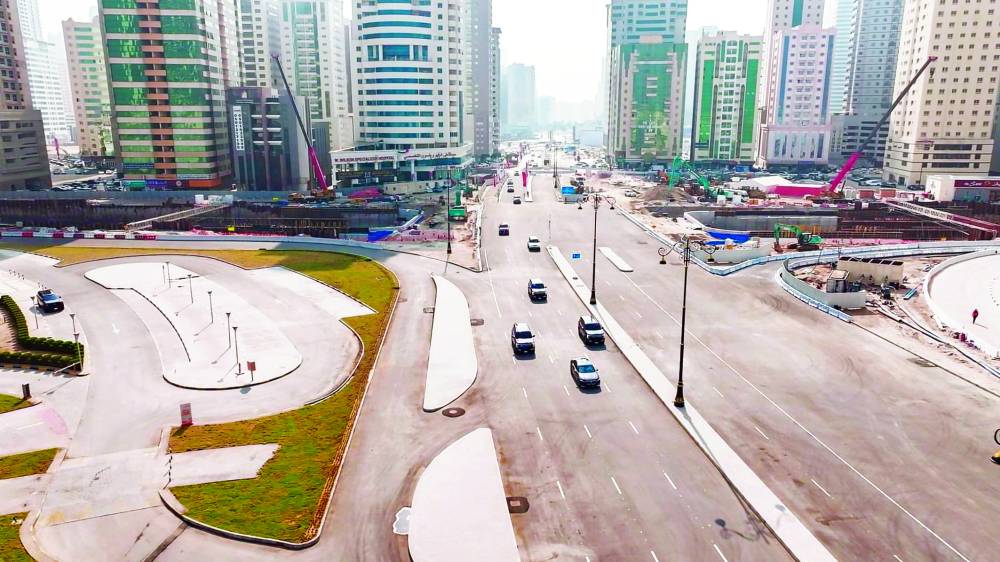
In a significant development for traffic management between the Emirates of Sharjah and Dubai, the first phase of a major project aimed at enhancing road connectivity has been successfully completed in just 126 days. The project, which entailed over 2.7 million hours of dedicated work, is set to alleviate traffic congestion by as much as 85% and provide an additional capacity of 5,200 vehicles per hour along the crucial Industrial Street 3 corridor.
Project Scope and Infrastructure Development
The initiative encompasses five main components: the enhancement of existing intersections and highways, as well as the construction of new roadways spanning a total length of 9.18 kilometres. More than 207,000 square metres have been paved as part of the project, accompanied by a stormwater drainage network extending 19 kilometres. Collectively, these improvements are designed not only to upgrade the current traffic infrastructure but also to ensure efficient drainage to prevent flooding on the new road networks.
The Significance of Industrial Street 3
At the heart of the project is the Industrial Street 3, with an explicit goal of increasing its capacity to accommodate 5,200 vehicles per hour once the development is complete. This ambitious target reflects the anticipated impact of the upgrade on traffic flow, with expectations of significantly reduced congestion following the project’s conclusion. The enhancements on this corridor are vital, linking Sharjah and Dubai more effectively and improving connectivity for commuters.
Improving Traffic Flow and Network Efficiency
The project’s dual focus on upgrading existing thoroughfares and adding new roads is integral to its success. Enhancements to intersections, where vehicle paths converge, are crucial to easing traffic, while the addition of new routes is intended to expand the network linking Sharjah and Dubai. This comprehensive approach combines improvements across all facets of the transport network, aiming to facilitate smoother vehicular movement.
Quantifying Progress and Future Expectations
The completion of the first phase within a span of just over four months underlines the efficiency of execution, supported by the remarkable total of over 2.7 million hours of labour put into the work. Additionally, the extensive development of 9.18 kilometres of new roads and over 207,000 square metres of paved surfaces, alongside the robust stormwater drainage system, highlights the project’s scale and the infrastructure needed to support it.
The overarching goals of this initiative are not only to enhance vehicular capacity but also to reduce traffic congestion by 85% post-completion, which is paramount for facilitating ease of movement between the two Emirates. This ambitious project embodies a forward-thinking approach to roadway development, optimising existing structures while fortifying the network as a whole.
The project aims to redefine traffic flow between Sharjah and Dubai by upgrading intersections and crucial corridors while establishing new routes. By strategically enhancing the infrastructure, the initiative promises to transform public transport dynamics, ultimately benefiting everyday commuters and traffic management alike.