
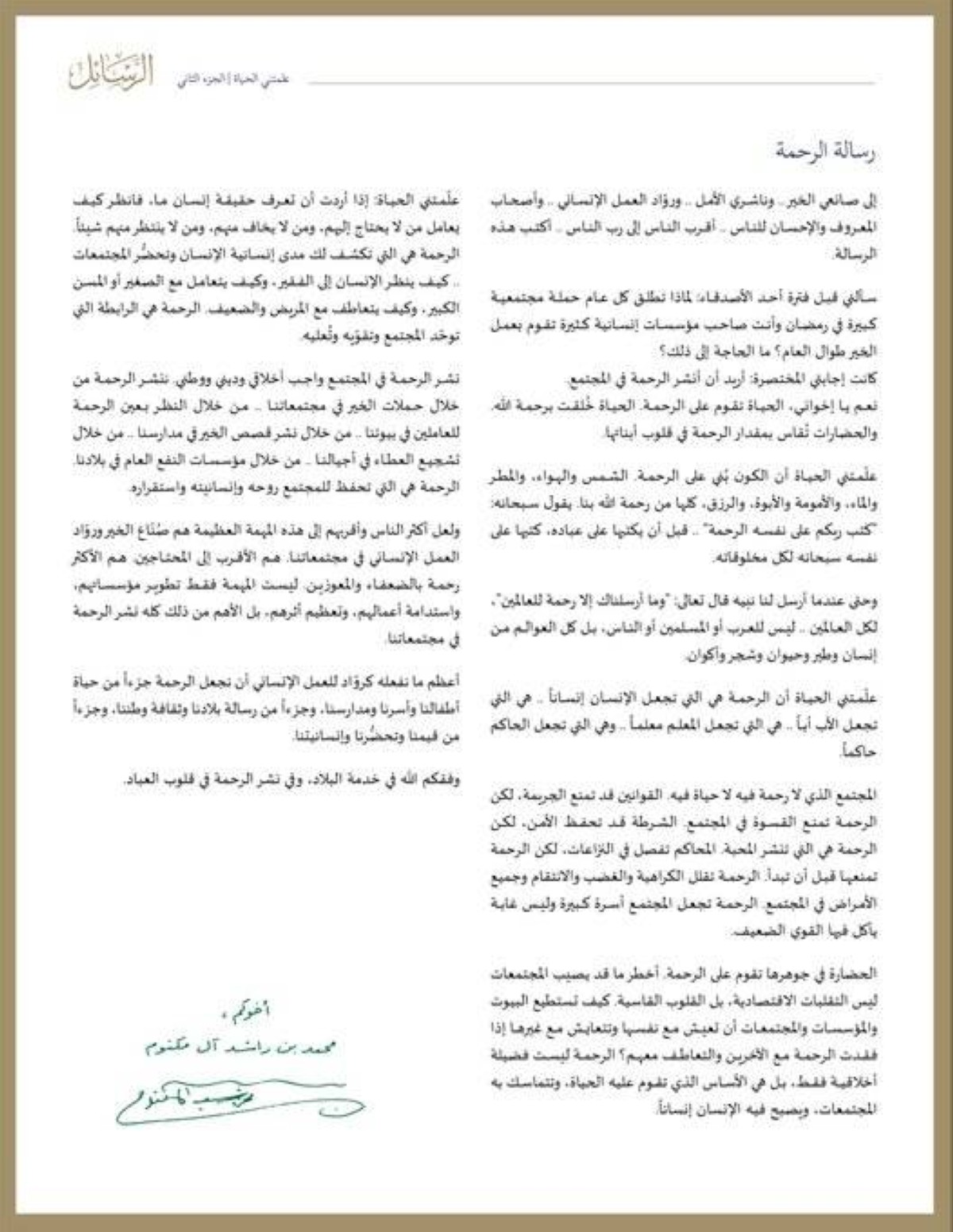
In a heartfelt message aimed at inspiring goodness and fostering compassion, His Highness Sheikh Mohammed bin Rashid Al Maktoum, the Vice President of the United Arab Emirates, Prime Minister, and Ruler of Dubai, has articulated a profound vision for community solidarity and human kindness. The message, titled “A Message of Mercy,” serves as a clarion call to all those dedicated to humanitarian work, urging them to proliferate hope and act as beacons of light in society.
A Call to Arms for Compassion
In a recent post on his official account on the platform “X,” Sheikh Mohammed expressed the essence of his message: “To the creators of goodness, to the disseminators of hope, to the pioneers of humanitarian work, to those who do good to others, the closest to God—this letter is for you.” This statement encapsulates his unwavering commitment to instilling mercy in the fabric of society.
The Importance of Spreading Mercy
Reflecting on why he advocates for a significant community campaign during Ramadan, despite already overseeing numerous charitable institutions, Sheikh Mohammed stated simply, “I want to spread mercy in the community.” He stressed the foundational role of mercy in life, affirming that existence itself is rooted in the mercy of God. He stated, “Life was created with the mercy of God,” asserting that civilizations are measured by the amount of compassion they cultivate among their citizens.
The Universality of Mercy
Sheikh Mohammed elaborated on this concept by highlighting various elements of life that embody mercy—sunlight, air, rain, parental love, and sustenance—all are manifestations of divine kindness. Quoting scripture, he remarked, “Your Lord has decreed upon Himself mercy,” emphasizing that this mercy extends to all of creation. Moreover, he reminded us that the Prophet was sent “as a mercy to the worlds,” underscoring that such compassion is meant for all beings, transcending cultural and religious boundaries.
The Essence of Humanity
“Mercy is what makes a person human,” he continued, showcasing how it shapes our identities as parents, educators, and leaders. In his view, a society devoid of mercy lacks vitality. Laws may deter crime, yet only mercy can foster genuine love and community. “Mercy lessens hatred, anger, and revenge,” he remarked, advocating for a society built on kinship rather than survival of the fittest.
The Core of Civilisation
Sheikh Mohammed asserted that the true danger to any society is not economic upheaval but rather hardened hearts. He challenged us to consider how communities can thrive if they lose their compassion. He believed that mercy extends beyond mere ethical virtue; it is essential for life and societal cohesion, contributing to what it means to be human.
Measuring Humanity through Compassion
“To discern the essence of a person, observe how they treat those who cannot reciprocate,” he advised. The measure of an individual’s humanity lies in their interactions with the less fortunate and vulnerable—children, the elderly, the sick, and the weak. In a society rooted in mercy, these values become the threads that unify and strengthen communal bonds.
A Moral, Religious, and National Obligation
Introducing mercy into our spheres of influence is both an ethical and national responsibility. This can be achieved through charitable initiatives, fostering a culture of kindness in our homes and schools, and encouraging generosity among the younger generations. “Mercy is what preserves the spirit and humanity of society,” he passionately stated.
The Role of Humanitarian Leaders
Sheikh Mohammed urged humanitarian leaders and doers of good to recognise their crucial role in this mission. “Are they not the closest to those in need and the most compassionate towards the weak and destitute?” he posed, reminding us that enhancing their institutions and impact is important, but more imperative is the need to embed mercy into the community’s heartbeat.
Inculcating Mercy in Future Generations
One of the highest callings for those involved in humanitarian work is to ensure that mercy becomes an integral part of the lives of our children, families, schools, the ethos of our nation, and the very fabric of our identity as a society. “May God grant you success in serving the country and spreading mercy in the hearts of people,” concluded Sheikh Mohammed, echoing a commitment to collective compassion.
In essence, the message transcends the individual and speaks to the interconnectedness that binds humanity. It is an invitation to embrace compassion as a cornerstone of our existence, reinforcing the notion that mercy must be cultivated and celebrated within our communities.