
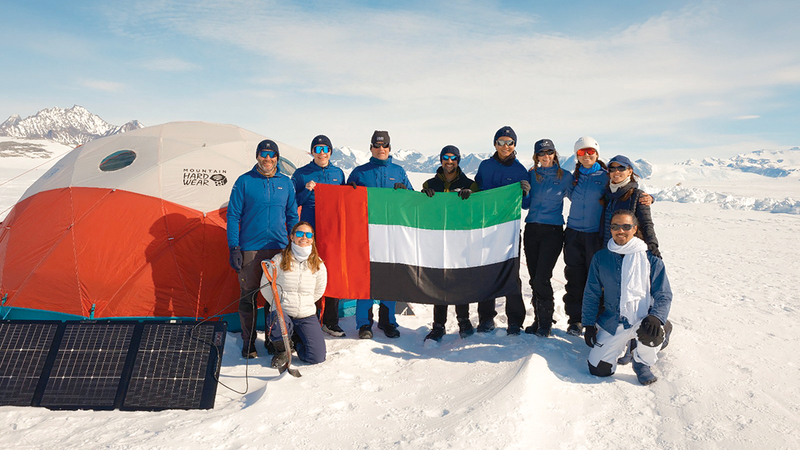
In one of the harshest environments on the planet, amid the ice of Antarctica, Emirati citizen and marine engineer Dr. Hussain Khansahib embodies the essence of identity beyond geography through his participation in the exploratory mission “Ice Station 2025.” This article delves into his experiences and insights, showcasing how identity is dynamic and resilient while the climate crisis challenges our humanity.
Exploring Identity in Extreme Conditions
Dr. Khansahib shares his journey, reflecting on an expedition that intertwined scientific exploration, climate awareness, and cultural diplomacy, alongside powerful human messages that transcend geographic boundaries. He emphasizes, “Identity does not freeze, and the climate tests our humanity.” His experience at the South Pole transforms climate change from mere scientific warnings into an ethical challenge for nations and humanity.
A Call for Action
Reflecting on his presence in Antarctica, Dr. Khansahib notes, “Being at the South Pole today means more than an exploratory journey; it is a direct test of our responsibility towards our planet.” The understanding of climate change shifts from data and statistics to a tangible recognition of its impacts on terrestrial life, marine ecosystems, and environmental systems. “How do we act? What can we practically change?” he asks, highlighting that participation in such missions enables individuals to see the relevance of their choices—large and small.
Human Connections in a Polar Landscape
Describing his experience during the “Ice Station 2025” mission, Dr. Khansahib emphasizes that it is not merely about scientific exploration but also involves climate education and leadership skill development in one of the world’s most unforgiving environments. He adds that the accompanying educational program, supported by Dubai Holding, deepens participants’ understanding of global climate systems and enhances their ability to work under pressure, aligning with the UAE’s long-term sustainability goals.
Bridging Cultures Through Shared Experiences
Dr. Khansahib recounts how sharing a traditional Emirati coffee created a profound human moment at the South Pole. “We sat around the coffee without a common language but felt a deep understanding among each other. At that moment, I realized that identity is not just spoken; it is practiced.” He further describes how that simple act became a microcosm of soft cultural diplomacy, where shared human values converge, overshadowing any differences.
Shared Challenges in Diverse Environments
He observes a surprising similarity between the UAE and Antarctica. “Despite their apparent differences, both environments—Antarctica as a glacial desert and the UAE as a sandy desert—test human adaptability and innovation. They also reflect a shared commitment to peace and science.” Dr. Khansahib stresses that the climate crisis, regardless of geographical context, demands innovative solutions, where technologies tested in extreme cold can be adapted to tackle heat extremes.
Antarctica: A Platform for Global Responsibility
The discussion about establishing a permanent UAE presence in Antarctica illustrates a broader vision. Dr. Khansahib asserts that such an endeavor represents not only a scientific project but a test of a nation’s capability to operate in one of the planet’s harshest environments. “Antarctica is characterized by its towering mountains and thick ice sheets, but it stands as a testament to international cooperation,” he explains. The UAE’s approach signifies its global responsibilities and commitments to protect the Earth and advance knowledge for humanity.
Confronting Climate Change Directly
Dr. Khansahib emphasizes the personal transformation that comes from direct exposure to climate change realities. Observing the gradual separation and melting of icebergs instills a deep sense of responsibility for protecting our planet. His belief in a permanent Emirati presence in Antarctica aligns with a strategic vision for scientific contributions to global climate efforts. “Our commitment reflects a dedication to science, peace, and international collaboration,” he states, tying it to the UAE’s 2050 carbon-neutral vision and reinforcing the nation’s role as a responsible global citizen.
Empowering Action for a Sustainable Future
Dr. Khansahib argues that the essence of environmental discourse lies in translating awareness into actionable practices. He stresses that meaningful change begins with personal conviction, manifests in daily behaviors, and accumulates into impactful policies—ultimately shaping a more sustainable future for all. “The climate crisis is no longer just an abstract concept discussed in conferences but a concrete reality easily observed in the melting ice and shifting ecosystems,” he affirms.
Antarctica by the Numbers
- 150,000 annual visitors to Antarctica for research or eco-tourism.
- Less than 1% reach the depths of the continent near the geographic South Pole.
- Union Glacier is approximately 1,000 kilometers from Earth’s axis and features a natural ice runway for large aircraft.
- Temperatures can drop to −25 degrees Celsius during fieldwork and camping periods.
A Profound Journey
In his reflections, Dr. Khansahib poignantly states, “Climate change is a scientific reality, but witnessing it firsthand is vastly different—it instills a deep sense of responsibility for planet protection.” He believes that a permanent Emirati station in Antarctica represents a strategic commitment to scientific research and a significant contribution to global efforts in safeguarding our world.