
Artificial Intelligence: From Experimentation to Integration in the Workplace
The United Arab Emirates is witnessing a significant transformation in the use of artificial intelligence, making it a model for transitioning from experimentation to actual integration of this technology in government operations. This article explores how this transformation is being achieved and highlights the importance of incorporating artificial intelligence as a fundamental part of government processes to enhance efficiency and effectiveness.
Advanced Model for Institutional Integration
A new research study has confirmed that the UAE presents an advanced model for moving from the experimentation phase to integrating artificial intelligence into core government functions. The study, published by the Yangoo Technology Group in collaboration with INSEAD, indicates that governments treating artificial intelligence as part of their core operational framework—rather than as separate technical projects—are better positioned to sustainably scale its use across various government services.
Design and Governance Challenges
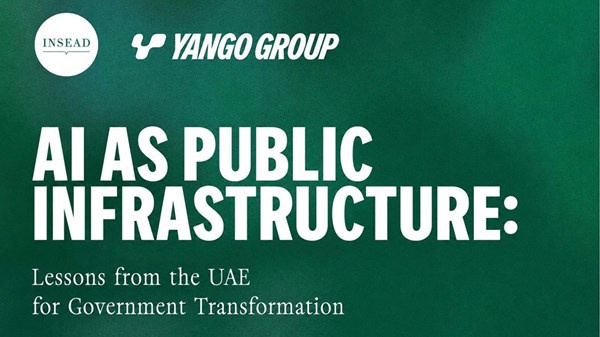
The study, titled “Artificial Intelligence as a Public Infrastructure: Lessons from the UAE for Government Transformation,” showcases that artificial intelligence has entered a new phase in the government sector. The main challenge is no longer about the feasibility of adopting the technology, but rather about how to design, govern, and integrate it institutionally to ensure long-term public value. The UAE’s experience involves three key factors: strong leadership commitment, redesigning government processes, and using procurement and partnerships as strategic tools to support the transformation.
Practical Models and Inspiring Experiences
The study highlights several practical models, including the National Artificial Intelligence Strategy 2031, which serves as a national framework for institutional coordination. Additionally, it features the “Tamm” platform, developed to become a government system supported by artificial intelligence that provides over a thousand government services. The Dubai Initiative to Accelerate AI Integration aims to reduce 183 proposed use cases to 15 high-impact applications in diverse fields such as mobility, healthcare, and logistics.
Strategies for Accelerating Transformation
The study addressed Abu Dhabi’s approach, which prioritizes digital infrastructure, bolstered by sovereign cloud capabilities and a vision for an AI-driven government. It emphasized that the challenges of implementation are not solely technical but also include data incompatibility and a lack of unified competencies between technical expertise and policy-making, in addition to governance frameworks lagging behind the pace of application.
The research was led by Professor Peter Zemsky from INSEAD, based on interviews with government officials and AI experts from across the UAE. Participants in the research included representatives from the Dubai Future Foundation, the Abu Dhabi Government Empowerment Department, Mubadala, Core42, and Inception. The Yangoo Group contributed unique operational insights into the governance of AI systems and their scaling in complex operational environments.
In this context, Islam Abdulkarim, the regional director of the Yangoo Group in the Middle East, stated that the question now is no longer whether governments are adopting artificial intelligence, but rather how to build institutional frameworks and supporting infrastructure on a broad scale. The UAE’s experience has confirmed that artificial intelligence has become an essential part of long-term government and operational systems.
For his part, Mark Mortensen, the associate dean at INSEAD’s Middle East campus, emphasized that while artificial intelligence represents a technological shift, its success also requires addressing institutional challenges. By adopting an approach that treats AI as public infrastructure, the UAE offers valuable models and lessons that contribute to realizing sustainable public benefits through this advanced technology.