
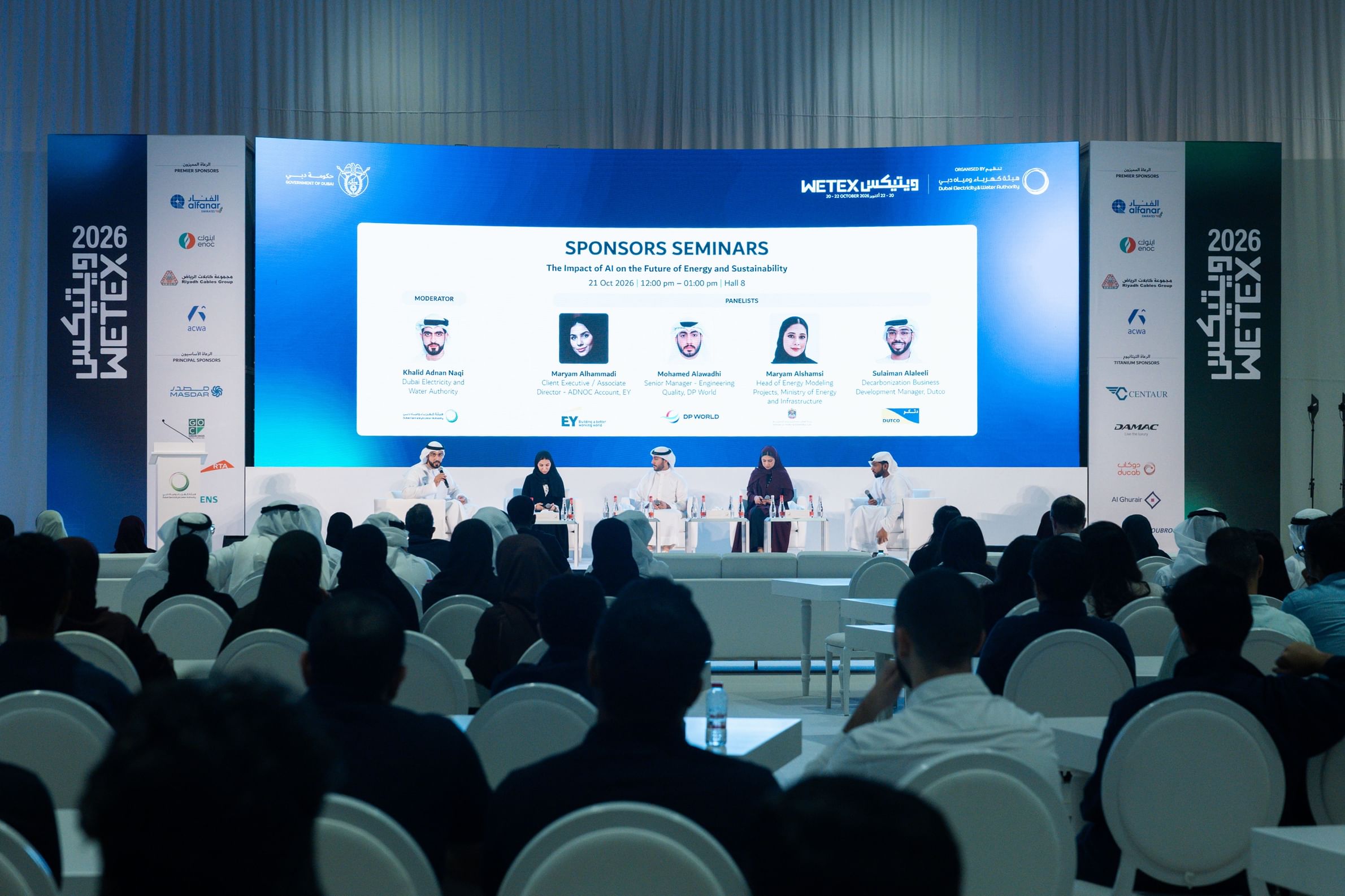
The ongoing discussions surrounding the application of artificial intelligence and digitisation in enhancing the sustainability and resilience of energy, water, and environmental sectors dominated the second day of the 28th edition of the Water, Energy, Technology, and Environment Exhibition (WETEX 2026). Organised by the Dubai Electricity and Water Authority (DEWA) at the Dubai World Trade Centre, the event featured 26 specialised seminars and interactive sessions aimed at strengthening collaboration between DEWA and suppliers to bolster partnerships and drive sustainability and circular economy initiatives.
Building Resilient Power Networks
One of the key sessions titled “Building Resilience in Electricity Networks in an Unstable World: Leveraging Remote Sensing, IoT, and AI for Safer, More Reliable Energy Networks” highlighted the increasing demands and pressures related to supply and cybersecurity. Andy Warner, the global lead for utility services at Hitachi Energy, presented the “HMAX Energy” solutions that utilise sensors and thermal cameras for risk-based predictive maintenance and remote responses, aimed at extending equipment lifespan and minimising failures.
Warner asserted that artificial intelligence opens up new opportunities, revealing an innovative system that analyses streams from both conventional and thermal cameras installed at sites and substations. This system enables continuous visual inspections to detect potential issues, eliminating the need for engineers to conduct annual thermal camera inspections, thereby facilitating immediate problem identification.
The Role of AI in Energy and Sustainability
The session on “The Impact of Artificial Intelligence on the Future of Energy and Sustainability” explored how AI can be harnessed to analyse energy data, enhance operational efficiency and asset reliability, while supporting clean energy planning and emission reductions. It also addressed the challenges associated with the proliferation of smart applications, including rising electricity demands, data quality, and cybersecurity concerns. The importance of governance and inter-sector collaboration for responsibly and sustainably deploying these technologies was emphasised.
Enhancing Future Power Plant Performance
Discussions in the session “Optimising Future Power Plant Performance: Digitisation, Resilience, and Renewable Integration” focused on developing gas turbines, hybrid solutions that integrate them with batteries, and the blending of hydrogen with gas to boost efficiency and flexibility while integrating renewable energy sources. Andreas Siebert, a gas turbine technology expert, and Magdiel Shaheen, a digitisation consultant from Siemens Energy, shed light on the crucial role of digital twinning technology in performance loss monitoring and improving plant start-up processes, contributing to reduced fuel consumption, emissions, costs, and enhanced grid stability and reliability.
Human-Centric Cities and Indoor Air Quality
In the session “Human-Centric Cities: Indoor Air Quality and Post-Wellbeing in the Workplace,” the focus was on the impact of indoor air quality and thermal comfort on the health and productivity of building occupants. The importance of monitoring carbon dioxide levels and particulate matter (PM2.5) was highlighted. The session’s participants included Vitaly Matyunin, co-founder and CEO of Airvoys, عبد اللطيف البيطاوي, CEO of the Emirates Green Buildings Council, Dr. Hassan Ali, associate professor at Birmingham University Dubai, and Sabine Ghossn, environmental sustainability director at Innova. Nour Mazhar, the director of strategy and programs at Frontier 25, moderated the session.
The speakers discussed the role of standards and certifications in enhancing individual well-being and balancing energy efficiency with operational costs through continuous monitoring, filtration, and smart ventilation to improve the performance of existing buildings.
Ensuring Safe Drinking Water
The session titled “NSF: Your Gateway for Products to Global Markets” was presented by Ahmad Anab, Senior Director for the Middle East and North Africa at NSF. He discussed the vital role of standards, tests, and compliance certifications in ensuring potable water safety from source to consumer, facilitating entry for products into global markets. The presentation included details on the testing of pipes, fittings, valves, filters, and chemicals for water treatment, adhering to NSF/ANSI standards 60, 61, and 14, which are updated in collaboration with regulatory bodies to tackle contaminants such as lead and PFAS compounds.