
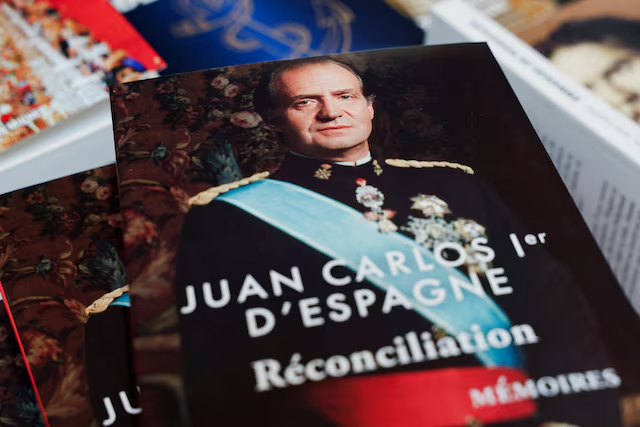
The release of former King Juan Carlos of Spain’s memoirs has reignited discussions surrounding his contentious political legacy. These memoirs, published to coincide with the 50th anniversary of General Francisco Franco’s death, delve into his complex relationship with the dictator who paved his way to the throne. As the former king, now aged 87, reflects on his past, the revelations have sparked intense debate regarding the implications of his insights on Franco and Spain’s transition to democracy.
Spotlight on Franco’s Legacy
In his memoirs titled “Reconciliation,” co-authored with French writer Laurent Dubreuil, Juan Carlos presents a narrative of his journey toward leading Spain’s democratic transformation. Released in Paris and set to debut in Spain in December, the memoirs not only recount his personal life but also traverse his political decisions during a turbulent era. Most notably, the former king expresses remarkable admiration for Franco, stating, “I respected him greatly, and I valued his intelligence and political sense. I never allowed anyone to criticize him in my presence.” Such remarks have reignited discussions about Franco’s controversial legacy in Spain.
Reactions and Criticism
The responses to Juan Carlos’s comments have been swift and vociferous. Spanish Culture Minister Ernesst Otaçón condemned the former king’s tribute to Franco, labeling it “disgusting,” and argued that justifying an authoritarian regime is unacceptable. Otaçón emphasized that while many view Juan Carlos as a pivotal figure in Spain’s democracy, the true credit belongs to the countless individuals who opposed Franco’s regime, suffering imprisonment and torture in the process. Former Prime Minister José Luis Rodríguez Zapatero also criticized the sympathetic tone towards Franco, asserting that it is at odds with the oppressive nature of Franco’s rule.
Complex Narrative of Democracy
The royal palace has refrained from commenting directly on the memoirs; however, it has confirmed that Juan Carlos will abstain from participating in the 50th-anniversary celebrations of his own ascension to the throne, having distanced himself from public life since 2019. Historian Narciso Martín from the Complutense University of Madrid suggests that the memoirs provide the former king a platform to present his perspective on his reign. He describes the portrayal of Franco as “unique,” indicating that the authoritarian leader expected Juan Carlos to guide the nation toward democracy, even if that notion was never truly realized.
The Memory Debate
Juan Carlos’s memoirs also touch on personal incidents, including a widely criticized elephant hunting trip to Botswana in 2012 during a crippling economic crisis in Spain. Acknowledging his mistakes, critics argue that this narrative serves more as a rebranding effort than a genuine reflection. Martín adds that memory is often selective and reconstructing past events can be fraught with challenges, stating, “When we remember an event, we are effectively reauthoring its occurrences.” This perspective raises important questions about how history is recorded and interpreted, particularly in relation to Juan Carlos’s controversial reign and the shadows of Franco’s rule.
With the memoirs now available, the discussions around Juan Carlos’s legacy and his relationship with Franco continue to stir emotions and provoke critical analysis of Spain’s history, revealing the ongoing complexities embedded in the nation’s collective memory.