
Dubai is demonstrating its strong commitment to active participation in the global technological movement by launching an innovative global classification system. This new system clarifies the extent of collaboration between artificial intelligence and humans in the realms of creative and scientific content production, research, and dissemination. With technology rapidly evolving, it is imperative to establish a framework that elucidates the role of AI in enhancing productivity and creativity.
His Highness Sheikh Hamdan bin Mohammed bin Rashid Al Maktoum, Crown Prince of Dubai, Deputy Prime Minister, Minister of Defense, and Chairman of the Dubai Future Foundation, announced the launch of this groundbreaking system. During the unveiling, he articulated, “Differentiating between human creativity and artificial intelligence has become a genuine challenge in light of the rapid technological advancements. This necessitates a new approach to clarify the role of AI in our endeavors and productivity. Thus, we have launched the world’s first global classification of its kind, consisting of five primary categories that define the level of collaboration between humans and technology in content production and dissemination, including reports, research studies, academic papers, images, and all forms of digital content.”
The initiative encourages researchers, writers, publishers, content creators, and designers globally to utilize this new system responsibly and beneficially. Sheikh Hamdan directed Dubai’s government entities to begin adopting the five classifications within their research and knowledge work. He further emphasized that the launch of this pioneering initiative reflects Dubai’s commitment to actively engaging in the global technological movement, leveraging technology to enhance scientific research and creative content development.
In a post shared on the social platform X, Sheikh Hamdan noted, “We have launched the world’s first global classification system to enhance transparency regarding the level of cooperation between humans and artificial intelligence in research, publication, and content production. This initiative, developed by the Dubai Future Foundation, reaffirms Dubai’s leadership in fostering responsible innovation principles, widening inclusivity by providing opportunities for everyone, and preparing various sectors for the future. We invite researchers, content creators, and institutions worldwide to benefit from this new classification and use it responsibly for the public good.”
The new global classification system aims to clarify the extent of human-machine collaboration in enhancing transparency in scientific research. It provides a clear framework that allows readers, researchers, and decision-makers to assess the impact of AI on content production, design, and publication—domains increasingly reliant on technology. The newly introduced global classification icons are a significant addition, enhancing the quality of intellectual and creative efforts related to research, content preparation, and design.
This classification encompasses all types of content, including academic studies, research papers, scientific articles, educational materials, reports, graphics, presentations, books, and digital artworks shared on social media. The concept of “artificial intelligence” includes various digital technologies, such as algorithms, automation tools, generative AI, robotics, and any technological tool that aids in research or content production.
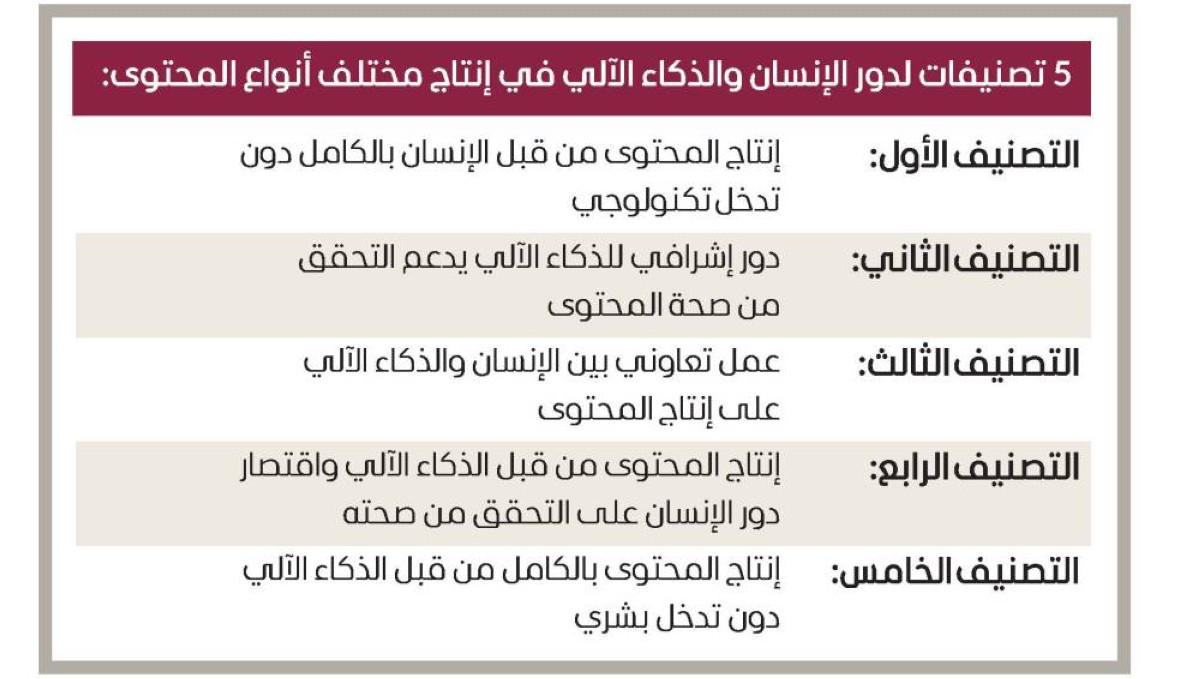
The system features five main icons that producers can utilize according to the level of AI involvement with human input. The first category indicates content produced entirely by humans, without any technological intervention. The second category identifies a supportive role for AI in verifying human-generated content, correcting errors, and improving outputs. The third category highlights collaborative efforts between humans and AI in content creation, while the fourth emphasizes AI’s primary role in content production, with humans focusing on quality checks. Finally, the fifth category denotes content produced entirely by AI, without human intervention.
In addition to the five primary icons, there are nine sub-icons that classify the stages of collaboration between humans and AI in content production. These stages include idea generation, research review, data collection, data analysis, data interpretation, editing, translation, visual content, and design. These icons are designed to be flexible for use in research and content publications across any industry or context, including visual content like images and videos, even though precise percentage allocations are challenging to define due to the subjective nature of these assessments and the lack of a standardized measurement method.
For more information on how to utilize this new global classification system and understand its icons, please visit: www.dubaifuture.ae/ar/hmc.