
24 أغسطس 2026 11:27 صباحًا
|
آخر تحديث:
24 أغسطس 11:47 2026

الخلاصة

مرصد الختم بأبوظبي صوّر سديم عين القط NGC6543 على بعد 3000 سنة ضوئية خلال 9 أيام بتعريض 36س وتكديس 724 صورة وأظهر بنيته المعقدة
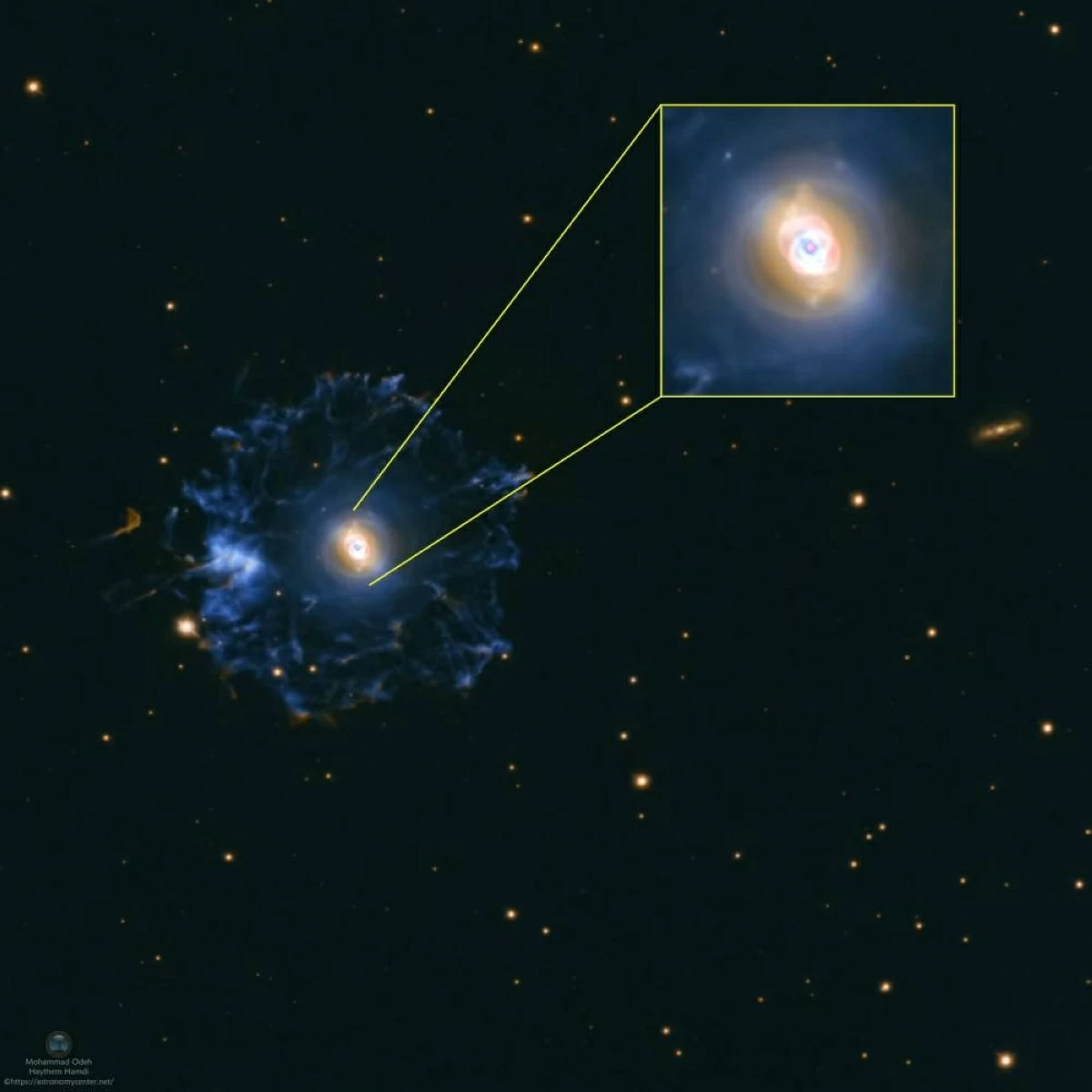
The Al Khatem Observatory in Abu Dhabi has successfully captured stunning images of the Cat’s Eye Nebula (NGC 6543), renowned for its complex structures. The images distinctly reveal two different components: the bright, compact centre resembling a cat’s eye, and a large, faint, irregular outer envelope surrounding it.
Located 3,000 Light Years Away
The Cat’s Eye Nebula resides approximately 3,000 light years from Earth in the Draco constellation. It represents one of the final stages in the life cycle of stars with masses similar to that of our Sun. As such stars approach the end of their life, they expand into red giants and shed their outer layers, releasing gases into space, while the core evolves into a hot white dwarf.
Nine Days of Imaging
The imaging process of the Cat’s Eye Nebula took a total of nine days, utilising the observatory’s main 14-inch reflector telescope equipped with a monochrome camera. A total of four filters were employed: three narrow-band filters targeting emissions from hydrogen, oxygen, and sulphur, along with an infrared filter.
Gathering 724 Images
The final image was created from an impressive total exposure time of 36 hours and 12 minutes, compiled from 724 individual photos, each exposed for three minutes. This included 183 images with the hydrogen filter, totalling 9 hours and 9 minutes; 187 with the oxygen filter, for 9 hours and 21 minutes; 178 with the sulphur filter, amassing 8 hours and 54 minutes; and 176 with the infrared filter, adding another 8 hours and 48 minutes.
The Cat’s Eye
The remarkable aspect of the captured images lies in the stark contrast between the two distinct components. At the centre is the Cat’s Eye itself: a small yet intensely bright region surrounded by intricate shells and gas arcs. Previous Hubble Telescope observations have identified this area as one of the most complex known structures among planetary nebulae, featuring gas shells, fast jets, and knots of gas, some of which are created by shock waves.
Researchers theorise that the rapid stellar winds emitted by the hot white dwarf at the centre played a crucial role in sculpting these structures, colliding with the gas expelled by the star earlier in its life cycle. This interaction compressed and pushed the gas outwards, forming the intricate shells and details we observe surrounding the star. Chandra X-ray Observatory findings indicate that the heart of the Cat’s Eye Nebula is enveloped in gas heated to millions of degrees, stemming from the collision of these stellar winds with previously ejected material. Some of the expelled matter is moving at an astonishing speed of around six million kilometres per hour.
The intricate shape of the Cat’s Eye remains an area of ongoing research. One hypothesis suggests that the central white dwarf may have been influenced by a companion star, where the interaction between the two stars could help guide ejected material and create non-spherical, complex structures. Hubble studies have also pointed towards the likelihood of a binary star system contributing to some of these features.
The second structure, the larger, fainter outer envelope, appears as an expansive, irregular cloud in the image, displaying diffused threads and uneven gas clumps. This outer envelope is not a simultaneous extension of the inner ‘eye’ structure but rather represents an earlier phase in the star’s death, marking the shedding of its outer layers.
Hubble and Euclid Telescopes Join Forces
Recent images combining data from the Hubble and Euclid space telescopes corroborate that the material in this outer region was ejected by the star in an earlier phase, prior to the formation of the bright primary nebula we see at the centre. Therefore, the captured image chronicles multiple stages of the star’s demise: older gases expelling further away, contributing to the extensive outer envelope, followed by more recent material loss and stellar winds that generated the brighter, smaller, and more complex central structure known as the Cat’s Eye.
Hubble observations have also revealed that the vicinity surrounding the Cat’s Eye contains 11 concentric shells or rings, appearing as rings in the images due to the projection of nearly spherical gas bubbles on the sky. Data suggests that the star experienced repeated phases of mass loss at intervals of approximately 1,500 years, rather than shedding all its outer layers in a single event.
The Future of Our Sun
The Cat’s Eye Nebula serves as a potential glimpse into the fate of our sun. In billions of years, as it exhausts its fuel and expels its outer layers, only the core will remain as a white dwarf. However, the resultant nebula’s shape will not necessarily resemble the Cat’s Eye; various factors influencing the mass loss process, stellar winds, and the presence of companion stars contribute to the diverse morphologies seen among planetary nebulae.
The team involved in this remarkable achievement included imaging by Mohamed Awda, image processing by Haitham Hamdi, and observatory personnel Osama Ghanam, Anas Mohamed, and Khalfan Al-Nuaimi.