Four contemporary artworks in Al Ain bring the city’s history and environment into public view, drawing on the waterways that have sustained its farms since the Iron Age and the gold jewellery preserved in Emirati family memory. Through sculpture, natural materials and sound, artists from the UAE, Spain, Morocco and India invite audiences from different cultures to consider the bonds between people and place.
Three works are installed at Al Qattara Oasis, part of Al Ain’s UNESCO World Heritage-listed cultural landscape, while a fourth occupies Tawiya Roundabout. The installations are part of the second Abu Dhabi Public Art Biennial, which opened on 23 October. Their settings place art among farms and irrigation channels, as well as in a busy public space, bringing it beyond galleries and into residents’ everyday surroundings.
Waterways and inherited adornment
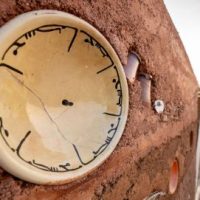
At Al Qattara Oasis, Spanish artist Asunción Molinos Gordo’s Bilhana wa Afia (2026) draws on the traditional falaj irrigation system, which originated in the Iron Age. The work reflects the shared distribution of water among farmers and the role of the channels in the life of the oasis.
Its rammed-earth walls resemble roots and contain seven layers, incorporating pottery fragments and material traces from different historical periods. Together, these elements connect the natural character of the oasis with the history of human settlement and agriculture in the area. The falaj is not presented simply as a relic of the past: the system continues to irrigate farms and remains part of Al Ain’s agricultural and social landscape.
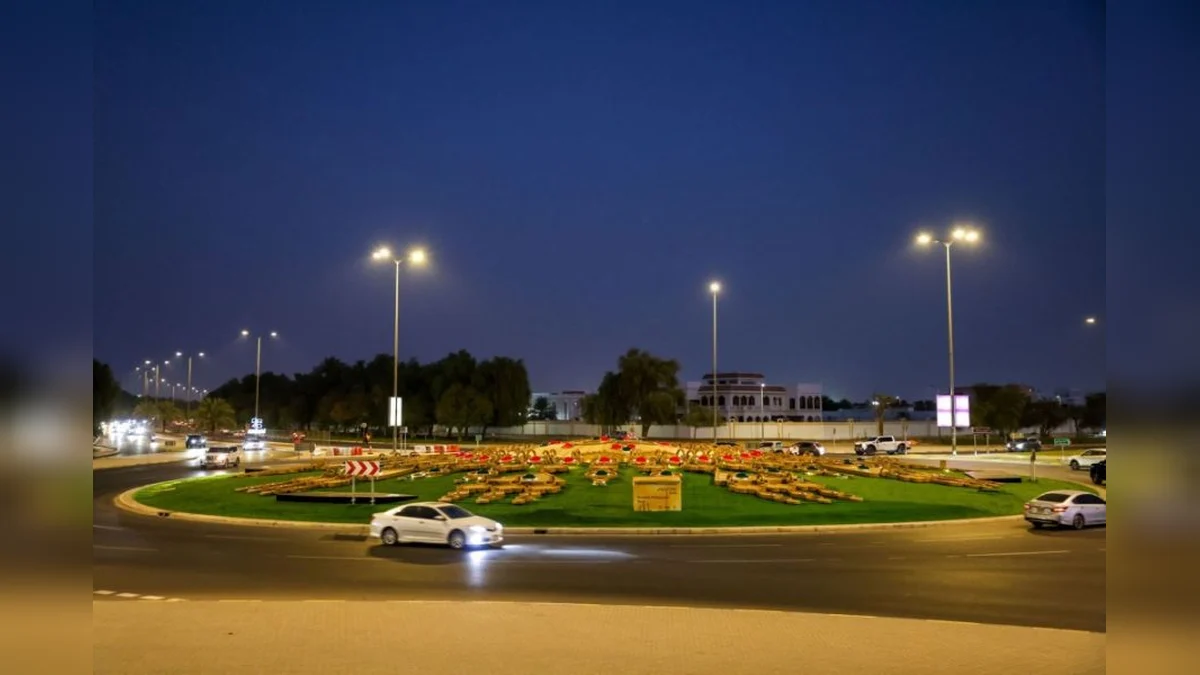
Emirati artist Rawdha Al Mazrouei’s Tasa (2026), installed at Tawiya Roundabout, reimagines a traditional gold headpiece associated with Emirati women’s adornment. Measuring 80 metres in diameter, the sculpture expands the headpiece’s dangling chains, curves and distinctive decoration into a large-scale form integrated with the city’s urban landscape.
Children have contributed to the work’s development through conversations and art workshops, bringing their perspectives to the reinterpretation of an object tied to family and community memory.
Architecture, poetry and the sounds of nature
Another work at Al Qattara Oasis by Moroccan artist M’barek Bouhchichi takes inspiration from traditional pigeon towers, a form of architecture found across North Africa and the UAE. Using stainless steel, he reimagines the structures as spaces of refuge and passage.
Titled I Am Not the Stone Thrown into the Water, but the Seed Sown in the Field (2026). The work takes its name from Tayeb Salih’s novel Season of Migration to the North. It also incorporates a poem from al-nahma, the Emirati maritime chant sung by sailors. The poem is rendered in Braille through holes and wooden panels in the structures, bringing together traditional architecture, literary memory and seafaring song.
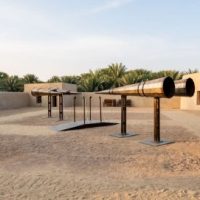
Indian artist Reena Saini Kallat explores the relationship between people and their environment in Thresholds: Requiem (The Last Call) (2026). The work repurposes 20th-century acoustic locating devices, originally designed to detect distant aircraft, to transmit calls of extinct and critically endangered birds. Many of these species are native to the UAE and the Arabian Peninsula, or migrate through the region.
By evoking the sounds of birds that have disappeared or face the threat of extinction, the installation connects natural memory with the surrounding landscape. It turns a surveillance device into an invitation to listen and reflect on environmental memory, loss and our shared responsibility to care for the places we call home.
Art in the everyday landscape
The four works are part of the biennial’s edition, Bayt: A Dictionary of the Shared Place, and will remain on view in Al Ain until 15 February 2027. Their locations give them a presence beyond the traditional exhibition space: at Al Qattara Oasis, contemporary installations sit alongside farms and waterways, while at Tawiya Roundabout an element of Emirati heritage becomes part of the urban scene.
Maryam Al Shehhi, assistant curator at Abu Dhabi Public Art, Department of Culture and Tourism – Abu Dhabi, said the works draw their significance from details rooted in the memory of place, including the falaj channels that shaped Al Ain’s agricultural and social life.
She added that reinterpreting these elements through contemporary art offers new ways for audiences to explore their relationship with heritage and the environment. Showing the works in their original settings, amid the details of everyday life, gives them another dimension and makes heritage part of an experience that crosses geographical and cultural boundaries, WAM reported.