
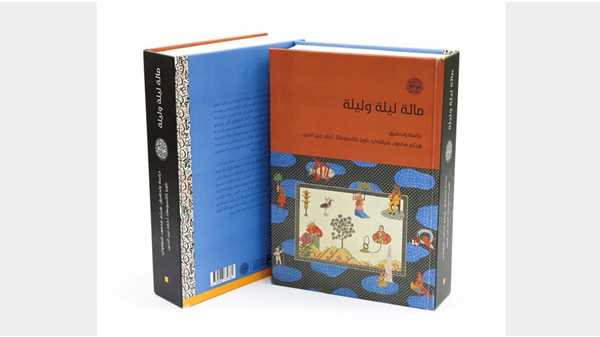
Abu Dhabi continues to strengthen its commitment to scientific research and the preservation of the Arabic heritage for future generations. The Abu Dhabi Centre for the Arabic Language has recently published a new edition of “One Thousand and One Nights” as part of its “Insights into Research and Studies” series. The edition is a critical study and analysis by Haitham Mahmoud Sharqawi, Naoya Katsumata, and Ahmed Zain Al-Din.
New Research Perspectives on a Timeless Classic
This latest release offers a fresh research perspective on the renowned Arabic narrative by conducting a critical examination of three historical manuscripts: the “Uppsala” manuscript, the “Aga Khan” manuscript, and the “Leiden” manuscript. Each manuscript is analysed individually, enabling researchers to delve into the linguistic and narrative characteristics of the texts while tracing the differences and connections between them.
Significant Discovery of the Uppsala Manuscript
A notable highlight of the publication is the first-time presentation of the “Uppsala” manuscript, preserved at Uppsala University in Sweden. This manuscript significantly enriches the body of research surrounding “One Thousand and One Nights,” bringing the total number of known manuscripts of this work to ten.
Exploring Historical and Literary Contexts
The book delves into the sources of the tales and their historical and geographical boundaries, as well as their interaction with various literary and narrative texts. It also investigates the relationship between “One Thousand and One Nights” and “Alf Layla wa Layla,” contributing to the understanding of the text’s position within the map of Arabic storytelling.
Focus on Manuscript History and Characteristics
Additionally, the work pays close attention to the history of the manuscripts, their editions, and translations. It highlights the material and textual characteristics that differentiate the various versions, notably that all known manuscripts are written in Maghrebi script. This detail raises questions about the cultural environment that fostered the text’s transmission and evolution.
Supporting Arabic Research and Development
This book is part of the fifth cycle of the “Research Grants” programme, conducted by the Abu Dhabi Centre for the Arabic Language to support specialised scientific research and enhance the status of Arabic as a language of knowledge and creativity. This fifth cycle received a remarkable 516 applications from 36 countries, with only seven research projects selected. The subsequent sixth cycle for 2026 has already received 623 applications from 34 countries.