
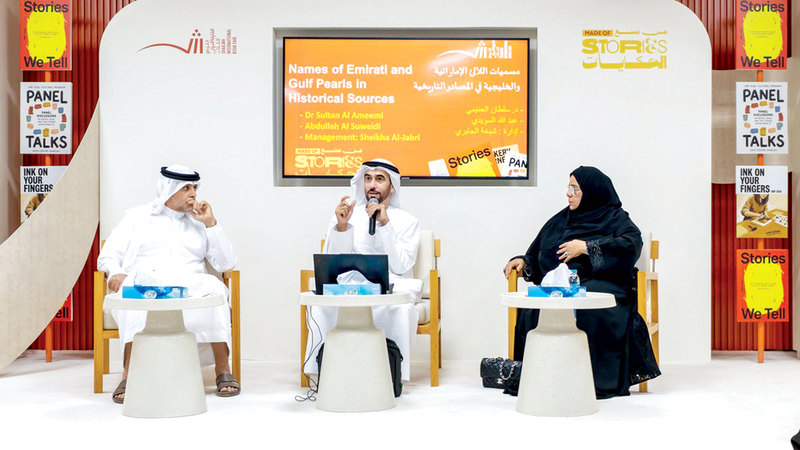
At the 45th Sharjah International Book Fair, Dr. Sultan Al-Ameemi, President of the Emirates Writers Union and an expert in heritage and folk literature, alongside Abdullah Al-Suwaidi, founder of “Pearls of Al-Suwaidi,” gave attendees a captivating insight into the rich history of pearls in the United Arab Emirates and the Gulf region. Their session highlighted the significance of pearls in both the economic and social fabric of the area.
The Historical Significance of Pearls
During their presentation titled “The Names of Emirati and Gulf Pearls in Historical Sources,” Dr. Al-Ameemi and Al-Suwaidi revealed that historical records have documented over 70 different types of pearls, along with more than 20 names attributed to them. In the early 20th century, the Gulf region dominated the global pearl trade, accounting for approximately 80% of it.
A Deep-Rooted Connection
Dr. Al-Ameemi emphasized that the connection between the people of the UAE and the sea, particularly pearls, spans thousands of years. He cited the discovery of the oldest pearl in the world, found on Abu Dhabi’s Marwah Island, as a testament to this enduring relationship. He also showcased a recently published historical lexicon that documents over 70 types of pearls known to the Arabs, offering insights into maritime vocabulary up until the 4th Hijri century.
The Cultural Identity of Pearls
Al-Suwaidi added that pearls are a cornerstone of the economic, social, and cultural identity of the UAE and the Gulf region. He noted that the area was a pivotal hub for global pearl trade, with around 80% of the world’s pearl commerce in 1906 originating from the Gulf.
Classification Criteria for Pearls
In discussing how pearls are classified, Al-Suwaidi outlined three main criteria: size, colour, and shape. He also shared several common names used by pearl merchants in the Gulf, such as “Dana,” “Yikah,” “Qolwah,” “Badlah,” and “Jiwah.” Among these, “Dana” stands out in terms of value and rarity, distinguished by its large size, roundness, and consistent shape. The ideal “Dana” pearl rolls smoothly on a flat surface without settling in one spot, characteristics that enhance its scarcity and price.
Conclusion
As underscored by both Dr. Al-Ameemi and Al-Suwaidi, the cultural and economic importance of pearls continues to resonate within Emirati heritage. The legacy of pearl diving and trading reflects the deep-rooted connection between the people of the UAE and their maritime environment.