
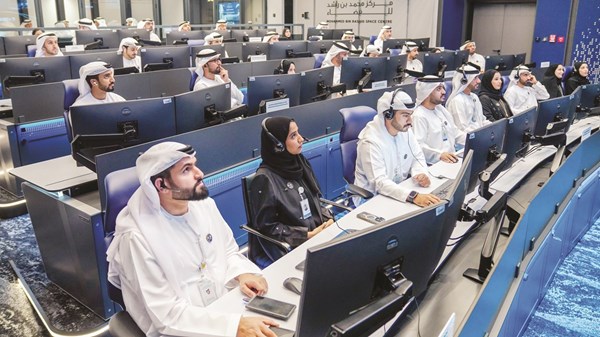
In a significant stride towards environmental resilience, Saeed Al Mansoori, Director of Remote Sensing at the Mohammed bin Rashid Space Centre (MBRSC), highlighted the institute’s recent efforts in addressing climate change challenges. The center has put forth over 75 studies concerning disasters and crises in 2024, showcasing its commitment to sustainability and proactive solutions. The combination of advanced remote sensing technology with analytical systems powered by artificial intelligence (AI) positions the MBRSC as a leader in leveraging space-based data to illuminate pressing global issues.
Advancements in Remote Sensing Technology
According to Al Mansoori, the integration of high-precision remote sensing capabilities has become essential for tackling the repercussions of climate change. He emphasized the need to analyze satellite imagery, stating, “A team of researchers is working on merging the center’s strategy with high-resolution remote sensing capabilities and AI-supported analytical systems.” The MBRSC has successfully developed six smart applications for governmental entities, demonstrating the effective use of modern engineering technologies in image processing and analysis.
Impact of 75 Studies on Global Challenges
In his conversation with Al Ittihad, Al Mansoori revealed, “The Mohammed bin Rashid Space Centre has provided over 75 studies on disasters and crises during the past year.” These studies aim to foster solutions for sustainability and address environmental challenges, particularly concerning rising sea levels due to increasing temperatures. This rise poses significant threats to coastal regions, often leading to severe flooding, infrastructural damage, and community displacement, underscoring the urgent need for effective responses.
Innovations in Image Quality
Highlighting advancements in image quality, Al Mansoori remarked, “One of the most important tools we developed at MBRSC is an instrument to enhance satellite image quality.” Weak signals from satellites can sometimes compromise image clarity. However, their new tool improves the quality of images by adjusting color distribution and harmony through specific geometric and mathematical equations. This innovation allows for better monitoring of environmental changes using high-resolution satellite imagery.
Resource for Governmental and Global Organizations
Established in 2006, MBRSC is dedicated to building and operating various Earth observation satellites. Al Mansoori noted, “The center provides partners and stakeholders with a well-indexed archive of high-quality satellite images.” This resource grants easy access to detailed and high-quality satellite imagery, which meets specific project needs for a variety of stakeholders. Following an assessment of each client’s requirements, a dedicated team at the center creates custom accounts to ensure streamlined access to archived satellite images.
In addition to providing high-resolution images, the MBRSC plays a vital role in environmental protection, supporting global initiatives aimed at studying Earth’s ecology. This includes monitoring water quality, coastal pollution, and phenomena such as harmful “red tides.” By aiding in sustainable urban planning and environmental monitoring, the center prepares for natural events like sandstorms and dense fog, facilitating effective disaster management strategies.
Through the provision of high-resolution images, the Mohammed bin Rashid Space Centre empowers global organizations to combat crises and enhance disaster management efforts. These satellite images are invaluable for assessing damage from natural disasters and supporting practical solutions to mitigate the impacts of events like floods and earthquakes. Furthermore, the center has launched a scientific platform that offers a wealth of analytical studies on natural and human phenomena and their effects on the UAE’s environmental resources. This pioneering platform, the first of its kind in the region, is grounded in remote sensing technology, image processing, geographic information systems, and artificial intelligence.