At Ayyam Gallery in Dubai’s Alserkal Avenue, Bahraini artist Hisham Sharif turns intimate interiors into vivid spaces shaped by memory and emotion. His paintings bring rooms to life with dense colour and expressive detail, transforming passing moments into lasting images while probing the feelings beneath the surface of everyday experience.
Rooms filled with memory
In one work, a mirror becomes more than a reflective surface: its ornate circular frame seems to open onto another time. A warm pink interior sits within a poetic palette of earthy and golden tones. Speaking to Al Bayan, Sharif explains that his creative practice does not follow a conventional narrative with predetermined beginnings and linear endings. Instead, he translates genuine feelings and gives lasting form to moments rooted in personal experience.
Elsewhere, a richly upholstered classical sofa anchors an intimate scene. A figure stands with quiet dignity, dressed in red and dark tones that cut through the stillness of the background. The composition brings together the comfort of an interior setting and a visual world steeped in stories and Eastern references. Sharif says the exhibition reflects personal and artistic stages in his life, from the end of his twenties to a later period that led him to reconsider and move beyond his feelings. He also seeks to dismantle stereotypes about men’s lives and restore their humanity.
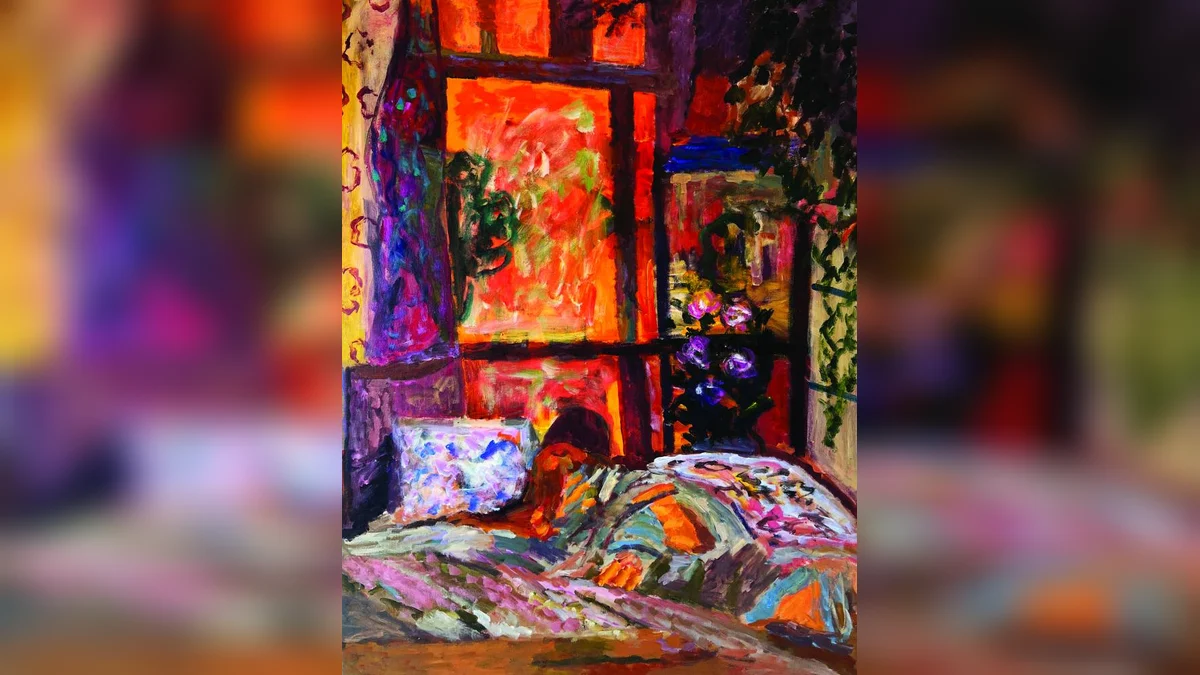
In another painting, fiery orange sunlight streams through a window, filling a room with a glow that seems to touch the spirit. Deep orange meets the purples and pinks of the interior, drawing the viewer into a warm seclusion that absorbs the noise of the outside world.
Beyond appearances
Mirrors are among the unconventional visual elements Sharif uses to blur the boundaries between reality, illusion and visual invention. He also draws on his intellectual roots, bringing symbols from heritage and old stories into the fabric of his contemporary work.
In one scene, a face is barely discernible in a mirror amid a poetic jumble of beauty products and coloured bottles. The reflection becomes a searching metaphor, its features seemingly lost in the clutter of daily life. Sharif says he prefers to paint in complete silence, without music, so he can remain focused on his thoughts and inner feelings until a work is complete and able to stand on its own. He believes that leaving paintings open to viewers’ interpretations is essential to keeping art alive, rather than imposing a single meaning.
The exhibition reaches a vivid crescendo in a work saturated with fiery crimson and pink. Around a four-poster bed, the room becomes a sensuous space in which body, colour and light converge. Sharif concludes that art can withstand technological change. Artificial intelligence may serve as an aid or help with administrative tasks, he says, but it cannot take away the human spirit or the artist’s distinct human imprint. In a world of change, he argues, people continue to seek the truth and authenticity that make art a living witness to life.