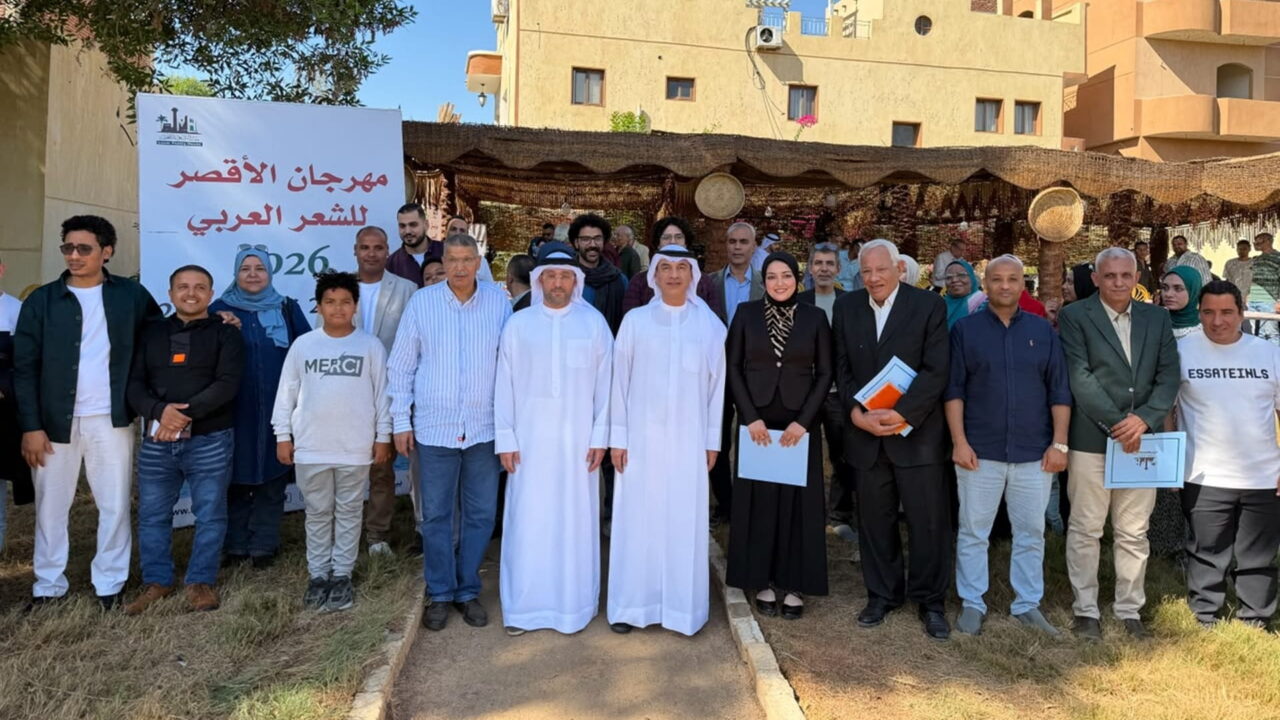
The 11th Luxor Arabic Poetry Festival has concluded after four days of events featuring more than 90 poets and other creatives from 21 Egyptian governorates. Held under the patronage of His Highness Sheikh Dr Sultan bin Mohammed Al Qasimi, Supreme Council Member and Ruler of Sharjah, the festival was organised by Sharjah’s Department of Culture in cooperation with Egypt’s Ministry of Culture.
The closing ceremony took place at the open-air theatre of the Egypt Public Library’s Luxor branch. Among those attending were Abdullah bin Mohammed Al Owais, Chairman of Sharjah’s Department of Culture; Mohammed Ibrahim Al Qassir, Director of the Department’s Cultural Affairs Directorate; Dr Mahmoud Hamed, Head of the Fine Arts Sector at Egypt’s Ministry of Culture, representing Dr Abdulaziz Qansoua, Minister of Higher Education and Acting Minister of Culture; Dr Ahmed Mohie Hamza, Dean of the Faculty of Fine Arts at Luxor University; and Hussein Al Qabbahi, Director of the House of Poetry. A large audience also gathered to celebrate poetry and its creators.
Participating poets praised Sharjah’s cultural role in Egypt and the Arab world, describing the Houses of Poetry as an essential part of the region’s cultural landscape. They said the House of Poetry in Luxor, established as part of Sharjah’s cultural project, has become a lively creative space and a platform for supporting young talent and encouraging poets to develop their work.
This year’s programme also brought together poets who are doctors, including Dr Mahmoud Abdullah, Dr Mohamed Salah, Dr Mayar Ahmed, Dr Loay Magdy and Dr Rabie Al-Sayeh. Their participation reflected the varied interests of Arab creatives and the ways professional practice can coexist with literary pursuits.
Al Owais thanks poets and organisers
In his closing address, Al Owais thanked the poets for their dedication and contribution to the festival, saying: “We express our deep gratitude to the poets of the Luxor Arabic Poetry Festival for their dedicated efforts and for achieving this cultural output, of which we are proud. It continues to receive the attention and support of Sheikh Dr Sultan bin Mohammed Al Qasimi, Supreme Council Member and Ruler of Sharjah.”
Al Owais also highlighted the Sharjah Award for Arab Creativity (First Publication), which supports people under 40 across several cultural fields, including poetry. “The true counterpart of the Houses of Poetry in this context is the Sharjah Award for Arab Creativity (First Publication), which gives attention to younger generations under the age of 40 in several cultural fields, including poetry,” he said. “We are pleased in this edition to hear from poets who have contributed to the award since its launch. Some have become accomplished literary critics, while others belong to a new generation whose poetry has delighted us.”
He said the festival had demonstrated the House of Poetry in Luxor’s role as a home for poetry across Egypt. “As we always emphasise, the House of Poetry in Luxor is the House of Poetry in Egypt. This edition has brought that statement to life here in the city of Thebes, by welcoming poets from 21 governorates. Every year, the House’s festival opens its doors to a long line of creatives travelling to Luxor from across Egypt.”
Tribute to Sharjah’s support
Al Qabbahi spoke on behalf of Egypt’s cultural community, expressing gratitude to the Ruler of Sharjah. “At this moment, as our joy and that of our guests is complete, I speak on behalf of Egypt’s intellectuals, creatives, writers and people who love His Highness Sheikh Dr Sultan bin Mohammed Al Qasimi, Supreme Council Member and Ruler of Sharjah. He has given much to humanity, and his generosity and support have been felt in Egypt and Luxor,” he said. “We ask God to grant him lasting health and wellbeing, and to accept all that he offers for the good of humanity. We praise God for granting him recovery and completing His blessing of good health.”
Al Qabbahi thanked Sharjah’s Department of Culture and the festival’s partners, particularly Egypt’s Ministry of Culture, the Luxor Public Library and Luxor University, for helping make the 11th edition a success. He also thanked the audiences who had followed the festival from its opening through to the final poetry evening.
A cultural partnership spanning 11 years
Dr Ahmed Mohie Hamza, Dean of the Faculty of Fine Arts at Luxor University, said the university and the House of Poetry had maintained a cultural partnership for 11 years. Since becoming dean six years ago, his direct work with the House had helped organise several art exhibitions and strengthen cooperation between the two institutions.
“I see the House of Poetry as more than a creative home: its horizons extend to criticism and the arts, giving it a wider cultural presence,” he said. “With every new edition, it sustains this cultural activity and reflects the support provided by Sharjah, its commitment to giving, and the House’s determination to continue its cultural role.”
Hamza added that Luxor’s cultural community regularly attended and engaged with the House’s programmes, making it a centre of cultural activity in Upper Egypt and across Egypt’s wider cultural scene. He also noted that the House had hosted artists from Arab countries alongside the festival, reflecting the energy and variety of its events.
Poetry beneath Luxor’s ancient landmarks
The closing poetry evening was held at the open-air theatre beside the Avenue of Sphinxes, the route linking Luxor’s major archaeological sites, from Karnak Temple to Luxor Temple. The setting brought poetry into dialogue with the city’s historic landscape. Ahmed Salama, Ahmed Al-Aqtash, Habiba Al-Zein, Ezzat Al-Tayri and Medad Al-Mubarak took part.
Salama recited a poem about his father:
My father is a poet, his dark complexion beguiling the fair;
His poems are humanity, and love is his home.
When the wind resolved to crush a rose,
It opened first, its fragrance an apology.
My father never bowed to the wind;
He swayed like a palm weighed down by its fruit.
…
Everything here, in all its reach, is precious to my father;
The long metre alone can contain it.
Changing language in Arabic poetry
The festival’s second day featured five activities: a critical seminar, a poetry session, the opening of a fine arts exhibition, an evening of poetry and a signing of poetry collections published by Sharjah’s Department of Culture and written by Egyptian creatives.
The seminar examined “Transformations in the Language of the Arabic Poem”. Dr Mahmoud Salim, Assistant Professor of Literature and Criticism at Qena University, presented a paper on poetic language in Arabic poetry. Professor Mahmoud Al-Nubi, Professor of Arabic Literature and Literary Criticism and Dean of the Faculty of Al-Alsun at Luxor University, spoke about changes in poetic vocabulary between elite and everyday language.
Salim explored the movement of Arabic poetic language towards experimentation and openness of meaning, reflecting the psychological and existential concerns of contemporary life. He stressed that literary creativity is connected to its social surroundings, describing the poet as both influenced by and influential within society. In his account, poetry draws on the material of society and reshapes ordinary language into a more open space for interpretation, expressing the poet’s view of the world.
Al-Nubi’s paper considered the changing vocabulary of poet Refaat Salam, focusing on the interaction between two registers: an elite vocabulary drawing on cultural, philosophical and heritage references, and an everyday vocabulary rooted in ordinary life, its places and material details. He argued that renewal does not come simply from transferring everyday language into poetry. Rather, the distinctiveness of Salam’s work lies in creating a productive tension between the two registers within a poetic structure shaped by multiple voices and references.
Five poetry collections launched
The second day also included signings of five collections published by Sharjah’s Department of Culture: Waterfall by Mohamed Helal; What Does Ash Say to Fire? by Ayman Mansour Al-Gamali; Writing with Glass Fingers by Ahmed Thabet Abdel Rady; A Candle Reads the Night by Ahmed Abdelqader; and I Squeeze Embers by Sayed Hosni Sayed.
A poetry session followed, with readings by Ayman Mansour Al-Gamali, Abdullah Toba, Ali Abu Salem, Mohamed Ismail, Mohamed Salah and Nesma Al-Kurdi. Al-Kurdi read:
Alone, like a desert longing for a homeland rich in plenty,
while drops of water refused to make me grow.
Since I invented my greenness, autumn has grown,
mischievous, entangled in its inventions.
My stillness before a wind, whenever it rages,
is only like a statue yielding to its sculptor.
With what remains of a voice touched by hope, I speak;
my stories have not grown tired of me.
Students showcase their work
As part of the continuing partnership between the House of Poetry in Luxor and Luxor University’s Faculty of Fine Arts, the festival opened an exhibition featuring work by 50 students. The display included a range of artistic approaches and subjects, among them some students’ graduation projects.
The students said they were pleased to take part, adding that the House’s annual initiative encouraged them to experiment, create new work and develop their artistic practice.
The Faculty of Fine Arts also hosted a poetry evening featuring Taqa Al-Morsi, Sohaib Shaaban, Mohamed Helal, Mahmoud Bilal, Mahmoud Al-Banna and Loay Magdy. Bilal read:
What shall I call you? A dawn that scatters my night
and wipes away its rust?
Shall I call you a tune that came near, then leaned
on the seat of my heart?
Shall I call you a willow, offering shade
from the flame of longing?
Or shall I call you my life, my meaning,
the time that has been cut short?
I come to you with no moon in my right hand,
no victorious flock, only thirst.
I come, weary from the journey; tell me
to say “I love you” just once, by mistake.
Readings by the Nile and evening sessions
On the festival’s third day, a poetry session was held on the banks of the Nile, with Ahmed Abdelqader, Hassan Shehab El-Din, Sayed Shaker, Mohamed El-Bebeshy and Mayar Ahmed. Abdelqader read:
In the forest of the world, a trunk wept,
and the axe fled from its woodcutter.
In the forest of humanity, a wolf sleeps,
with a false bloodstain on its fangs.
They are a band, while the wolf howls alone,
and Joseph’s shirt is soaked in its dye.
A child, a prophet, saw his dream
and whispered it to his toys.
Mayar Ahmed read from “A Stranger’s Letter”:
I walk…
like a shepherd on the land of wolves,
seeing,
in every span, a fate.
I steer towards my destination.
Alone…
I chant the fear of passers-by
on the blade of time,
like firewood for its hearth.
Alone…
I gather my sighs and send them
to the depths…
each tremor born of its breathing.
How many hands are there, with time
as a person’s ally?
Yet if it leans, no trace remains
of those who might help.
How far apart
are the one who gives, the one who waits,
and the one who gives away
what little is left in his hand.
That evening, Ahmed Thabet Abdel Rady, Ahmed Al-Mariakhi, Rabie Al-Sayeh, Al-Samah Abdullah, Shireen Magdy and Walid Fouad read their work. Al-Sayeh recited:
With a heart, he sees the truth of intentions;
in darkness, he discerns those with insight.
As though, from your sorrow, you drew a road,
the directions surging as you travel.
For you were made to meet a challenge:
great even in your losses.