
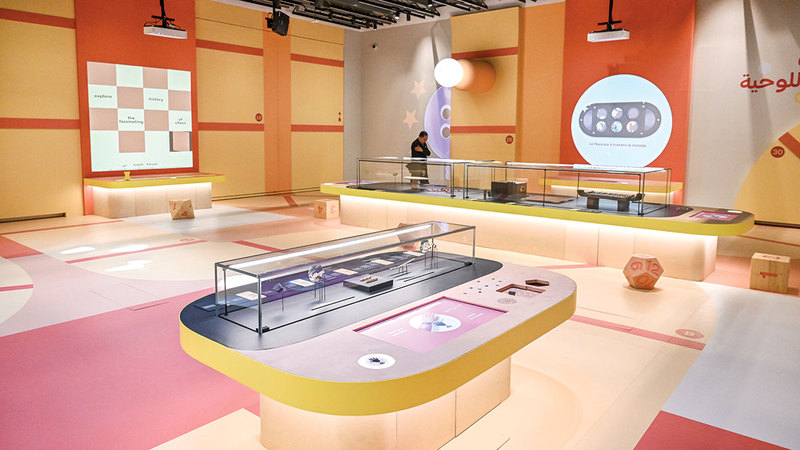
“Louvre Abu Dhabi” has opened its latest Children’s Museum exhibition, an immersive family experience that explores board games as a shared human language connecting civilisations, carrying knowledge and encouraging imagination and communication across thousands of years.
Running until April next year, the exhibition is designed for children aged four to 12 and their families, and is supported by Mubadala. It brings together 24 artworks and artefacts from the Louvre Abu Dhabi collection, alongside loans from major cultural institutions including the Louvre in Paris, the National Museum of Asian Arts – Guimet, the Musée du quai Branly – Jacques Chirac, and the al-Sabah Collection at Dar al-Athar al-Islamiyyah in Kuwait.
A journey across civilisations
The exhibition takes visitors on a historical journey stretching from ancient Egypt and Mesopotamia to Japan in the Edo period, highlighting how board games developed over time and travelled between cultures along trade routes. It also underlines their role as tools for learning, social interaction and building connections between peoples.
Among the notable pieces on display is the painting William and Penelope Wilby Playing Chess by Francis Cotes, as well as rare examples of historical games such as mancala and the ancient Egyptian game of serpents. The exhibition also presents works tracing the journeys of well-known games, including chess, carrom and ludo, and their movement across civilisations.
Three themes, one interactive experience
The exhibition is organised around three main themes. It begins by looking at the history of board games and their material culture, then examines the motives behind play as an innate human behaviour, before inviting visitors to reflect on their own relationship with games and the ways they shape thinking and cooperation.
It also offers an immersive experience blending art, digital technology and interactive storytelling. Each visitor creates a personal profile and receives an electronic wristband that allows them to interact with the exhibition stations and complete educational challenges combining physical and digital activities. The experience extends outdoors as well, through workshops and interactive activities for children and families.
By presenting board games as both cultural objects and living experiences, the exhibition invites young visitors and their families to see how play has travelled through history, connecting people across time and place.