
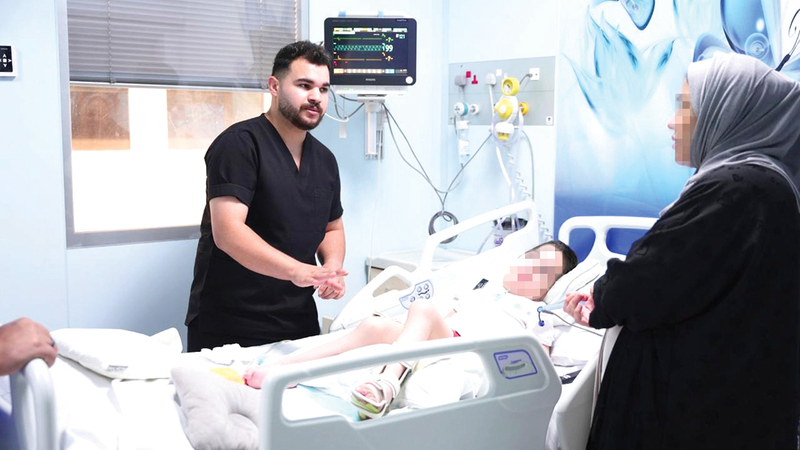
Seven-year-old Ismail, a Moroccan child, has been undergoing a demanding treatment journey since birth after being diagnosed with spinal muscular atrophy, Down syndrome and autism spectrum disorder — a complex combination of health conditions that has required years of intensive medical and rehabilitation support. His family now needs 360,000 dirhams to continue his therapy for another year at a specialist centre for people of determination in Sharjah, an amount far beyond their current means.
A long-term medical and rehabilitation programme
Medical reports say Ismail urgently needs to continue with physiotherapy, occupational therapy and speech and language therapy, together with regular medical follow-up. These sessions form a fundamental part of his treatment plan, which aims to improve his motor, cognitive and communication abilities, preserve his health condition and give him a better chance of facing the challenges of his illnesses while gaining as much independence as possible in future life.
His mother told Emarat Al Youm that the first signs of concern appeared in Ismail’s earliest months. “My joy at the birth of my first child did not last long,” she said, explaining that she noticed clear delays in movement compared with other children his age, as well as severe muscle weakness and an inability to hold up his head or sit normally.
That led her to visit several hospitals and undergo a long series of examinations and tests, which revealed spinal muscular atrophy, in addition to Down syndrome. Later, doctors also confirmed that he was living with autism spectrum disorder, meaning his case requires close follow-up from a multidisciplinary team including neurologists, physiotherapists, occupational therapists and speech and language specialists.
Why early intervention matters
She said doctors had made clear from the beginning that early intervention was the most important factor in improving Ismail’s condition and preserving his physical and mental abilities. Any interruption in treatment, she added, could lead to a decline in his condition and the loss of some of the skills he has gained after years of training and rehabilitation.
“Hope returned to the family years ago when a philanthropist covered the cost of the special treatment injection for spinal muscular atrophy,” she said. The injection, which cost about nine million dirhams, was provided when Ismail was two years old and helped save his life, giving him a better chance of confronting the disease.
“I will never forget that humanitarian gesture for as long as I live,” she said. “It gave my son a new chance at life, but the treatment journey did not end there. The injection was only the beginning. Ismail still needs continuous follow-up and regular rehabilitation sessions so that he can maintain the progress he has achieved and continue learning new skills.”
Progress made through therapy
She said her son is now enrolled in a comprehensive rehabilitation programme at a centre for people of determination in Sharjah, which includes physiotherapy, occupational therapy, speech and language therapy, behaviour modification sessions and skills development, as well as periodic assessments and medical reports to monitor his progress and determine the most suitable treatment plan.
According to her, the sessions have made a noticeable difference in his movement and his interaction with those around him. He has become more responsive to instructions and has begun to make gradual progress in communication and self-reliance compared with his earlier condition.
Doctors, she said, have stressed that the programme must continue without interruption because any pause could reverse the gains made over the past years. His condition requires long-term rehabilitation to preserve the therapeutic benefits achieved so far, but the annual cost of the sessions, rehabilitation and medical reports reaches 360,000 dirhams — an amount the family cannot afford.
A mother carrying the burden alone
“The family depends entirely on my monthly income,” she said. “I am the sole provider, and I work for a modest salary that barely covers the basics of living, including rent, utility bills, transport and daily necessities. I simply cannot afford the cost of his treatment.”
She added that she feels helpless in the face of her son’s needs and becomes distressed whenever she thinks about the possibility of his therapy stopping because she cannot pay the fees. “He needs these sessions more than anything else,” she said, “because they are the hope for his continued improvement.”
She described Ismail as a child who loves life, responds well to rehabilitation programmes and shows clear progress whenever treatment continues. She hopes, she said, to find someone who can help him complete his treatment journey so that he can further develop his abilities and integrate better into society.
Her greatest dream, she said, is to see her son become more independent in the simplest aspects of daily life and to continue the progress he has made over the years. That hope, she added, now depends on the treatment sessions the family cannot afford.
Ismail’s mother has appealed to benefactors, compassionate individuals and charitable organisations to help cover the annual treatment programme so that her son is not deprived of the rehabilitation he needs on an ongoing basis.
• The child’s mother is the sole breadwinner for the family, and her monthly income barely covers their essential daily living expenses.