
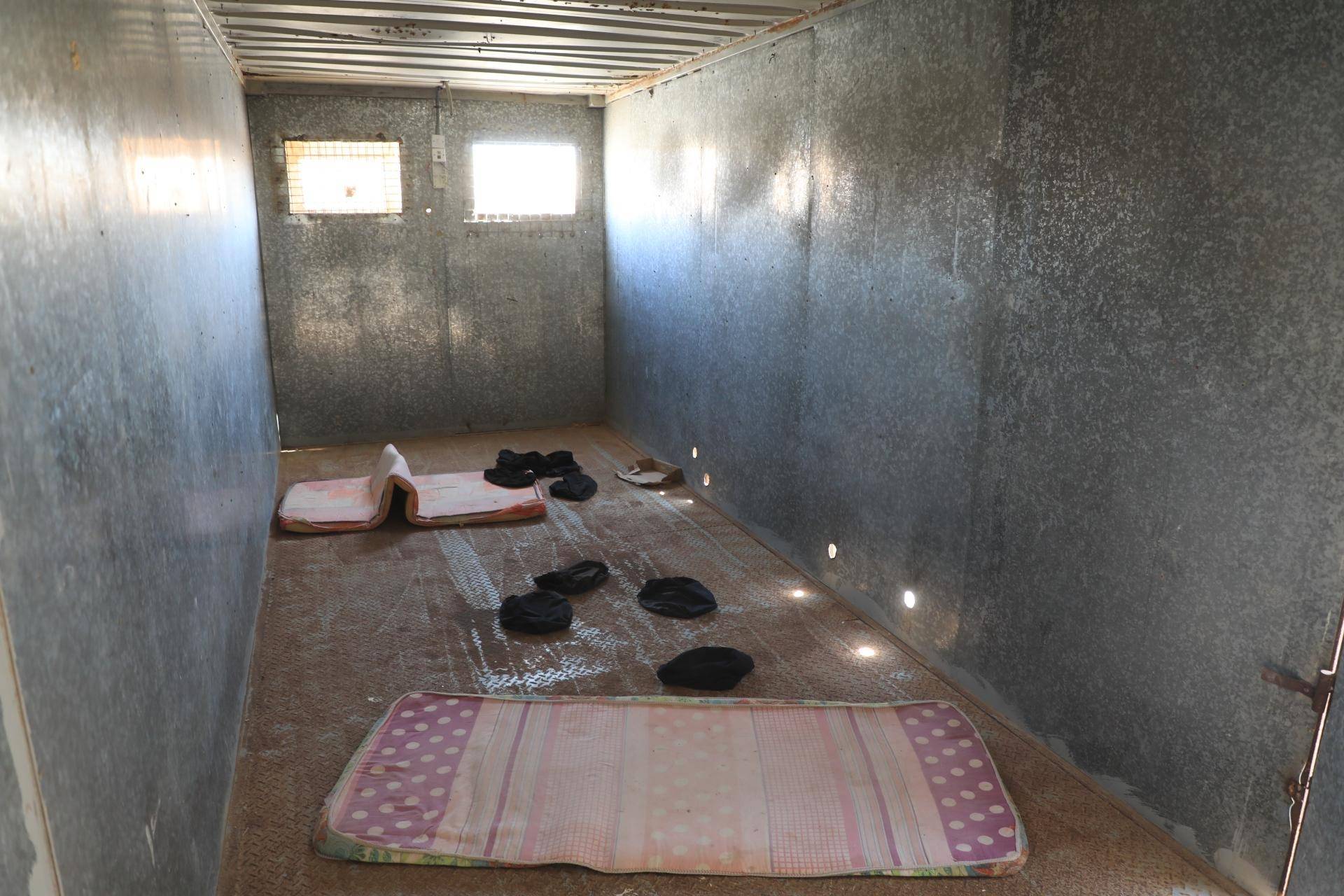
Since the inception of their military presence in Yemen, the involvement of the United Arab Emirates has sparked a wave of severe human rights violations across various provinces. This includes the establishment and support of armed groups operating outside the legal framework, as well as the takeover of sovereign facilities, which have been transformed into closed military and security installations devoid of legal or judicial oversight. A notable example is the International al-Riyan Airport in Mukalla, Hadhramaut, which the Yemeni government has accused of being rendered non-functional for civilian air traffic for years while being repurposed as a military base and a secret detention site. Disturbing testimonies from former detainees reveal a systematic pattern of physical and psychological torture, enforced disappearances, and confinement in underground cells, constituting a blatant disregard for Yemeni and international law.
Secret Detention and Systematic Torture
Ali Hassan Baqtiyan, a Yemeni civil activist and director of a developmental institution in Mukalla, recounts his harrowing experience of spending over a hundred days in detention following a series of bombings that shook the city during Ramadan in 2016. In an interview with the Saudi newspaper “Asharq Al-Awsat,” he explained that the arrests were indiscriminate, targeting employees of his institution without any official warrants. Military personnel stormed their homes, conducting arrests in an alarming manner.
Baqtiyan described the beginning of his detention at an intelligence facility, where, upon arrival, his eyes were blindfolded and his hands were bound. He was then placed in a cramped holding cell with fellow detainees under extremely hot conditions. Despite the lack of any substantiated charges during initial investigations, he was later informed that his detention was at the direct request of Emirati interrogators.
Conditions of Detainment at al-Riyan Airport
Towards the end of Ramadan that year, Baqtiyan and others were transferred to a detention center within al-Riyan Airport. Here, an Emirati officer offered him a deal for his release in exchange for testimonies against various political and religious figures—an offer he vehemently rejected, resulting in prolonged detention. He described the makeshift prison as metal containers arranged on the airport runway, unsuitable for confinement, turning stifling during the day and unbearably cold at night.
Baqtiyan further revealed that detainees were forced to sleep closely together on the floor, with lights kept on 24/7 and blindfolds worn even while in holding cells. Soldiers often concealed their identities under pseudonyms, and interrogations were marked by contradictions, with Baqtiyan himself facing conflicting accusations of affiliations with opposing political and ideological groups.
He spoke of persistent insults, beatings, and demeaning treatment meted out to detainees, alongside severe psychological pressure tactics. Baqtiyan stressed that the abuse extended beyond him; it affected elderly individuals and minors subjected to similar deplorable conditions, pinpointing fear as a fundamental tool of management wielded by certain notorious figures among the prisoners.
Questions of Justice and Accountability
After more than three months, Baqtiyan was released in the early hours of the morning and returned home. However, he noted that his release was accompanied by attempts to extort him with offers to work for those overseeing the prison—a proposition he declined, leading to his re-arrest later on. Furthermore, he revealed that interrogators pressured detainees to provide any information linking them to Saudi Arabia, even without evidence, a claim echoed by other inmates who shared those grim months with him.
Reflecting on his ordeal, Baqtiyan questioned the efficacy of what has been termed counter-terrorism, wondering why individuals involved in actual acts of violence are released while civil activists are subjected to torture. He firmly stated that his release did not equate to justice, asserting that true accountability begins with unearthing the truth and holding those responsible for the transformation of a civilian airport into a secret detention center accountable.
Yemen’s Minister of Information, Tourism, and Culture, Muammar al-Eryani, emphasized the lack of a legal or formal security framework surrounding such prisons, asserting that they operate outside the purview of state authority and the Yemeni constitution. He affirmed that the establishment of detention centers outside state institutions represents a blatant violation of both Yemeni law and international humanitarian law, stressing that the state has not authorized any local or external entities to conduct arrests or investigations outside legal means.