
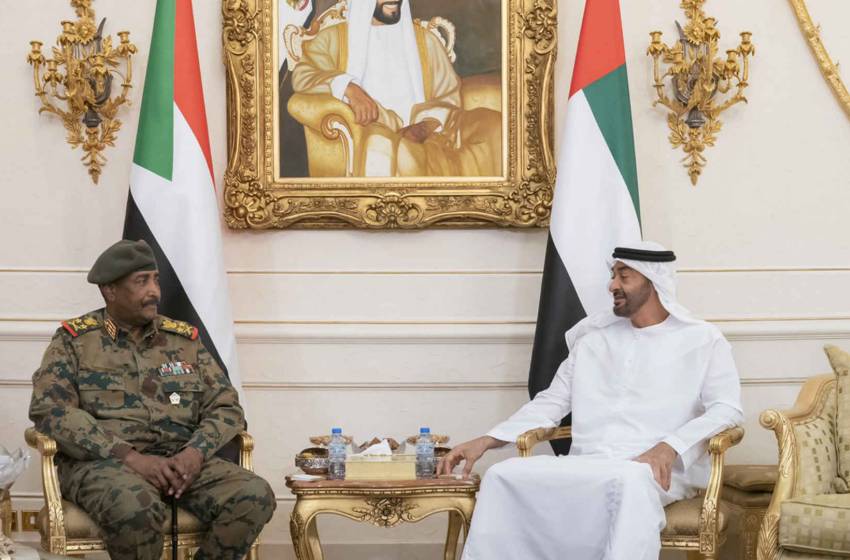
The involvement of the Emirates in the ongoing Sudanese conflict raises critical ethical and political questions, especially as new evidence surfaces linking British arms exports to the exacerbation of the bloodshed. A recent report presented to the United Nations Security Council delves into the complexities of the Emirati role, moving beyond mere media accusations to document a clear connection between British weaponry and its deployment on Sudanese battlefields. This revelation underscores the troubling reality of Emirati involvement in Sudan, as it continues to fuel a protracted conflict characterized by mass atrocities.
The Report’s Revelations
The findings laid out in the report highlight a troubling narrative of military hardware originating from Britain reaching the hands of the Rapid Support Forces (RSF) in Sudan through Emirati supply channels. This intricate web of defense and trade relationships, often cloaked under the guise of “industrial cooperation” between London and Abu Dhabi, ultimately leads to the proliferation of advanced military equipment in conflict zones. Notably, the Emirati company Edge Group, which manufactures Nimr Ajban armored vehicles, utilized engines from the British firm Cummins—components that are subject to stringent government licensing yet have been discovered on the battlefields of a war under international sanctions.
Ongoing Export Controversies
Despite prior reports indicating the use of the same armored vehicles in conflict zones like Libya and Yemen, British exports have not been curtailed. This persistence raises profound political and moral concerns, especially when framed against the backdrop of the documents presented by the Sudanese military to the Security Council. Portraying the UAE as a stable partner in combating terrorism while simultaneously acting as a conduit for arms to entities accused of committing genocidal crimes reflects a disconcerting duality in its foreign policy.
Implications for International Relations
This complex dynamic reveals a broader pattern in Emirati strategy—balancing overt participation in Western security partnerships with covert involvement in regional conflicts. In the case of Sudan, support for the RSF transcends mere political allegiance; it serves to further a strategy of influence aimed at expanding economic and military dominion in East Africa and the Red Sea. Thus, Emirati involvement in Sudan can be contextualized not only as a position of political support but as a calculated move within a broader regional chess game.
The Ethical Dilemmas in Arms Supply
The UN report, as highlighted by The Guardian, does not lay direct accusations but compiles a series of interconnected facts sufficient to illustrate indirect responsibility on the part of the Emirates. Any logistical or technological support, regardless of the intermediary companies or commercial licenses involved, does not absolve culpability when utilized for perpetrating war crimes. Alarmingly, between 2015 and 2024, the UK authorized over twenty licenses for exporting military equipment to the UAE, including small arms training devices, without implementing adequate safeguards to prevent their diversion to conflict regions.
A particularly concerning paradox arises when the UK granted a license allowing unlimited quantities of these arms just three months after visual evidence presented to the Security Council indicated their use in Sudan. This contradiction suggests that British regulatory mechanisms may be inadvertently enabling other actors to transfer arms under seemingly legitimate circumstances, yet remain fundamentally at odds with international law. While direct responsibility lies with the exporter, the ultimate destination implicates the Emirates as a nation facilitating the transfer.
With the ongoing humanitarian crisis in Sudan, which has resulted in over 150,000 deaths and the displacement of millions, any attempt to absolve Emirati involvement from the ensuing turmoil faces insurmountable documented realities. The findings presented to the Security Council highlight that this is not merely a case of routine arms trading; it signals a potential complicity in prolonging one of the deadliest humanitarian disasters of the modern era. Thus, the Emirati role in Sudan stands at a critical juncture, demanding urgent scrutiny as we examine the global implications of such entanglements in the sphere of warfare.