
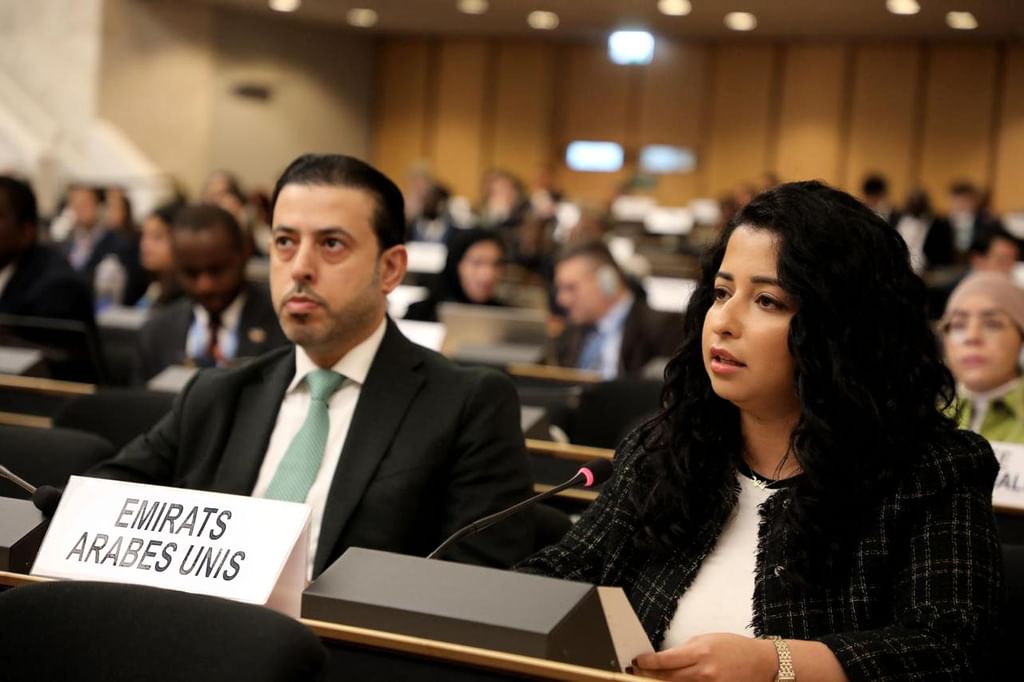
The United Arab Emirates has firmly asserted its right to respond to Iranian aggressions in accordance with international law, emphasizing the imperative to safeguard its sovereignty and territorial integrity. This declaration was made during an address by the UAE’s Deputy Permanent Representative to the United Nations and other international organizations in Geneva, Shahad Matar, as part of the UAE’s participation in the ongoing Human Rights Council sessions.
Details of the Aggressions
Matar highlighted that the UAE has been subjected to repeated Iranian attacks using ballistic missiles and drones, which have specifically targeted civilians and civilian infrastructure within the nation since February 28. These assaults have tragically resulted in the loss of three innocent lives and left 58 others injured. She stressed that such blatant aggression is a severe violation of the UAE’s sovereignty and a gross disregard for the principles of international law and the United Nations Charter.
UAE’s Stance on International Relations
The UAE firmly rejects any notion of its territory being used as a battleground for settling scores or escalating conflicts. Matar condemned the attacks that have been aimed not only at the UAE but also at fellow Gulf Cooperation Council states and other Arab nations in the region. She expressed full solidarity with these countries, underscoring the need for collective security and well-being.
Calls for Dialogue and Diplomacy
In her remarks, Matar called for restraint and advocated for dialogue and diplomatic solutions as the most effective means to secure regional stability. She emphasized that peaceful resolutions must be prioritized to maintain security and cooperation among nations in the area.
Emphasizing Global Principles
Matar concluded her statement by pointing out that the UAE is home to more than 200 nationalities, many of whom are represented in the Human Rights Council. She emphasized that the attacks were not only directed against the UAE but also against international principles themselves, asserting that this issue should be addressed on that basis.