
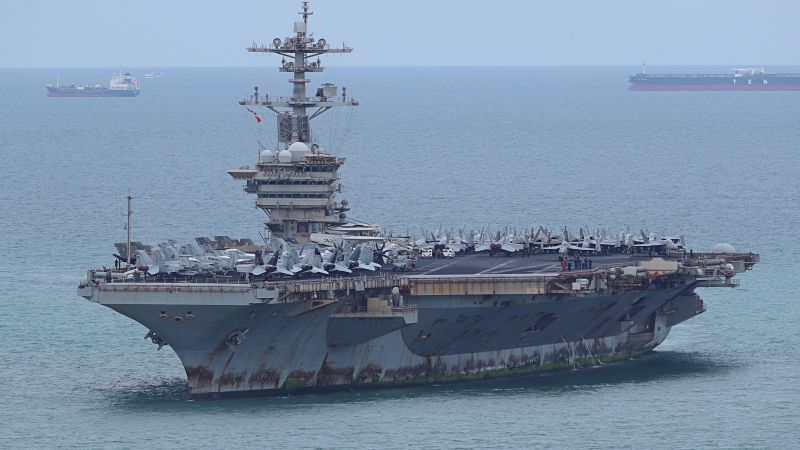
(CNN)– Eight members of the US Navy assigned to the aircraft carrier strike group “Abraham Lincoln” attempted suicide during a deployment that included combat operations against Iran, during which the carrier set a new record for prolonged time at sea. This information was disclosed in a letter from the Acting Secretary of the Navy, obtained by CNN.
Suicide Attempts Among Crew Members
The Acting Secretary of the Navy, Hong Tao, revealed this previously undisclosed figure, which encompasses personnel from multiple ships operating together, including the carrier itself, in response to written queries from Senator Kirsten Gillibrand regarding the morale and mental health of the “Abraham Lincoln” crew.
Tao confirmed in his letter that there were no actual suicide fatalities among service members during this deployment. He noted that the rate of suicide attempts among sailors in the Lincoln strike group closely mirrored the overall rate recorded across active naval forces in 2024, the most recent year for which the Department of Defense (Pentagon) has released suicide statistics.
Suicide Statistics in the Navy
In that year, the Navy recorded 356 suicide attempts among approximately 337,000 active-duty sailors. Tao’s letter dated Tuesday stated, “Since the onset of the Lincoln group’s deployment, a total of 8 suicide attempts have been recorded.” This count involves crew members from Lincoln and sailors from the carrier’s air wing, the strike group command staff, destroyer squadrons, and all aviation squadrons aboard the ships.
Approximately 6,000 to 7,000 sailors participated in the Lincoln strike group deployment across six ships, with the carrier remaining out of port for more than six months while conducting intensive combat operations against Iran.
Concerns Over High Suicide Attempt Rates
A U.S. military official informed CNN that the eight suicide attempts represent a particularly high number, noting that recent deployments of carrier strike groups typically recorded only one or two such instances annually. The official stated, “The stress arising from combat operations greatly surpasses the pressures of a regular deployment; there are no port visits, constant readiness, and so forth.”
Prior to the publication of this report, the Navy did not respond to requests for comment regarding the mentioned letter. According to the correspondence, the Lincoln carrier was equipped with various mental health resources, including five clergy, an embedded holistic prevention counselor, a psychologist, a clinical social worker, three behavioural health technicians, and a service dog designated for psychological support in field missions.
Previous Incidents and Crew Mental Health
Earlier reports indicated that two sailors from the Lincoln strike group—including one from the carrier and another from a different vessel—had jumped into the sea during the recent deployment, with U.S. officials confirming both were rescued. Additional efforts were made to prevent other potential incidents, as per reports from Navy Times and Stars and Stripes.
In his letter to Gillibrand, Tao also affirmed that a sailor from the air wing fell overboard from the carrier in early August but was “quickly retrieved” and received medical treatment from the Lincoln crew. He added, “Additionally, another sailor attempted to jump overboard in March, but colleagues prevented him from doing so. This sailor also received immediate medical care and later returned to the home base.”
Navy’s Perspective on Mental Health Resources
The Navy previously stated to CNN, “We have not observed any increase in suicidal thoughts or attempts aboard the carrier. We are deeply committed to the safety and well-being of every service member, and we have professionals in religious, medical, and mental health fields to assess and address any emerging concerns.”
A former U.S. official likewise relayed to CNN that the Navy does not believe there is a connection between the duration of the deployment and thoughts of self-harm, asserting that incidents of personnel falling overboard are not exclusive to this group.
Impact of Prolonged Deployment on Morale
Conversely, one crew member from the Lincoln described “a severe downturn in morale,” mentioning “frequent reports of suicidal thoughts circulating among teammates.” The individual cited “ongoing pressure regarding basic facilities,” noting issues such as toilets and faucets being regularly shut down, and often a lack of hot water.
Another crew member commented to CNN before the carrier was ordered back to its home base in San Diego, stating, “Every day we wake up to hear from the captain, filled with desperate hope and concern about updates on when we will return.” The carrier departed the Middle East in August and is expected to arrive back in San Diego in the coming weeks.
Other sailors aboard Lincoln described conditions markedly different from previous missions, primarily due to combat operations that have prevented the carrier from stopping in friendly ports. Such stops typically allow vessels to resupply and provide sailors the opportunity to rest and recuperate.