
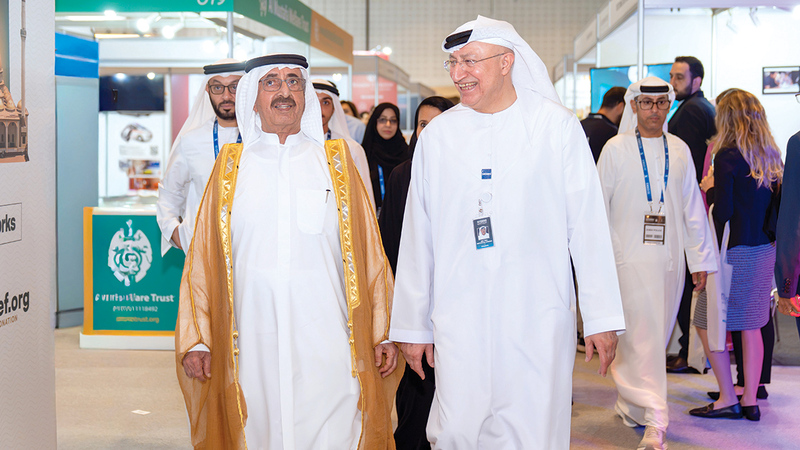
Under the patronage of His Highness Sheikh Mohammed bin Rashid Al Maktoum, Vice President of the UAE, Prime Minister, and Ruler of Dubai, His Highness Sheikh Hashr bin Maktoum bin Jumaa Al Maktoum, President of the Dubai Media Foundation, inaugurated the 22nd edition of the Dubai International Humanitarian Aid and Development Exhibition and Conference (DIHAD 2026). Held over three days at the Dubai World Trade Centre, this year’s event gathers key decision-makers from NGOs, UN agencies, charitable institutions, and government bodies, as well as private sector providers of relief, education, and reconstruction services. DIHAD 2026 is themed “Humanity in Transition: Shaping the Future of Humanitarian Work,” reflecting the rapid transformations facing the humanitarian sector due to complex crises, changing global needs, and evolving operational environments. This necessitates a new approach to collaboration, innovation, and responsiveness.
Inaugural Highlights
After the opening ceremony, His Highness Sheikh Hashr bin Maktoum conducted a tour of the exhibition, accompanied by ambassadors, delegation heads, and representatives from international organisations. A significant launch during the event was the “Dubai Endowment and DIHAD Humanitarian Endowment Fund,” initiated by the Dubai Awqaf and Minors Affairs Foundation, aimed at supporting the sustainability of humanitarian work. This fund is designed to utilise endowment assets to finance impactful humanitarian and developmental projects, establishing a sustainable resource for humanitarian support and long-term effect.
Addressing Refugee Challenges
The refugee crisis remains one of the most pressing issues on the global humanitarian landscape, compounded by escalating crises that challenge the basic needs of displaced communities. In this context, Dr. Maitha bint Salem Al Shamsi, Minister of State and Head of the Sheikha Fatima Fund for Refugee Women, presented an overview of Sheikha Fatima bint Mubarak’s vision regarding key issues that she believes should be central to the development and updating of refugee-related strategies. This vision aligns with the challenges refugees face today, particularly in securing essential resources such as shelter, food, medical care, education, and employment opportunities, alongside various psychological, economic, and legal hindrances.
The Changing Landscape of Humanitarian Work
During the opening remarks, Ahmed Darwish Al Mehairi, Director General of the Dubai Islamic Affairs and Charitable Activities Department, stated, “This year’s conference is themed ‘Humanity in Transition: Shaping the Future of Humanitarian Work,’ which not only describes the phase we are currently in but also compels us to rethink how we build the future of humanitarian work, measure its impact, and ensure its sustainability. Today, the world is not facing a single crisis but rather an unprecedented accumulation of challenges, including conflicts, natural disasters, climate change, economic crises, and rapid technological transformations reshaping societal realities. In this context, humanitarian work has transitioned from a choice to a strategic necessity, central to achieving stability and development, and enhancing communities’ abilities to confront the future.”
Call for Flexibility and Sustainability
Ambassador Professor Abdulsalam Al Madani, President of the Sustainable DIHAD Organisation and Ambassador of the Mediterranean Parliament in the GCC region, noted, “DIHAD 2026 occurs at a pivotal moment for global humanitarian efforts, amidst increasingly complex crises and urgent needs. This requires a more proactive, flexible, and sustainable approach. The theme of this edition underscores the necessity of uniting efforts and re-evaluating humanitarian response tools to enhance their impact and adapt to global changes. DIHAD serves as a global platform, uniting various counterparts in the humanitarian framework, from governments and international organisations to the private sector, experts, and decision-makers, to exchange knowledge, build partnerships, and develop innovative solutions. From Dubai, we affirm that the future of humanitarian work relies on transitioning from response to preparedness, from solitary efforts to partnerships, and from temporary solutions to lasting impacts that bolster community resilience and uphold human dignity.”
Acknowledging Humanitarian Excellence
As part of DIHAD 2026, the exceptional contributions of Rania Daqash-Kamara, Deputy Executive Director of the Partnerships and Innovation Division at the World Food Programme, were recognised with the “Best International Humanitarian Relief Personality Award for 2026.” In her acceptance speech, Kamara highlighted, “For over two decades, DIHAD has gathered diverse segments of the humanitarian community—governments, humanitarian organisations, the private sector, experts, and youth—under one umbrella to work together in support of those impacted by crises. Our gathering here in the UAE is particularly significant for the World Food Programme, given the close partnership we have developed with the UAE to respond to emergencies, advocate for the most vulnerable groups, and address humanitarian challenges through collaboration.” She also emphasised the UAE’s role as host to the largest logistics centre for humanitarian response as part of the World Food Programme’s global network, contributing to the storage, preparation, and dispatch of lifesaving supplies.
A Global Dialogue on Humanitarian Efforts
The extensive international participation at DIHAD 2026 underscores the event’s growing reputation as a global platform for humanitarian collaboration. Over 1,000 entities and partners are expected, alongside more than 21,000 participants and visitors from over 165 countries, with more than 320 speakers involved in over 260 sessions and workshops. This includes over 180 procurement officers from UN agencies, charities, and NGOs, paving the way for experiences to be shared, partnerships built, and innovative solutions explored to address evolving humanitarian challenges. The UAE International Aid Agency reaffirms its presence as an official partner of DIHAD 2026, with Denmark serving as the guest of honour, reflecting its commitment to international cooperation and humanitarian work.
Understanding Change Drivers in Humanitarian Work
Engineer Khalid Al Attar, General Director of the Sustainable DIHAD Organisation, stressed the importance of comprehending the drivers of change in humanitarian work, stating, “Humanitarian work is undergoing rapid transformation in light of increasing crises and complex needs. This necessitates enhancing multi-stakeholder efforts, integrating work among governments, international organisations, humanitarian actors, and the private sector. We at the Sustainable DIHAD Organisation believe that the upcoming phase requires expanding cooperation and leveraging available expertise, resources, and capabilities more comprehensively, alongside developing responsive mechanisms that adapt to changes and enhance their ability to reach the most vulnerable communities.”
Fostering Discussion on Vital Issues
The first day of DIHAD 2026 focuses on the theme “Understanding the Transition Phase: Drivers of Change in Humanitarian Work,” shedding light on rapid global developments reshaping the humanitarian landscape. It involves reviewing traditional approaches and existing response models, discussing significant shifts in the sector, from the changing nature of crises and the needs of affected communities to the growing role of innovation, technology, and partnerships, and their impacts on the future of humanitarian response, necessitating the development of more flexible, proactive models capable of achieving lasting impacts.
Water and Artificial Intelligence in Humanitarian Response
The inaugural day of DIHAD 2026 featured a robust programme of high-level discussions and events, including roundtable meetings hosted by the Sustainable DIHAD Organisation in partnership with several international humanitarian organisations. These sessions brought together senior leaders and experts to examine the swift transformations in the humanitarian and developmental scope and explore new pathways for enhancing international collaboration and developing more integrated, effective, and sustainable responses. Key topics addressed included water resource management, alongside the role of artificial intelligence and modern technologies in advancing humanitarian work.
There was also a donor appreciation event, conducted by Zayed University in collaboration with the Sustainable DIHAD Organisation, celebrating the quality contributions of the university’s benefactors and partners, recognising their roles in supporting its academic and community journey, and enhancing its impact in education, knowledge, and community service.
DIHAD’s events run alongside the 17th edition of the International Conference and Exhibition on Disaster and Emergency Management (IECM 2026), which convenes experts and specialists from around the globe in disaster management, showcasing the latest solutions, technologies, and services to bolster readiness and effective responses to crises and emergencies.
Ahmed Darwish Al Mehairi affirmed, “Humanitarian work is no longer an option; it has become a strategic necessity, and a fundamental element in achieving stability and development, enhancing the capacity of communities to face the future.”
Additionally, Sheikh Hashr bin Maktoum witnessed the launch of the Dubai Endowment and DIHAD Humanitarian Endowment Fund, marking a pivotal moment for humanitarian financing in the region.