
الشارقة 24:
As part of the 45th Sharjah International Book Fair, themed “The Makers of Tales,” the Sharjah Institute for Heritage made significant contributions to the cultural and intellectual landscape through two thought-provoking sessions. Organised with the participation of esteemed academics, researchers, and specialists, these discussions attracted a number of cultural enthusiasts and visitors to the fair. In addition, the institute took the opportunity to unveil a new heritage publication aligned with the event’s offerings.
Exploring Popular Narratives: From Memory to Contemporary Novel
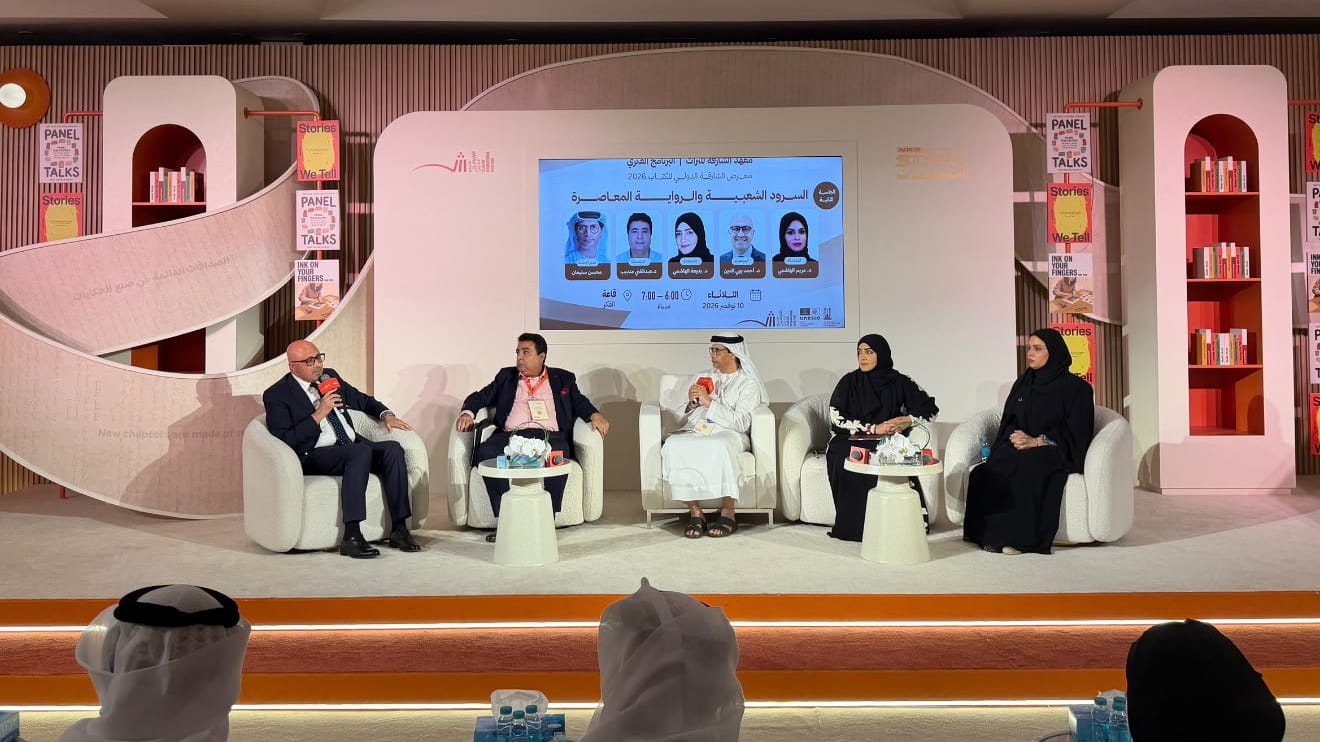
In this context, the institute hosted a panel discussion titled “Popular Narratives and Contemporary Novels,” which examined the intricate relationship between traditional oral storytelling and modern narrative forms. The session delved into the methodologies of drawing inspiration from folklore, myths, and oral accounts, exploring how these elements are recontextualised in contemporary literature.
The session featured prominent figures such as Dr Abdulaziz Al-Musallam, president of the institute, and Abu Bakr Al-Kindi, the institute’s director, alongside a variety of scholars and researchers. Moderated by writer and researcher Mohsen Suleiman, the panel included contributions from Dr Ahmad Bahi Al-Din, Dr Abdulghani Dhnib, Dr Badi’a Al-Hashimi, and Dr Maryam Al-Hashimi. They addressed how popular narratives serve as a living memory of communities and their significance in contemporary literature.
Discussions explored the presence of folklore, myths, and inherited stories within modern novel writing, tracing their transition from oral traditions to literary texts imbued with contemporary perspectives. The panel highlighted narrative techniques borrowed from popular heritage, such as character development, narrative voice diversity, and the utilisation of memory, symbols, and cultural significances.
Literary Integrity and Cultural Memory Preservation
The discussion also touched on the writer’s responsibility in engaging with the narrative heritage, emphasising the need for a balance between preserving its authenticity and cultural distinctiveness while accommodating literary innovation and renewal. The importance of safeguarding the essence and symbols of these tales for future generations was a pivotal point in the conversation.
Proverbs and Expressions: The Memory of the Emirates and Generational Wisdom
The second panel, entitled “Popular Proverbs and Expressions,” focused on the richness of the Emirati heritage represented through proverbs and idiomatic expressions. The session underscored their role in preserving cultural memory and societal identity, viewing them as reflections of human experiences and mirrors of societal maturity and consciousness.
This session was moderated by poet Shaikha Al-Mutairi, with contributions from Emirati proverbs expert Khamees Ismail Al-Matrooshi and researcher Fahd Al-Mamari, who shared insights on the significance of popular proverbs in Emirati culture, highlighting them as indicators of intellectual and social growth in the UAE over the decades.
Both speakers examined the diversity of Emirati proverbs, their connections to various local environments—whether terrestrial, marine, or mountainous—and the expressive imagery and meanings they encapsulate, illustrating the essence of life within those contexts and the experiences, knowledge, and traditions they convey.
Documentation: A Collective Responsibility
Discussions reaffirmed that the system of proverbs and expressions represents a cultural and knowledge asset that deserves preservation due to the social values, human wisdom, and knowledge it embodies, closely linked to the history and environment of the Emirati community. The session stressed the importance of documenting these oral traditions, preserving their narratives, contexts, and meanings from fading into obscurity, through the collective efforts of institutions and generations dedicated to heritage preservation, particularly the Sharjah Institute for Heritage, the Hamdan bin Mohammed Centre for Heritage Revival, alongside the Ministry of Culture and other relevant entities. This endeavour aims to sustain this legacy and ensure its accessibility to future generations.
“Al-Madima”: A Publication Capturing the Essence of Swahili Art
Within the institute’s expansive knowledge offerings, the book “Al-Madima” by Rustam Muhammad Kubwa was signed at the institute’s stand, exploring one of the traditional dances rooted in Swahili culture. The publication presents the dance’s historical, cultural, and social origins, alongside its heritage dimensions.
The book discusses the “Al-Madima” dance, known as “Musondu” in East Africa, linked to Lamu Island within the Lamu Archipelago off the northern coast of Kenya, representing a vital form of artistic and cultural expression within Swahili communities. Furthermore, it traces the historic roots of this dance and its spread across several Gulf countries, including the UAE, Oman, Bahrain, Kuwait, Egypt, and parts of Yemen.
Maritime Vocabulary in Pre-Islamic Poetry
Additionally, Dr Sultan Al-Ameemi’s book “Dictionary of Maritime Vocabulary in Pre-Islamic Poetry” was presented at the institute’s stand. The work catalogues maritime vocabulary found in early Arabic poetry, revealing vital insights into the relationship between Arabs and the sea through terminologies related to ships, professions, marine life, and sea locales, alongside the tribes and families associated with trade and habitation by the sea. Al-Ameemi asserted that the dictionary opens new horizons for in-depth studies on the historical relationship between Arabs and the ocean, marking his fourth publication in collaboration with the Sharjah Institute for Heritage after three previous works.
Sheikh Mubarak bin Saif Al-Nakhi: A Beacon of Intellectual Awakening
Another notable signing at the institute’s pavilion was the book “Sheikh Mubarak bin Saif Al-Nakhi: A Pioneer of Intellectual and National Awakening in the Gulf Region (1900–1982)” by Shaikha Mubarak Saif Al-Nakhi, which provides a comprehensive documentary account of a prominent figure in UAE cultural history. The book covers various aspects of Sheikh Mubarak’s life, including his social and commercial background, spotlighting Sharjah’s Al-Hirah as a center for intellectual discourse and a gathering place for poets. It also highlights his roles as a teacher and educator, alongside his contributions to intellectual and national renaissance, whilst exploring his relationships with Emirati rulers, thinkers, and cultural figures, as well as showcasing examples of his articles published in Arab press and testimonials from his contemporaries, offering a holistic view of his influential journey.
A Cultural Programme Enriching Heritage in the Knowledge Landscape
These events reflect the diverse scientific and cultural programme presented by the Sharjah Institute for Heritage during its participation in the Sharjah International Book Fair, merging academic dialogue, research documentation, and celebration of heritage publications, while facilitating communication and exchange of experiences among researchers, creators, and enthusiasts alike.