
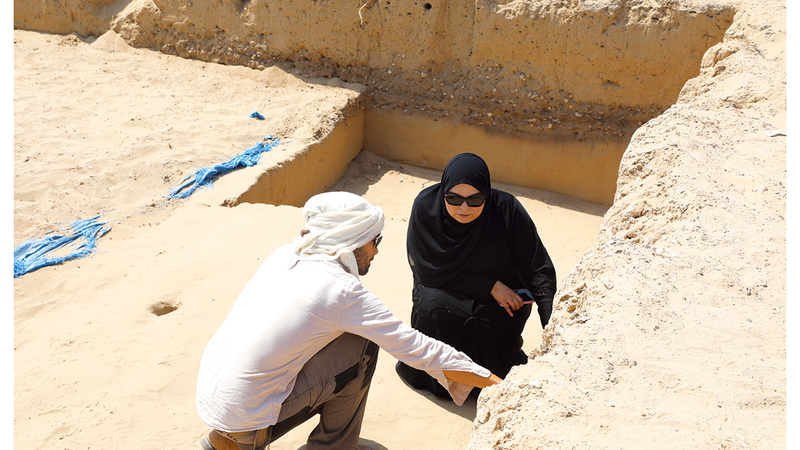
In recent years, the Department of Tourism and Antiquities in Umm Al Quwain has successfully restored approximately 300 artifacts and nearly 15 historical buildings. This ongoing preservation work relies on skilled national experts as well as international archaeologists and researchers.
Preserving Heritage and Cultural Identity
The results of these restoration efforts have played a significant role in safeguarding archaeological sites while revealing new architectural and historical elements. They have also allowed researchers to study the sites with greater precision, enhancing the documentation of discoveries and deepening the understanding of their cultural dimensions. This initiative not only reinforces national identity but also elevates awareness of the importance of cultural heritage.
A Foundation for Cultural Legacy
The restoration of sites and artifacts in Umm Al Quwain serves as a cornerstone in the efforts to preserve its civilizational heritage. It protects historical evidence from the elements, enabling researchers and specialists to gain finer insights into the emirate’s history and its cultural progression over the ages. Furthermore, these efforts bolster the emirate’s stature on the cultural tourism map of the United Arab Emirates.
Significant Archaeological Sites
The emirate boasts several prominent archaeological and historical sites, including the Al-Dour archaeological site, the Siniya Monastery, the Pearl Fishing Town on Siniya Island, and the Umm Al Quwain Fort, along with the Al-Falaj Al-Muhalla Fort. These sites have undergone continuous restoration and maintenance projects in recent years, employing the latest scientific standards for cultural heritage preservation.
Documenting Historical Discoveries
According to Rania Hussein Qanouma, the Acting Director of the Archaeology and Heritage Department at the Department of Tourism and Antiquities in Umm Al Quwain, archaeological findings in the emirate document successive historical phases. Discoveries at the Al-Dour site, which includes temples, graves, forts, palaces, and residential homes, date back from the 1st century BC to the 3rd century AD. Meanwhile, the Pearl Fishing Town on Siniya Island dates from the mid-4th to the mid-6th century AD, and the Siniya Monastery and Bishop’s House span from the late 6th to the mid-8th century AD. The forts and historical buildings are dated to the 18th and 19th centuries.
Care from Discovery to Display
The journey of preserving artifacts begins at the moment of discovery. Each piece undergoes a dual documentation process: first during excavation and second upon registration in the museum record. Following that, they are subject to restoration phases in accordance with global standards before being stored or prepared for display in museums.
Advanced Techniques in Restoration
Restoration relies on specialized materials and techniques tailored to the nature of each artifact, employing digital imaging and laboratory analyses while adhering to the principle of minimal intervention to maintain the piece’s authenticity and historical value.
Challenges in Preservation
Environmental factors, particularly humidity and salinity, represent significant challenges for restoration teams, necessitating regular maintenance programmes and preventive conservation measures.
A Highlight: The Temple of Al-Dour
One of the standout projects in the emirate’s heritage preservation efforts is the restoration of the Al-Dour Temple, dating back to the 1st century AD. Discovered by a Belgian mission in 1987, the temple is characterised by architectural styles inspired by Roman temples, constructed from marine stone and featuring walls lined with local plaster.
• Restoration efforts employ specialized materials and techniques that suit the nature of each artifact.