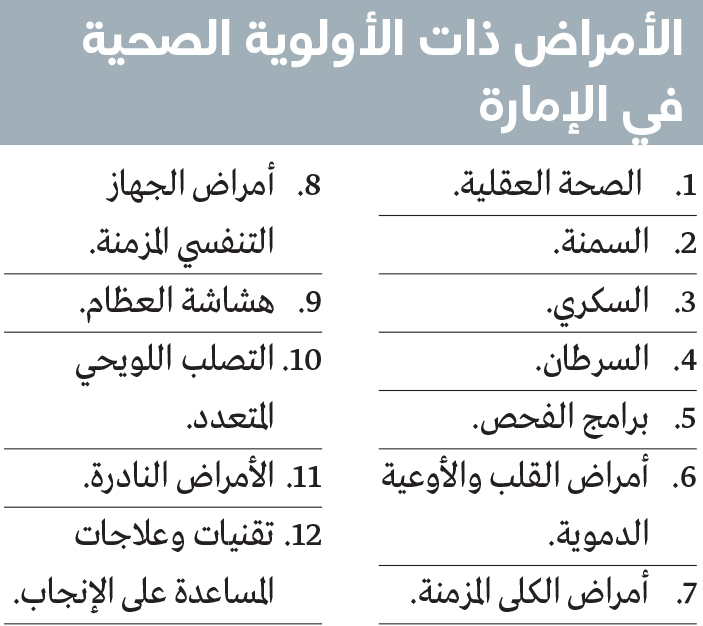
Abu Dhabi’s health authorities have completed the creation of 12 disease registries, a move designed to strengthen a smart, proactive health system built on data and focused on preventive and personalised care. The registries will help track disease prevalence, incidence, trends and demographic links, supporting better health outcomes, stronger prevention, and earlier diagnosis and intervention.
Data-driven public health planning
The registries are integrated digital systems that collect patient information, including diagnoses, tests and treatments. They are intended to support decision-makers and policymakers in planning and resource allocation, monitoring community health indicators, identifying higher-risk groups, and designing targeted preventive interventions.
They also provide a valuable base for scientific research and for understanding disease patterns, helping develop more innovative and effective health solutions.
The registries cover the priority health conditions in the emirate and are being operated fully automatically through the integration of data from Abu Dhabi’s health information exchange platform, Malaffi.
Supporting prevention, screening and policy
The registries are expected to become an important resource for public health initiatives, supporting the tracking of disease patterns, policy development, improved efficiency of health programmes, and stronger health campaigns and screening programmes.
The next phase will see artificial intelligence integrated into the population health intelligent analytics platform, alongside the expansion of data sets and integration with the Saahtna app, which is embedded within the TAMM platform. This will enhance patient engagement, improve access to digital services, and support predictive analysis to detect disease patterns, improve diagnosis and care pathways, identify higher-risk groups, and enable earlier intervention, with a positive impact on health outcomes across the emirate.
Officials highlight a more proactive system
Dr Noura Al Ghaithi, Undersecretary of the Department of Health – Abu Dhabi, said improving the health care system begins with a deeper understanding of the community’s needs, and that making the most of health data strengthens the system’s ability to prevent, respond and make evidence-based decisions. She said completing the disease registries marks an important step towards building a more proactive and personalised health system grounded in knowledge.
Dr Rashid Obaid Al Suwaidi, Director General of the Abu Dhabi Public Health Centre, said the disease registries represent a strategic pillar that multiplies the system’s ability to monitor epidemiological patterns and decode community health trends, paving the way for the design of preventive programmes.
He added that investing optimally in accurate, real-time data gives decision-makers a forward-looking view that supports health policy, improves the efficiency of medical resource distribution, and enables critical therapeutic and preventive interventions at the right time.
For his part, Karim Shahin, Chief Executive Officer of Abu Dhabi Health Data Services, part of M42 Group, said the initiative clearly reflects the company’s ambition to lead and develop large-scale digital health projects that have a deep and lasting impact on public health.