
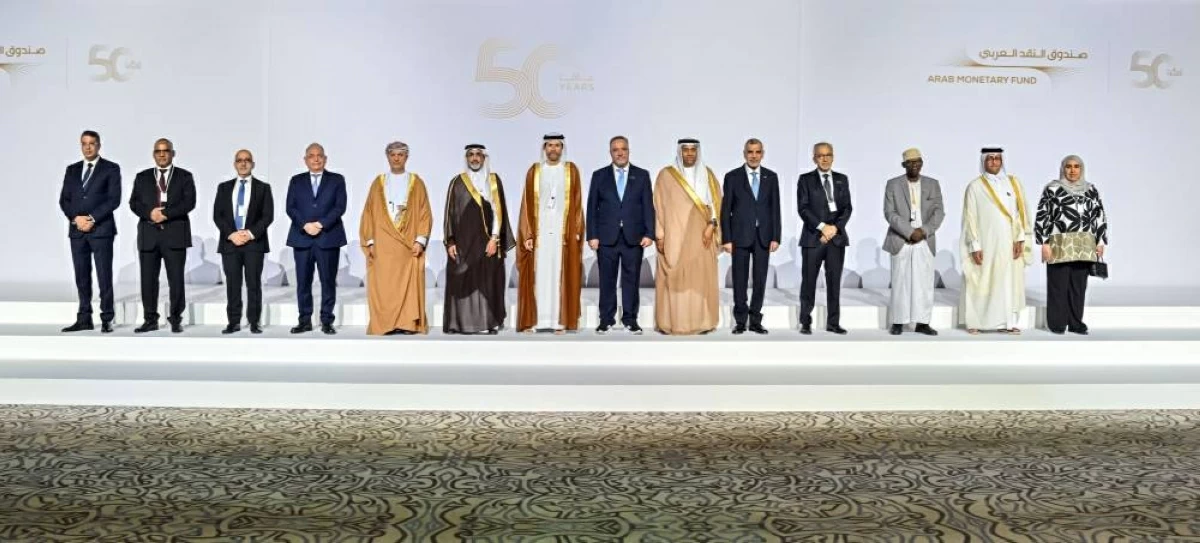
On September 28, 2026, Abu Dhabi played host to a prestigious event commemorating the golden jubilee of the Arab Monetary Fund (AMF). Celebrating 50 years since its establishment, the event was held under the patronage of His Highness Sheikh Mohammed bin Zayed Al Nahyan, President of the United Arab Emirates. This high-level gathering underscored Abu Dhabi’s position as a regional centre for financial decision-making, uniting financial leaders to formulate policies and coordinate Arab visions in response to the rapid global economic transformations.

Attendees included Arab finance ministers, representatives from regional and international financial institutions such as the World Bank, and experts and decision-makers from across the Arab world. They gathered to celebrate five decades of financial collaboration, coinciding with the 17th regular session of the Council of Arab Finance Ministers.
A Legacy of Achievement
During the welcoming address, Mohammed bin Hadi Al Hussaini, Minister of State for Financial Affairs and representative of the host country, highlighted the significance of the golden jubilee as a moment to reflect on the past fifty years of dedication and the AMF’s invaluable contributions to financial stability and economic cooperation among Arab nations.

Al Hussaini stated that the event represents not only a celebration of past achievements but also a commitment to future cooperation in building a more integrated and prosperous economic landscape. He expressed optimism for a new phase where the AMF continues to evolve, aligning with rapid economic, financial, and technological changes while enhancing its tools and programmes to support regional economies towards increased stability, resilience, and sustainable growth.
A Significant Pillar
Dr. Fahd bin Mohammed Al-Turki, Director General and Chairman of the AMF Board, reaffirmed the fund’s commitment to leveraging its five decades of experience to maintain stability and sustainable growth. He highlighted the AMF’s aim to enhance partnerships with member countries and international institutions, focusing on financial cooperation and expanding advisory and capacity-building support. Moreover, he underscored the need to develop digital payment infrastructure and financial inclusion to improve the efficiency of Arab financial systems and facilitate regional economic exchanges.
Historical Milestones
The event showcased a documentary detailing pivotal milestones and developmental achievements of the AMF since its founding in 1976. This included disbursing over $11.8 billion in financing, conducting more than 400 training sessions for 20,000 trainees, doubling its capital to nearly $10 billion, and developing regional payment platforms like the “Buna” platform. Attendees also explored an exhibition that depicted the fund’s 50-year journey, emphasizing its foundational support to member states, transitioning towards digitalisation, and promoting financial inclusion.
Arab Financial Stability
Alongside the jubilee celebrations, the 17th regular session of the Council of Arab Finance Ministers addressed recent regional and international financial and economic developments. Discussions focused on securing the future of Arab financial stability through practical pathways that enhance the resilience of Arab economies, with participation from finance ministers and representatives from international financial institutions. The agenda included in-depth presentations, where the AMF delivered insights on public finance realities and policies in Arab states, as well as the applications of artificial intelligence in tax administration. Al Hussaini shared the UAE’s government strategies to shift 50% of federal operations to assistant AI models within two years, detailing the Ministry of Finance’s applications of these technologies in budgeting, payroll, procurement, and final accounts, along with results from the bureaucracy reduction programme that achieved a 90% decrease in requirements and a 73% reduction in timelines.
The World Bank also contributed a presentation focused on sustainable financing for resilient infrastructure, while the Organisation for Economic Co-operation and Development discussed the latest developments in tax policy concerning base erosion and profit shifting. During the session, commitment was reaffirmed by the UAE to implement these standards and apply a supplementary local tax starting from 2025, according to “GloBE” rules. Common issues and priorities for Arab nations were emphasised in the annual messages from both the World Bank Group President and the IMF’s Managing Director for 2026.
Workshops and Discussions
In conjunction with the session, a high-level workshop and roundtable on “Macroeconomic Resilience amidst Geopolitical Disruptions” is slated for Tuesday, featuring Dr. Fahd Al-Turki. This workshop will include two main sessions: the first addressing the macroeconomic implications of geopolitical disruptions and economic uncertainty, including contributions from central bank governors and finance ministers. The second session will focus on enhancing coordination between monetary and fiscal policies amid increasing global uncertainty, with the UAE scheduled to present its experience in establishing a Financial Stability Council and implementing specialised plans to integrate AI into financial stability monitoring.
Some key figures regarding the AMF’s contributions include:
• Over $11.8 billion in financing provided
• More than 400 training sessions organised for 20,000 trainees
• Capital doubled to approximately $10 billion
• Development of regional payment platforms such as “Buna”