
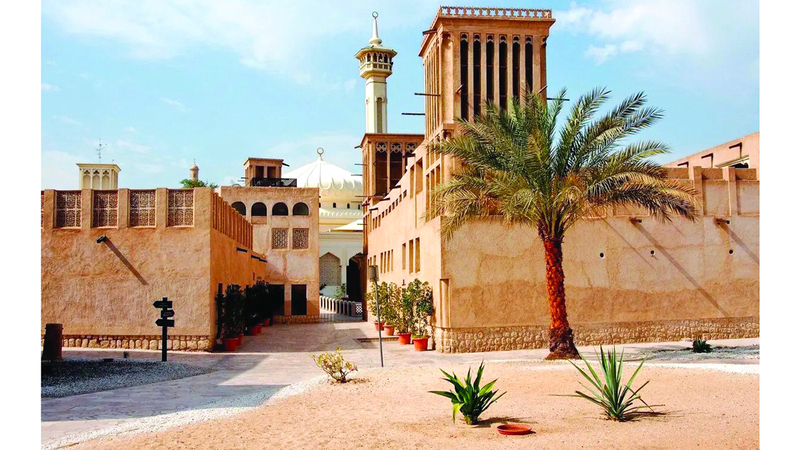
As the cultural season unfolds, the National Archives and Library organized a virtual lecture titled “Dubai Castle and Its Towers: A Journey from Roots to Globality.” Attendees were taken on an insightful journey through the history of Dubai, exploring its transformation from a modest settlement to a dazzling global city. This engaging exploration showcased Dubai’s remarkable progress and development over a relatively short period, emphasizing the city’s impressive evolution from its roots to its current prominence on the global stage.
The Historical Roots of Dubai
The lecture, presented by research expert Saeed Khamees Al-Suwaidi, began with a look back at Dubai in 1822, a time when the city was encased in a short wall made of mud and gravel. This wall was equipped with defensive towers, providing protection while leaving the northern side open to the creek. These historical structures laid the foundations for what would eventually blossom into a vibrant urban center.
Key Architectural Features
Al-Suwaidi highlighted the important architectural landmarks within the old city, beginning with the Al-Nayef Tower, which stood tall, allowing for a panoramic view of the surroundings, including the creek’s expanse. Located nearby was the British Bank, marking an early junction between the local economy and international trade.
Another significant site discussed was Al-Qurayeshat Square, also known as Marqab Al-Nayef. Additionally, the Al-Aqeedat Tower, attributed to the Al-Aqeedat family of the Al-Bufalasa clan, played a critical role in monitoring the southern region, particularly in terms of safeguarding vital resources like palm trees and water wells. This glimpse into Dubai’s past illustrated how these structures contributed to the community’s defense and resource management.
The Significance of Dubai Castle
The centerpiece of the lecture was Dubai Castle, a structure hypothesized by the lecturer to be distinct from Al-Fahidi Fort. Described by historian M. Hutton as a square fort with a crumbling tower at one corner, it symbolized the city’s defensive measures in earlier times. Al-Suwaidi noted that in 1841, during a deadly fever outbreak, residents had to relocate beyond Dubai’s walls in a bid to curb the spread of the disease.
He detailed the establishment of Al-Fahidi Fort, built north of Dubai Castle during Sheikh Hasher bin Maktoum’s rule from 1859 to 1886. This fort housed the ruling family until they moved to Shindagha and later served as a prison for lawbreakers, assuming a dual role in governance and defense. It later became a museum in 1971, thanks to Sheikh Rashid bin Saeed Al Maktoum, reflecting the nation’s commitment to preserving its heritage.
Restoration and Historical References
Al-Suwaidi shared that his insights were based on a multitude of sources, including a diagram by Lieutenant Robert Cohen detailing the early layout of Dubai and its palm groves. Notably, he pointed out that by 1829, extensive restoration efforts were undertaken to reinforce the city’s walls, its towers, and the castle itself, marking a pivotal moment in Dubai’s development.
This virtual lecture not only offered a captivating historical narrative but also underscored how landmarks like Dubai Castle and Its Towers have shaped the Emirate into the global hub it is today, reflecting a unique journey that intertwines heritage with modernity.