
Sharjah 24:
The need for Emirati translators to enhance their presence in the publishing industry has been strongly advocated by local writers and translators. They emphasised the importance of expanding opportunities for translating works of local authors into various languages. Experts assert that developing the translation sector necessitates greater attention from publishing houses towards translators, alongside a deep mastery of the Arabic language and an understanding of the literary and cultural nuances of the original texts. This approach ensures that translations preserve meaning and style while catering to the specific characteristics of the target audience.
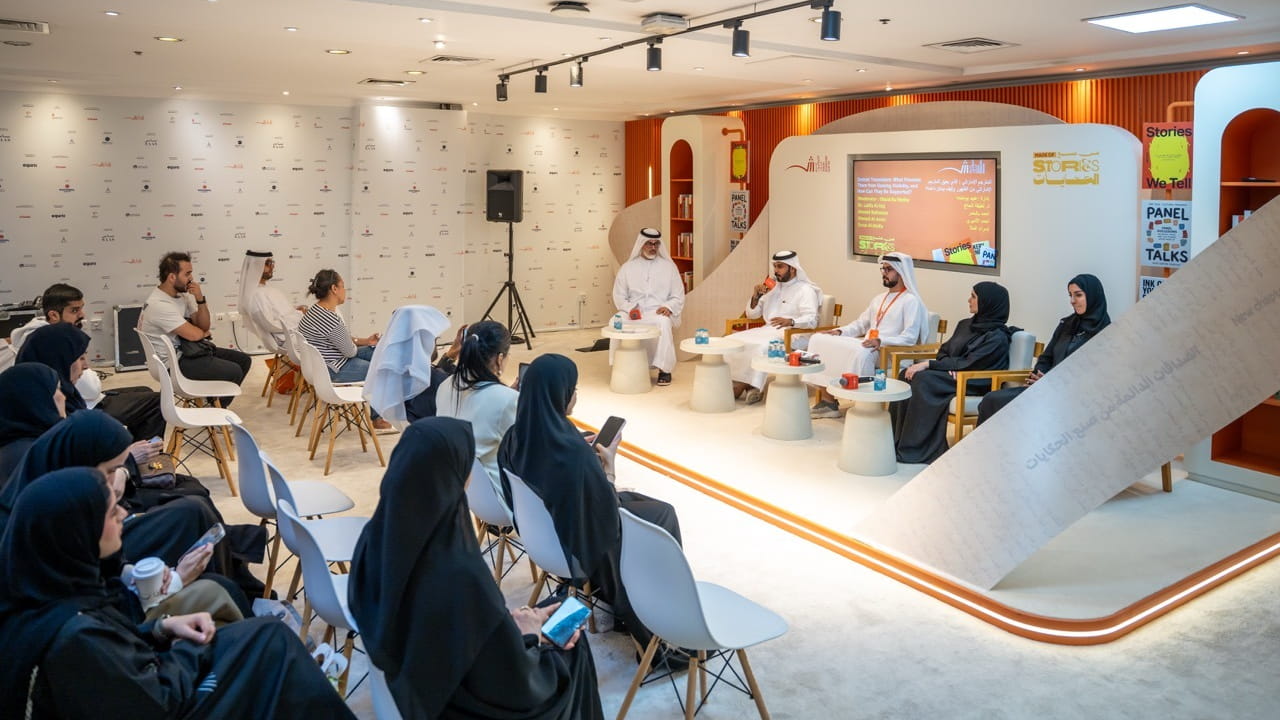
This was discussed during a session titled “The Emirati Translator: What Obstacles Hinder Their Presence and How Can They Be Supported?” which took place at the 45th Sharjah International Book Fair. The event featured notable participants including Dr. Latifa Al-Haj, poet Ahmed Bilhamr, novelist Ahmed Al-Amiri, and Esraa Abdullah Mulla, with the session moderated by Ubaid Boulha.
Challenges of Translating Poetry
During the session, poet and translator Ahmed Bilhamr elaborated on the challenges intrinsic to the nature of the text concerning the translator’s choices. He noted that translating poetry significantly differs from translating legal or academic texts. While legal translations demand meticulous precision in terms of terminology and syntax, poetic texts allow for a broader creative interpretation of meaning, rhythm, and literary imagery.
Bilhamr pointed out that classical poetry often contains indirect meanings that require careful reading and contextual understanding from the translator. This understanding is crucial in crafting an Arabic rendition that maintains the essence of the original work without being overly literal.
He shared his experience translating the works of William Blake, highlighting that after completing his translation, he found that it closely aligned with previous Arabic translations regarding the conveyed meanings. Additionally, Bilhamr discussed his work with American poet William Carlos Williams, where the volume of Williams’ poetry enabled him to be selective, excluding pieces where he struggled to grasp the meaning after repeated attempts, in order to present a clear and faithful translation.
The Importance of Comprehensive Translation
Dr. Latifa Al-Haj, head of literary translation at Boulha Publishing and Distribution, presented her experience translating the works of American author John Steinbeck. Her fascination with translating Steinbeck’s work began when she returned to the original English text of one of his novels and realised it was significantly longer than its previously read Arabic version. After some investigation, she discovered that the Arabic version was abridged, published within a series intended for a broad audience.
Her quest for a more comprehensive translation led her to choose Steinbeck’s play “Burning Bright,” which she translated as “اشتعال.” Delving deeper into Steinbeck’s unique style encouraged her to continue translating his works, resulting in a portfolio of four novels and a short story collection. Dr. Al-Haj underscores that the translation process can be time-consuming and labor-intensive, occasionally hindering her ability to pursue her own writing projects.
Furthermore, she highlighted Boulha Publishing’s commitment to securing translation rights for literary works and their efforts to introduce Emirati authors’ publications to a broader audience by translating them into other languages.
Mastering Arabic as a Foundation for Translation
Novelist and translator Ahmed Al-Amiri stressed that proficiency in the source language is as essential as mastery of one’s native tongue. He explained that understanding the subtle differences between languages aids translators in conveying the original’s depth and meaning, whether in a novel or short story.
Reflecting on his academic experience at Sorbonne University, where he studied international business management and applied foreign languages, he recalled that one of his professors emphasised the importance of strengthening students’ command of their native languages. This insight proved invaluable in his subsequent translation work.
Al-Amiri recounted his transition to translation after publishing seven literary works with various publishers. He cited his first translation of the novel “Salt of the Sea,” which he adapted from French to Arabic, noting that his attachment to the story and its characters helped him present it in modern standard Arabic without sacrificing the richness of the original literary experience. Initially, he anticipated only translating a single work; however, the experience motivated him to continue, leading him to translate a short story collection that remains unpublished. He observed that local publishers are generally more inclined to attract authors writing in Arabic compared to the opportunities available for translators, a situation that calls for increased support for this vital sector within the book industry.
Choosing Texts with the Audience in Mind
Esraa Abdullah Mulla, director of the International Story School at the Sharjah Institute for Heritage, articulated the importance of considering the age group and cultural background of the audience when selecting translated works. She shared her experiences with folklore and classic literary adaptations from around the globe.
Mulla noted that her passion for world literature began in childhood through reading classic works in English, which later led her to translate pieces by notable authors including Hans Christian Andersen, Charles Dickens, and Oscar Wilde, following discussions with publishers about presenting selections of global literature through an Emirati publishing house.
She highlighted her extensive reading of approximately 300 stories by Hans Christian Andersen, classifying them based on suitability for children, young adults, and adults. Mulla decided to exclude certain stories that contained themes deemed inappropriate for her target audience. Her experience reveals that the role of a translator extends beyond mere textual transfer to include thoughtful selection of works and consideration of their intended readership while respecting cultural differences across communities.
Enhancing the Role of the Emirati Translator
The discussions among participants underscored the vital need to regard translation as an integral component of the publishing industry, requiring linguistic and literary skills, cultural awareness, and collaboration with publishers in selecting works, negotiating rights, and defining target audiences. The session revived discourse on the visibility of Emirati translators in the publishing market and the necessity to expand opportunities available to them while also prioritising the translation of Emirati literary output into other languages. Such efforts are essential for increasing the reach of local authors’ works to readers beyond the Arab world.