
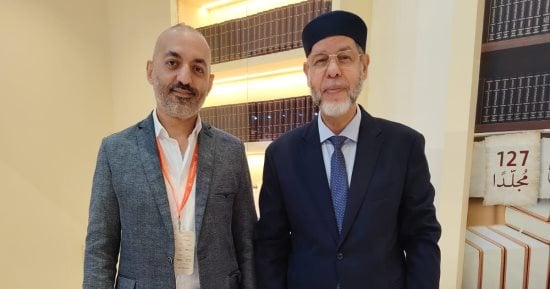
At the heart of the 45th Sharjah International Book Fair stands a unique cultural institution that embodies the aspiration to document human and Arab knowledge: the Language Academy of Sharjah. This year, it unveils a remarkable achievement — the presentation of the first 143 volumes of the “Comprehensive Arabic Encyclopedia of Sciences, Literature, Arts, and Figures.” This monumental work, launched by Sheikh Dr. Sultan bin Muhammad Al Qasimi, the Ruler of Sharjah, is the result of extensive contributions from a multitude of researchers and scientific committees. We had the opportunity to speak with Dr. Ahmad Al-Mustaghani, the Secretary-General of the Language Academy of Sharjah, to explore the inner workings of this civilizational project, the showcased volumes, and how the encyclopedia meets the challenges posed by artificial intelligence while maintaining its commitment to authentic documentation.
Insights into the Launch of the Comprehensive Arabic Encyclopedia
Dr. Al-Mustaghani reflects on Sharjah’s evolution into a haven for culture and academia, expressing gratitude to Sheikh Dr. Sultan bin Muhammad Al Qasimi for the launch of this unprecedented encyclopedia. He notes that the “Comprehensive Arabic Encyclopedia” is a serious and ambitious attempt to unify various scientific disciplines, encompassing linguistic, religious, humanitarian sciences, as well as pure theoretical sciences such as physics, chemistry, mathematics, and geology.
The Unique Contributions of the Encyclopedia
What sets this encyclopedia apart is its comprehensive gathering of diverse fields of knowledge within a single application. With the production now including 143 volumes, it significantly emphasises linguistic and religious sciences. Specifically, it features an extensive segment dedicated to astronomy, boasting 22 volumes — a feat unmatched by any other encyclopedia in the Arab world. The materials are presented in Arabic, with some content available in English and French, making scientific concepts accessible through simplified explanations. The encyclopedia not only presents terms but also elaborates on the schools of thought and their founders, providing thorough definitions backed by examples and referencing primary sources.
Key Areas Covered by the Current Volumes
The encyclopedia is structured into four primary categories: sciences, literature, arts, and figures. The completed volumes currently belong to the sciences category. Linguistic sciences alone span 47 volumes covering areas such as grammar, morphology, rhetoric, prosody, semiotics, applied and cognitive linguistics, discourse analysis, and argumentation science. The scope of religious sciences is vast, addressing multiple branches like Quranic sciences (including recitation, reasons for revelation, and abrogation), Islamic jurisprudence, principles of jurisprudence, prophetic biography, Hadith, and the science of authentication and critique.
Future Perspectives on Applied and Human Sciences
In the domain of applied sciences, substantial content on “Astronomy and Space” has been completed, encompassing 3,716 terms across 22 volumes. Future plans for this field include the addition of mathematics, physics, chemistry, and artificial intelligence. Meanwhile, humanity sciences have already introduced 1,830 terms relating to logic and argumentation, with further expansions in various human sciences planned for upcoming phases. Dr. Al-Mustaghani promises updates next year, including biographies of 40 notable figures spanning authors, poets, interpreters, narrators, jurists, and caliphs.
Tackling the Challenge of Artificial Intelligence
Amidst the rapid evolution of artificial intelligence, Dr. Al-Mustaghani identifies this as a significant challenge in ensuring the accuracy of documented information, avoiding the pitfalls of random answers. Researchers and verification committees have been mandated to commit to not presenting information casually, ensuring that readers do not receive misleading content. While AI is welcomed as a tool for initial research and material gathering, it is crucial that all information is traced back to original sources, with careful documentation of volume and page numbers. A diligent team of verification committees diligently oversees these processes behind the scenes, ensuring the encyclopedia serves as an accessible gateway for students and university attendees alike.
The Role of Artificial Intelligence in the Encyclopedia’s Future
Looking ahead, Dr. Al-Mustaghani believes that artificial intelligence will undoubtedly aid in the dissemination and development of the encyclopedia. In the future, students and researchers will be able to query the encyclopedia through digital platforms, receiving responses that are well-documented from the encyclopedic resource. While the initial steps may be challenging, technology is viewed as a facilitator of rigorous scientific inquiry rather than a substitute for it.
Aiming for Comprehensive Coverage of Human Sciences
While it is ambitious to claim comprehensive coverage of all human sciences, particularly given the complexity of specialized fields like medicine and pharmacy, the academy has successfully consolidated fundamental aspects of major sciences. With ongoing efforts and the generous support of Sheikh Dr. Sultan Al Qasimi, the initiative aims to broaden its scope in general arts and humanities.
A Message to Book Fair Attendees and Researchers
In closing, Dr. Al-Mustaghani extends an invitation to all knowledge enthusiasts: “Welcome! We are prepared to offer researchers and interested individuals a trial account for one week on our digital platform, allowing them to explore the treasures of this invaluable encyclopedia. We look forward to seeing you in Sharjah, the capital of culture and knowledge.”