
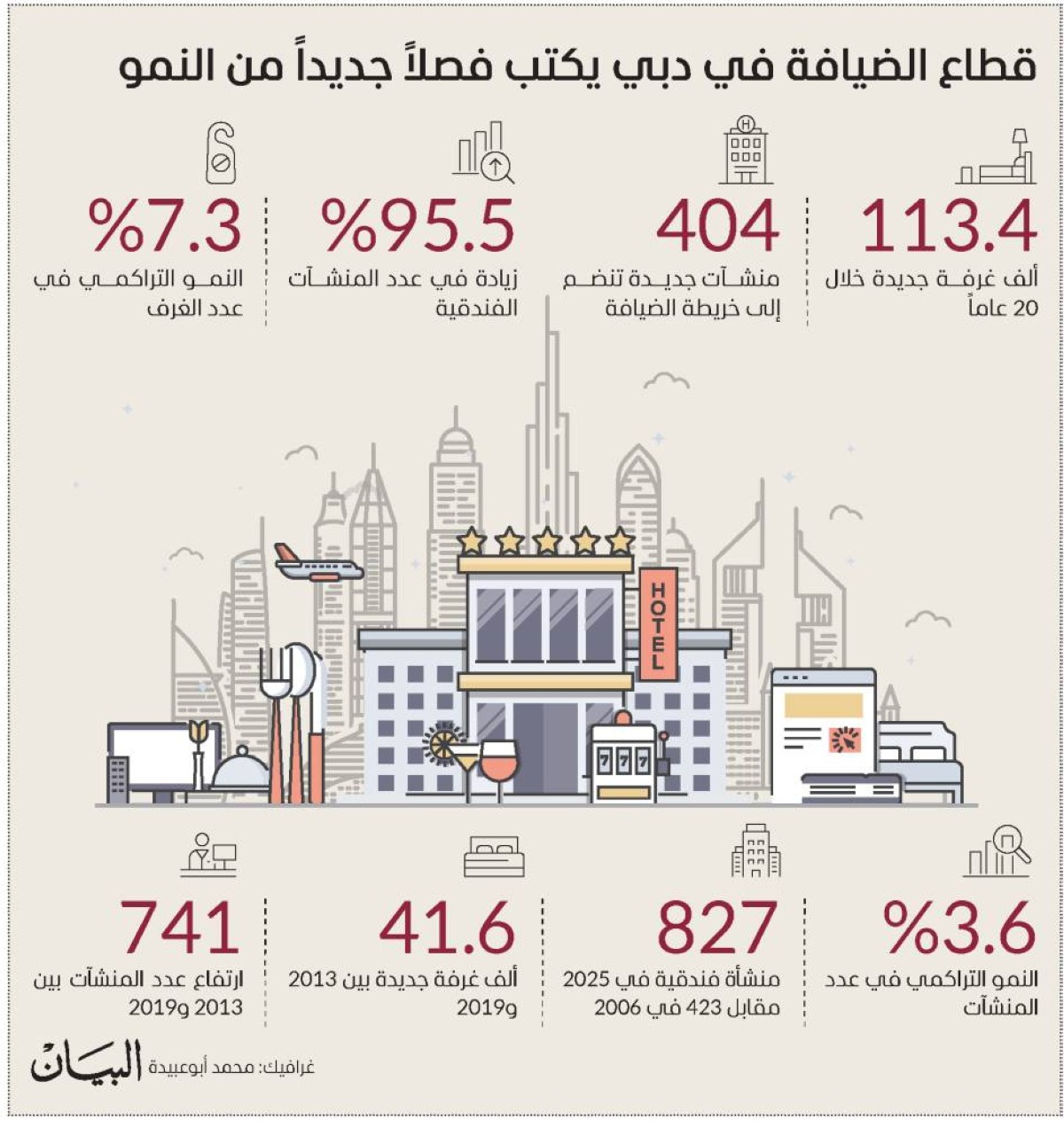
Dubai‘s hospitality sector has witnessed remarkable expansion over the past two decades, as the number of hotel rooms surged from 40,826 in 2006 to an impressive 154,264 by the end of 2025. This represents a staggering growth of approximately 278%, equating to nearly 3.8 times the room stock available two decades ago.
During this period, the emirate added more than 113,400 hotel rooms along with 404 new establishments across various categories, highlighting a significant transformation in the hospitality industry. An analysis by “Al-Bayan” of collated official statistics reveals that Dubai’s hotels have travelled an exceptional growth trajectory, solidifying the emirate’s status as one of the world’s leading hospitality destinations.
Expansion and Growth Trends
Between 2006 and 2025, the number of hotel establishments increased from 423 to 827, marking a growth of approximately 95.5% with 404 new venues added to Dubai’s hospitality map. This influx is a clear reflection of heightened investment in the hotel sector and a burgeoning demand for accommodation in the emirate.
The data reveals a structural shift in the market, with growth not solely reliant on the number of hotels but increasingly directed towards the development of larger facilities capable of accommodating rising demand. There has been diversification in hotel offerings, including luxury, mid-range, and serviced apartments, catering to the continuous growth in tourism, business, and international events.
The stark contrast between the growth rates of room inventory and establishments signals a significant transformation in market dynamics. While the total capacity rose at a rate outpacing the increase in establishments, this indicates not just an expansion of hotel projects, but also an augmentation in the average capacity of individual facilities.
Calculating the compound annual growth rate (CAGR) from 2006 to 2025 shows that room inventory grew at around 7.3% per annum, compared to approximately 3.6% for establishments. This discrepancy underscores a trend towards larger projects capable of accommodating an increasing influx of visitors.
A Period of Rapid Expansion
The years between 2013 and 2019 constituted a crucial phase for Dubai’s hotel sector, with room inventory jumping from 84,534 in 2013 to 126,120 by 2019, reflecting an increase of 41,586 rooms and a growth rate of nearly 49.2% over six years. Concurrently, the number of establishments increased from 611 to 741, registering a 21.3% growth.
This period stands out as a robust phase of expansion before the COVID-19 pandemic, as the market entered 2019 with a solid foundation of supply and tourism demand, bolstered by sustained visitor growth, infrastructural development, and continuous influx of new investments. This expansion coincided with Dubai’s preparations to host Expo 2020.
Data from 2019 indicates that the market was well-prepared before the pandemic, possessing a strong foundation both in terms of supply and demand, facilitating a swift recovery post-lockdown. The hotel sector in Dubai quickly regained its momentum thanks to the resurgence of international travel and the resumption of events, exhibitions, and conferences.
With Dubai firmly establishing itself as a global tourist destination and business hub, the hotel market has entered a new era after two decades of room and establishment additions. In the early years, the main challenge was increasing capacity to keep pace with the rapid influx of visitors. However, the current competitive landscape is focused more acutely on the quality of offerings, the location of establishments, brand reputation, guest experience, pricing, and yield management.
The Role of Government Initiatives
Dubai’s government agencies, such as the Department of Tourism and Commerce Marketing—now known as the Dubai Economy and Tourism Department—have played a vital role in boosting the hospitality sector through innovative initiatives. These initiatives aim to support tourism and make the emirate more attractive as a global destination.
Among these efforts are international marketing campaigns designed to attract visitors from major global markets and the organisation of large-scale events. The department has also worked to provide incentives that have encouraged developers to invest in the hotel sector, increasing hotel capacity to meet the growing demand for accommodation in Dubai.
These ongoing government efforts have firmly established Dubai as a global tourism hotspot and a primary attraction for hotel investments. By 2025, the Dubai Economy and Tourism Department launched a hotel incentive programme designed to foster the development of new properties in high-growth potential areas such as Dubai South, Palm Jebel Ali, Dubai Parks, and Dubai Islands.
These measures reflect a shift from merely boosting supply to strategically distributing hotel capacity across new areas, connecting hotel investment with urban expansion and infrastructure development alongside future attractions.
Sustaining Tourism and Event-Based Demand
The expansion of hotels in Dubai is closely linked to the ongoing growth within the tourism, aviation, and infrastructure systems. The extensive air connectivity and the development of the emirate’s airports have significantly bolstered its ability to accommodate millions of visitors from diverse markets, while the road network and infrastructure projects have provided a robust backbone for urban and tourism expansion.
In addition, events, exhibitions, conferences, and recreational activities play a crucial role in generating diverse demand for hotel rooms. With Dubai hosting a busy calendar of events throughout the year, the sector benefits from varied flows of visitors, encompassing leisure tourism, business travel, and events, thereby mitigating seasonality and enhancing occupancy levels.
Looking ahead, competition is likely to intensify around achieving a balance between supply growth and maintaining occupancy rates and yields, particularly as new hotel projects continue to enter the market. As the sector transitions from a phase of quantitative expansion to qualitative growth, the ability to deliver distinctive guest experiences, select prime locations, and enhance operational efficiency will become increasingly critical in determining the success of hotel investments and reinforcing Dubai’s stature as a leading global hospitality market.